3ality Technica to launch 3D content fund to boost 3D TV
Steve Schklair is the Founder and CEO of the Burbank based company and, like other 3D rig manufacturers, believes 3D television is essential for the growth of the 3D industry as a whole. 3ality purchased Element Technica last year to form 3ality Technica. The company’s stereoscopic systems are currently being used on The Hobbit,Prometheus, The Great Gatsby and Stalingrad 3D– the first Russian film to be picked up by IMAX of which Steve Schklair will be 3D producing. BSkyB also use 3ality Technica rigs for a lot of its live 3D sports coverage on Sky 3D. ...
Steve Schklair: Let’s start with the premise that 3D TV content creation is not growing quickly enough to support a large mainstream audience. Obviously there are pockets of active production such as BSkyB and what is happening in China, but from a global view there is not enough content. From a US centric view there is even less. The large one-off sporting events such as World Cup and Olympics are fantastic and need to exist, but they alone are not enough to shift the market toward 3D television. From a 3ality Technica point of view, the content that is vitally necessary is episodic television. And not just trial episodes, but entire seasons so that there is something new to watch every week, and this something happens to be the favourite show of a very large audience.
3ality Technica has a strategy to help deal with this. We have raised the beginnings of a “3D Delta Fund”, which is a fund that can be used to cover the cost differential between an episodic show shooting in 2D and one that would shoot in 3D. With this fund, there are episodics that can now start shooting in stereo at no additional cost to the show. There are two main laws in episodic production that cannot be violated and to some extent are tied closely together – Time and Budget. 3ality has proven time and time again on episodic show tests and on the features that are using our systems, that it is completely possible to shoot 3D on a 2D schedule. So we maintain the law of Time. With the fund we are able to cover the budget differential so the law of Budget can be adhered to.
The fund also includes any additional post production costs for the 3D version, but since the 3ality Systems shoot accurately enough for the material can go to air immediately, we are comfortable doing this because we know there will be no unknown costs to fix alignment and geometry problems in post. The fund will even cover the costs of visual effects in some shows, although for complex effects we are recommending that they be done in 2D and converted to 3D. We are making this as uncomplicated as possible, and request no rights to the 3D version. All we ask is that it goes to air, and we can help with the plan for 3D distribution.
Other strategies 3ality has for television is to continue developing better software and image processing algorithms to make it less expensive and improve the image quality for 3D shows.
3D Focus: Is the 3D television production side of your business growing or declining?
Steve Schklair: The television production side of the business on a worldwide basis seems to be growing, but this year we can thank the recent mandates in China for that. In some territories it is static, but as a whole it is growing. ...
3D Focus: Is it time to accept 3D TV is not going to transform the television landscape as expected?
Steve Schklair: Not at all. Its time to accept that the path is going to be one of slow steady growth. And it probably will not be lead by a US broadcaster. Or maybe not even by a European broadcaster. ...
3D Focus: Has 3D yet to be fully creatively exploited?
Steve Schklair: Absolutely not. Although it will be much further down the road with the release of the Hobbit, The Great Gatsby, Spiderman, Prometheus and a few other shows we have worked on. That’s actually one of the most exciting aspects of working in 3D today. There is an opportunity to help develop a new language for storytelling. Opportunities such as this do not come along too often.
See the full, lengthy interview here:
Legend3D creates 2D to 3D conversion solution for broadcast
 As part of our MIPTV 3D coverage, sponsored by 3D specialists Presteigne Charter, we speak to Dr Barry Sandrew, CCO/CTO, Founder and President of 2D to 3D conversion company Legend3D where he reveals thecompany's intention to speed up interest in 3D television with a conversion toolset, specifically intended for broadcast, allowing for a high quality half hour conversion on a weekly basis.
In similar news to what Steve Schklair told us yesterday (CEO of 3ality Technica and friend of Dr Sandrew),Legend3D will also use part of their new round of investment to subsidise the cost of conversion for studios.
3D Focus: I have seen a lot of shows recently that have been filmed with stereo rigs and been disappointed with some of the results. At what point do you think (if any) conversion will 100 percent replace stereo filming?
Dr Barry Sandrew: Conversion will never replace stereo filming and stereo filming will never replace conversion—the two will co-exist in a complementary manner. ...
3D Focus: I think it is fair to say that conversion is time intensive and costly – where is Legend3D at in terms of television conversion solutions where budgets and time are more restrictive compared to the movies?
Dr Barry Sandrew: Recognising the growing demand for 3D content, we’ve developed a broadcast solution that can convert TV programming at a price point that fits many TV studio budgets. Legend3D is the first studio to develop this type of specialized process.
Previously, the only TV 3D conversion processes available have been automatic, real-time or semi-real time 2D-to-3D conversion. That simply cannot work and will not work. There is too much subjectivity and creativity required in a properly executed conversion process.
We have created a separate pipeline to cater to the unique needs of TV 3D conversion. We’ve already demonstrated our broadcast product to several studios and there has been a remarkably positive response to both the quality and price. With careful planning, we can deliver a high-quality, converted half hour show every week. ...
3D Focus: What TV shows do you think would warrant conversion? (My personal belief is that Spartacus would be an ideal candidate!)
Dr Barry Sandrew: 3D has way of engaging audiences that transcends any specific genre. As such, I believe any and all shows would be great in 3D. 3D is applicable to everything from comedies and sitcoms such as The Office and Modern Family, and Sci-Fi fantasies such as Battlestar Galactica, Legend of the Seeker, and Game of Thrones. ...
3D Focus: Although stereo filming should mimic true human 3D perception, often it does not. Why is that? Does conversion mimic true human 3D perception?
Dr Barry Sandrew: As a neuroscientist, I can assure you that there is nothing “native” about native 3D. Neither stereo filming nor conversion can mimic true human perception nor should it.
When filming in 3D, slight variations in luminance and color alignment create artifacts that have to be corrected in post or in more serious situations, need to be recreated via 3D conversion. This is particularly true in over and under camera rigs that can create significant artifact, particularly in highlights. In those rigs, one camera records through a polarized mirror and the other camera records the same scene albeit with disparity via the reflection off that same mirror. That is not “native”. That is not how we see in real life; it’s quite the contrary.
Both shooting in stereo and conversion are creative processes and can be used in any number of ways by the filmmaker to create a desired “storytelling” effect. For more on how the brain perceives 3D, be sure to check out my new blog, “Reflections on the Growth of 3D.” ...
3D Focus: If a TV executive is reading this and wanted to trial conversion, what are the processes behind this? What conversation would they need to have with Legend3D?
Dr Barry Sandrew: Simple! Send us DPX files and we’ll return a stunning 3D TV demo that will fit your budget. ...
Read the full interview here:
LG, Samsung: We’re not done with 3D yet
3D phones may not have exactly caught on like wildfire here in the U.S., but that isn't going to stop engineers at LG and Samsung from innovating around it.
In fact, representatives for the rival Korean manufacturers both had something to say to me about 3D image technology for smartphones, and it doesn't stop at playing 3D golf games or watching "Avatar" on your phone without those dorky 3D glasses.
In fact, those use cases, which formed the cornerstone of the marketing campaigns for the LG Thrill 4G and the HTC Evo 3D, are just the beginning.
Instead, Nick DiCarlo, Samsung's vice president of product planning, sees mobile 3D technology as a gateway to more immersive entertainment in the coming years.
Just think of a smartphone that can simultaneously power 3D HD video streams on different screens, say a monitor and a TV. ...
While LG is actively marketing 3D smartphones, the advances his team will be able to accomplish in the next two or three years is what really excites Nho. It's then that a new type of 3D display technology will enter the smartphone market. "Lenticular lens," are known for adding depth. These lenses steer the light, Nho explained, to brighten the image without consuming more battery power. ...
Read the full story here:
Katy Perry Fans! Be A Part Of Her 3D Movie!!
 Paramount’s Insurge Pictures and Twitter have come together to give Katy's Twitter fans the EXCLUSIVE opportunity to help shape the movie!!!
From choosing songs and wardrobe, fans will be able to serve a crucial role in the film.
President of Insurge Pictures, Amy Powell says:
"Katy Perry: Part Of Me is a really fun and engaging movie that celebrates every aspect of Katy’s life including her relationship with fans. What better way to kick start the filmmaking process than by inviting her millions of fans on Twitter into her world.”
By using the Twitter hashtag #KP3D, fans can share their views and get involved!!!
SO cool!!!
What are you waiting for…??? Tweet your hearts out, Katy Kats!
See the original story post here:
India’s first true 3D thriller “Dangerous Ishq” (Hindi, 2012)
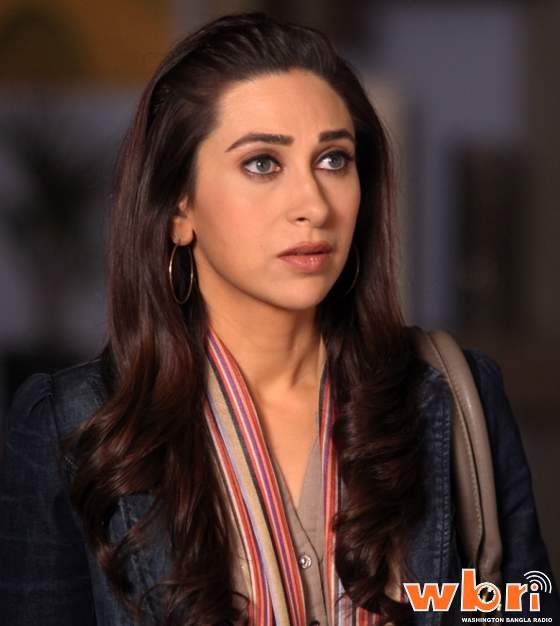 The makers of India's first Stereoscopic 3D movie 'Haunted 3D' now bring you India's first true 3D thriller 'Dangerous Ishq'. Supermodel Sanjana (Karisma Kapoor) and Rohan, son of one of the nation's foremost business tycoons have been one of the most popular couples in the social circuit. When Sanjana decides against flying to Paris at the last minute- for a lucrative modeling assignment, she does so, not just because she cannot bear to stay away from her boyfriend Rohan, but more importantly because her instincts push her against going. But what her instincts cannot do is stop Rohan from getting kidnapped.
Read the full storyline here:
Digital Drama: The technology transforming theatre
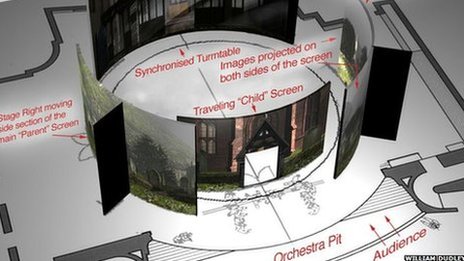 3D projections, virtual-reality masks for actors, stop-motion camerawork and computer animation have all been put to use.
And as the hardware and software become ever cheaper, the methods are trickling down to fringe theatre too. ...
The real digital revolution, says Mr Bird, is that you can now map your 2D projections onto your particular stage set in a venue - rather than merely project onto a flat surface.
"This gives the projected images a 3D quality without the audience having to wear the glasses", says Mr Bird, "which would kill the theatrical experience." ...
The trend appears to be towards ever more interactive sets, with effects triggered by actors live on stage.
See the full, lengthy story here
Stanford Univ: See the Universe in Stereo 3D on the Big Screen
The mysteries of the universe — from the first stars and supernovas to galaxy clusters and dark matter — are being revealed in stunningly beautiful full-color, high-definition 3D videos played on a huge screen in an intimate theater on the SLAC National Accelerator Laboratory campus.
Diaphanous veils of semi-transparent fluorescing gas and dust swirl hypnotically among exploding stars; colliding galaxies dance a cosmic do-si-do before they coalesce. These are some of the compelling scenes shown in the second-floor Visualization Lab of SLAC's Kavli Institute for Particle Astrophysics and Cosmology (KIPAC.)
In addition, KIPAC's newly redesigned website features an elegant gallery for the movies and images.
Each animation lasts just a minute or three. ...
As beautiful as the 3D videos are, though, they are first and foremost scientific tools.
See the full story here:
3D INFOGRAPHIC PROJECTION MAPPING IN GRAND CENTRAL STATION!
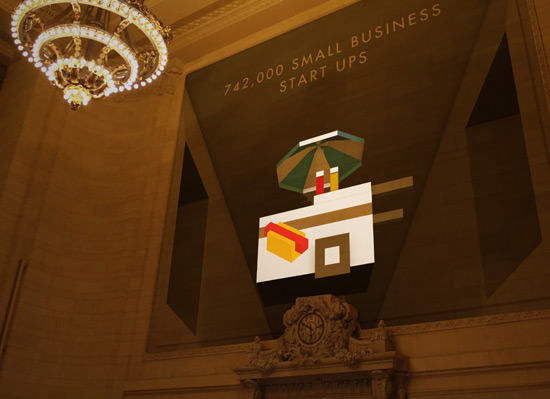 Fancy seeing the world’s first 3D projection-mapped infographic animations?
Along with ad agency DDB London and the Financial Times, we helped gather data and shape some of the stories for three short infographic films which will be projection-mapped on the inside of Grand Central Station in New York! Go see!
(Projection-mapping throws a 3D model of an environment or space back on itself in order to pull off some incredible visual effects).
I’ve not seen the finished films yet. They’ll be unveiled tomorrow (Tuesday 27th March) and run continuously for three days. Hashtag #FTGW. But project-mapping ninjas the Klip Collective have an incredible reputation for large scale awesomeness.
There’s a preview (and a picture of me doing Karate) running at http://www.ft.com/graphicworld.
See the original post here:
New 3D VOD app for LG TVs
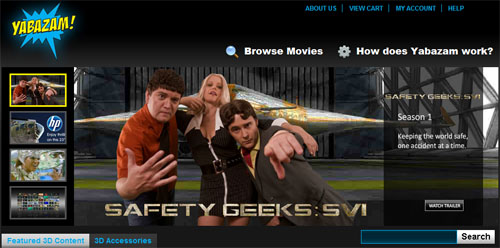 LG is beefing up content for its smart TV platform by partnering Australia-based 3D technology provider DDD Inc. to launch a new Yabazam 3D TV app. According to technology news portal TG Daily, this video-on-demand (VOD) service is an exclusive app for LG displays. However, Asia is off the chaebol's radar and the app will not be released in this region at the moment.
Yabazam 3D currently offers over 40 3D dramas, documentaries and movies produced by independent studios. Besides the app, these videos can also be viewed on smartphones and laptops via a proprietary TriDef 3D media player. An LG spokesperson added that the company will not rule out the possibility of introducing this app for Asia in the future.
See the original post here:
As 3D novelty wears off, some experts call for more extreme uses
[Philip Lelyveld comment: this is a report from the Ravensbourne’s 3D Storytelling event.]
[ScreenDaily]
...
Napier said that he’d notice skills levels and understanding of 3D coming on by leaps and bounds in recent years. “You can communicate your intention much much quicker now. The industry at large is adopting it, and people are skilling up.”
Vision3’s Parks advocated more extreme uses of 3D. “The mantra has become too much depth is bad,” whereas he’d like to see “more of the volume of the subjetcs.”
Parks said: “Directors find it difficult to accept the roundness of stereoscopic…But it’s our responsibility as people working in 3D to help to explain and break down some of these preconceptions.”
He doesn’t mean breaking the frame with one spectactular shot per film, but working with the depth and volume of 3D throughout a whole project. “Where we’ve got to movie it now is about shot by shot, scene by scene, the whole picture. It’s not just one shot here and there.”
Humphreys agreed that audiences might want more extreme use of 3D. “I am getting frustrated at paying an extra fiver to watch something at the cinema that is pretty much the same in 2D. I want more of a 3D experience…Hollywood has done some safe 3D productions and it’s time to widen that platform a little bit.”
Victor Riva, who worked on Martin Scorsese’s Hugo, takes another approach: “I’m a purist, I like gentle stereo, looking at stereo as if I’m looking through a window on the world.”
Other topics at the conference included the need for increased levels of 3D training in the UK, not just for camera operators but for everyone involved in a production, especially directors and producers. ...
There was also a groundbreaking live, glasses-free 3D link-up between Ravensbourne and Russia’s Tomsk Polytechnic University. [Philip Lelyveld comment: a story about this link was posted earlier.]
Read the full story here: