New PicoP Gen MicroVision: 2 Laser Display Engine Features High-Definition Projection from a Tiny Package
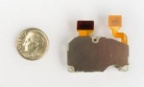 Beyond hallmark features of MicroVision's PicoP laser display technology such as infinite focus, vivid clarity and brightness uniformity, the PicoP Gen 2 HD laser display engine boasts 720p high-definition images and immersive displays up to 200-inches diagonal. MicroVision will also demonstrate new HD engine prototypes with brightness ranging from 15 to 25 lumens at CES. MicroVision plans to begin seeding early samples of the PicoP Gen2 HD laser display engine to selected OEMs for their own testing and evaluation starting in Q1 2012.
Additionally, MicroVision will push the boundaries of how consumers break free from the screen by demonstrating two PicoMagic(TM) display applications: touch interactive and 3D displays. Both will enable users to experience a new world beyond the basic projection. PicoMagic(TM) touch interactive display will allow users to interact with a projected image on any surface, instantly creating multi-user applications such as virtual whiteboards. With PicoMagic(TM) 3D capabilities users will be able to experience 3D content from a small display device anywhere, anytime. ...
Read the story here:
Scientists Propose Kinect-like 3D Camera for Cellphones
MIT group is using single camera and "time of flight" detection to develop a simpler, cheaper gesture recognition technology for cellphones. Qualcomm provided $100,000 research grant.
Read the full article here:
Medical Students at NYU School of Medicine Use Interactive Virtual 3D Cadaver
First-year students at NYU School of Medicine were introduced to a pioneering online 3D interactive virtual human body called the BioDigital Human(TM). This unique educational experience supplements the traditional use of human cadavers in anatomy instruction by allowing students to both view and interact with realistically simulated 3D organs and other anatomical structures. This technology is just one way NYU School of Medicine provides its students cutting-edge, web-based learning environments to break the lockstep of traditional medical education.
Anatomy students view the life-size digital content displayed on a projector screen in NYU School of Medicine's anatomy lab using sophisticated consumer-grade 3D glasses. They also use laboratory iPads to magnify and explore the models in great detail. Similar to experiencing a 3D film, viewing the graphics stereoscopically provides the illusion of depth and greater appreciation for the 3D models and their relationship to each other. This immersive, virtual reality set-up is an unprecedented 3D anatomy installation at NYU School of Medicine and is now available to its students and faculty. The 3D models of human anatomy were developed by NYU School of Medicine's Division of Educational Informatics and BioDigital Systems LLC, then packaged and deployed in the BioDigital Human platform.
...
See the full, lengthy press release here:
Karlheinz Brandenburg explained at Techfest how 3D audio creates grand illusions of sound
"At present, there are 50 3D audio installations around the world: in theatres in Los Angeles,Romania, South Korea. It will come to India too at some point in time." It was Brandenburg's deep interest in music that took him to audio engineering. "I was learning the recorder and the piano. Later, I took up the guitar so that I could sing along with people at campfires," he said. "I feel lucky that I could turn my love of music into my profession."
Toshiba Announces Its Most Advanced 3D Smart TV Series For 2012
Toshiba’s Digital Products Division (DPD), a division of Toshiba America Information Systems, Inc., today announced an all new level of 3D Smart TV for 2012. Featuring a full suite of new capabilities including ePortal, MediaGuide, Open Browser, SearchAll, MediaShare, Send & Play, eManual, Tablet Remote App Capability (TRAC), built-in Wi-Fi® and the dual core CQ Engine™, Toshiba is changing the Smart TV experience.
...
Consumers don’t just want a good Smart TV, they want a seamless Smart TV experience.
...
Read the full story here
True 3D telepresence getting closer
Researchers at the University of North Carolina have been working on life size 3D telepresence which allows remote viewers to look around a scene far away without wearing markers or 3D glasses.
The team, led by Dr. Henry Fuchs and graduate student Andrew Maimone, have created a telepresence system with room sized real-time 3D capture and a life size tracked display wall.
The prototype shown in the video below utilises ten Microsoft Kinect cameras, a two panel display wall (the 'window' to the remote scene), complex algorithms and GPU accelerated data processing to allow a remote viewer to look into a live scene, which changes perspective as the viewer moves his or her head. It is as if the displays are a window into another room so as you walk past, you will be able to look around objects.
The Microsoft Kinect cameras provides 3D scene capture of the remote room including depth information. The system then merges the data from multiple cameras, reads the depth information, and applies some processing to change the view presented giving the viewer of the remote room the illusion of depth which changes as the user's perspective changes.
UNC Chapel Hill is one of three universities participating in an international consortium called the Being There International Research Center for Telepresence and Telecollaboration that includes Nanyang Technological University (NTU, Singapore), Swiss Federal Institute of Technology Zurich (ETH Zurich, Switzerland).
...
3D for cinema is based on filming with two cameras side by side. This is a very primitive way of producing 3D content and has been around since the dawn of photography. The next stage of 3D capture is likely to offer multiple viewpoints within a 3D scene using ‘depth’ information (using two side-by-side cameras provides just one view – you cannot 'look around' objects) and the UNC Chapel Hill team are using the Microsoft Kinect to provide this depth data for telepresence.
They have presented a Kinect-based marker-less tracking system that combines 2D eye recognition with depth information to allow head-tracked stereo views to be rendered for a parallax barrier autostereoscopic display. Like the 2D system, a single Microsoft Kinect situated on a glasses free 3D display tracks the remote viewer’s head as shown in the video below. ...
One of the biggest challenges the team had to confront is the considerable overlay of images when using multiple Microsoft Kinect cameras. Several algorithms, such as hole filling and colour matching, were built to create a more true to life image. ...

A few weeks ago we reported that the have created a solution that enables direct eye contact for video conferencing. High tech R&D firm Fraunhofer Heninrich Hertz Institute in Berlin, Germany showed 3D Focus the Virtual Eye Contact Engine – a software module analyses a scene in real-time 3D from three cameras mounted around the video cameras display. It computes the depth structure information of the person’s head which is used to generate a 3D model. The 3D model is then used to compute the view of the virtual camera for both parties and the rendered output appears to show each person looking directly at each other.
Both systems are crude in appearance and the quality is still not high enough for commercialisation. However, it will be very interesting to see what researchers will do with the upcoming Microsoft Kinect 2, which is rumoured to be so accurate it will be able to lip read. ...
Read the full article here:
Microsoft builds a 3D hologram that you can touch (video)
Microsoft Research is presently working on some pretty clever 3D holograms, too. By combining the age-old optical illusion of the mirascope toy with a modern light field display, a team of researchers have managed to make a moving 3D image float in midair at 15 frames per second, emulating 192 different viewpoints at a time.
Typically, such light field displays have to be demonstrated under glass, away from curious fingers, to maintain their effect, but you can reach right out and "touch" these images with the aid of a depth tracking camera like Microsoft's Kinect. The team's calling the project Vermeer, ..., subsequent prototypes actually put cameras inside the mirascope to detect fingers and capture images to be displayed.
See the full story here
MakerBot text adventure gins up excitement for CES announcement
MakerBot Industries is the company behind the MakerBot, a build-it-yourself 3D printer that sells for just over $1,000. The MakerBot, and consumer 3D printing in general, are both in early stages. You can expect an increased presence for 3D printing at CES, with MakerBot and other vendors scheduled to make announcements.
To promote its own news, MakerBot commissioned game designer Andrew Plotkin to create Key Features, a text adventure in the vein of the old Zork and Hitchhiker's Guide to the Galaxy games. As you progress through the game you'll find free, downloadable plans for printable 3D objects, which serve as clues hinting at MakerBot's new product.
To play the game, go here. To beat the game, you don't need a 3D printer, but you do apparently need to be smarter than I am.
Read the full article here:
CES – everything you need to know
Sortable has posted an excellent info graphic of CES here:
