3D PRINTING, TELEPORTERS AND WISHES
From ANIL DASH
- The Teleporter: Every 3D printer should seamlessly integrate a 3D scanner, even if it makes the device cost much more. The reason is simple: If you set the expectation that every device can both input and output 3D objects, you provide the necessary fundamentals for network effects to take off amongst creators. But no, these devices are not "3D fax machines". What you've actually made, when you have an internet-connected device that can both send and receive 3D-printed objects, is a tele porter. ...
Read the full editorial here
4 Reasons 3D Movies Aren’t Just a Fad
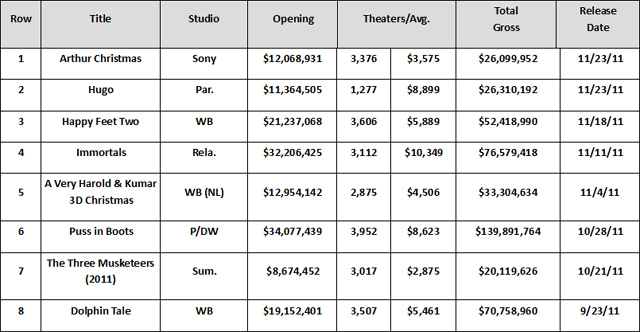
1. 3D Sales Are Strong and On the Rise
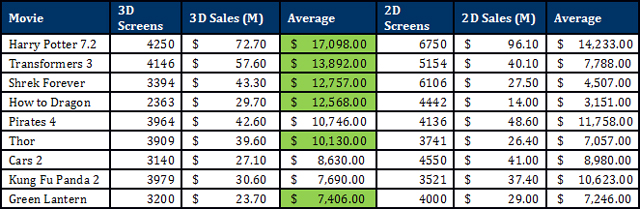
A fairer snapshot is this one below, which shows the relative performance of different 3D movies over the summer. The green boxes highlight 3D outperforming 2D on a per-screen basis.
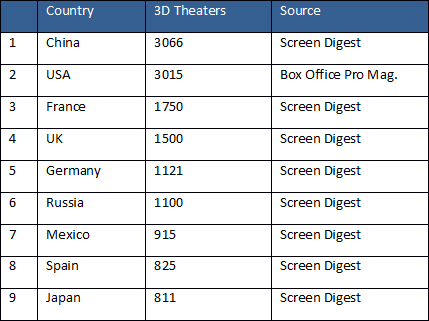
2. 3D Theater Installations and 3D Movie Production Are on the Rise
According to a Sept. 20 report from IHS Screen Digest, there are now more than 30,000 3D-enabled theaters in the world and new installations are reported across all regions.
3. 3D Gets Favorable Reviews
...
4. 3D Is Getting Better
...
Read the full article here
Real-time 3D modeling: Kinect and Lightspace in the Microsoft R+D Lab (Video)
[Philip Lelyveld comment: Microsoft has 850 researchers working on the project!]
...
Kinect Fusion is a system that uses the Kinect's sensors to create an interactive, real-time 3D model of the environment — the demonstration shows virtual balls bouncing around on the objects captured and rendered directly from the real world. (It's not the first time we've seen the Kinect used for 3D modeling, but it's nice to see an official effort.) Microsoft's Kevin Schofield is quick to point out that the $150 Kinect sensor can accomplish the same tasks as industrial versions of the technology that cost about $50,000.
Lightspace works in the opposite direction: with a combination of depth cameras and projectors, it can create linked interactive screens on different surfaces. In the video, principal researcher Andy Wilson demonstrates how objects projected on a table can be moved around, re-sized, and even carried to another display using his hands. It's something you have to see to really understand, so fire up that video.
See the full story and watch the video here:
3D Printers: Almost Mainstream
 Smaller and cheaper
3D printing isn't new. .... But over the last 24 months, prices have dropped to a level that makes it appealing to a wider audience. ...
3D design gets easier
It's relatively easy to use a free tool such as Google SketchUp to create simple objects for 3D printing. But for complex shapes and geometries, designers still reach for professional modeling tools like SolidWorks. ...
Pete Basiliere, an analyst at Gartner who covers 3D printing, doesn't see consumers using the technology for personal printing of unique, one-off household items. "What's inhibiting consumer use is cost. It's too expensive for most people." Instead, he says, service bureaus may step in to fill those needs. ...
Read the full article here:
3D Ornaments at GE Global Research
The folks over at the Additive Manufacturing Lab, GE Global Research, sent us this video about their 3D-printed jet engine Christmas ornament design. They’re looking to see what sorts of other 3D-printed and science-tech-themed tree ornaments makers are creating. If you’ve made any, post them to their Edison’s Desk Facebook page.
See the full story with a holiday video here:
IMAX 3D movie ticket price to drop (China)
... since the IMAX film equipment was monopolized by foreign companies, China's cinemas had to invest a lot in the preliminary period and did not have sufficient film resources. As a result, when the movie "Avatar" was shown in China in 2010, it was very hard for moviegoers to get the tickets since a ticket priced at 100 yuan was sold at a price of between 500 and 600 yuan by ticket scalpers.
A full set of IMAX huge-screen theaters costs about 10 million yuan, but the equipment made in China costs less than halfof that. With the development of the domestic screen, the price of the expensive 3D movie tickets is expected to drop.
See the original story here:
The Hobbit trailer
Vince Pace Reveals How Martin Scorsese’s ‘Hugo’ Is Changing the Future of 3D Filmmaking
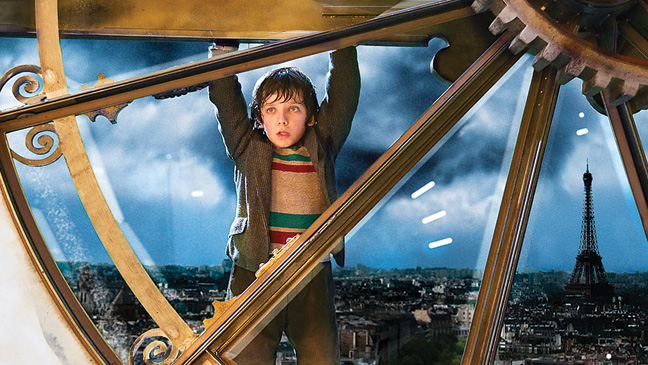 The co-chairman of the Cameron | Pace Group says the world's first "CPG Certified" 3D movie has already captured Hollywood studios' attention, surpassing even the work CPG did for James Cameron's "Avatar." ...
Read the full story here
3D-TV R+D activities in Europe (BBC Whitepaper)
... The BBC white paper is called “3D-TV R&D Activities in Europe.” One project that was mentioned in the white paper is called “3D Vivant.”This project is based on research and design of a “3D Holoscopic” camera with a single aperture. It will enable the real-time capture of 3D scenes.
Information was also revealed about software that is being worked on, which will focus on 3D Holoscopy for the Internet. This will enable 3D objects to by hyperlinked online.
Another project mentioned in the white paper is “Real 3D.” This projects is based on overcoming restrictions of current restrictions among stereo 3D, and autostereoscopic, displays. It is based on holography.
...
HELIUM3D is another project worth mentioning that comes from the report. This project is based on improving current glasses-free displays and deals with laser technology. This project is based on “direct-view RGB” laser projection.
...
Other interesting projects mentioned include Mobile 3D-Tv, which is a 3D service for mobile users, and an end-to-end production pipeline for multimedia content that aims to allow HD and 3D video capture of live events. This will be done by using unmanned aerial vehicles and should allow us to consume more of a variety of 3D content from the comfort of our homes.
Lastly, a project, called TSB i3DLive, was mentioned that is based on extracting 3D information from live action. This project seems to be geared toward film makers and movie professionals and not the average user though.
“A typical application would be on the set of a movie production. In this case the principal camera would be a high-grade film camera and the witness cameras could be video cameras,” as mentioned by 3DFocus.
...
See the original article here: http://www.3dtv.com/UI/ViewArticles.aspx?ArticleId=462
Download the original BBC whitepaper as a pdf here: http://downloads.bbc.co.uk/rd/pubs/whp/whp-pdf-files/WHP215.pdf