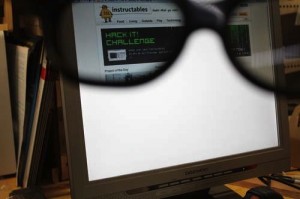
 You've always wanted a bit more privacy with your monitor (porn jokes notwithstanding) and if you're willing to tear apart a spare LCD monitor and a pair of 3D theater glasses (thanks, Dreamworks and Pixar!), you'll get it. In lieu of a thicker tinfoil hat, Instructables' dimovi suggests removing the LCD's frame, cutting out its polarized film with a utility knife before removing the screen's film adhesive with a combination of cleaner and paint thinner and reassembling the monitor. Once complete, grab the glasses, cut out the lenses and combine them with the plastic film removed from the monitor before inserting them back into their frames. The result is an LCD monitor that displays a white screen to anyone not wearing the customized glasses, your actions being confidential, no matter what they might happen to be. Check the how-to video embedded after the break, or hit the source link for full instructions
See the original post and video here
 If you want to see the source material that inspired Scorsese, get the magnificently restored 5 DVD(!) boxed set of Melies's films here.
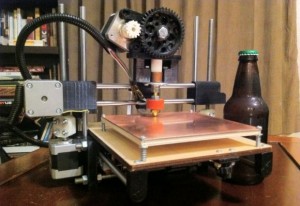 ... Brook Drumm aims to change that with a new Kickstarter project for his 3D printer called the Printrbot. The project managed to collect 100% of the funding he required in just 46 hours, ...
The Printrbot is desirable because a full kit will only cost you $499. There’s also a Bare Bones Kit for $199 where you supply the electronics yourself, or for the really adventurous a $75 option that gives you the printed parts, but leaving the hardware up to you. ...
Read the full story and watch the video here
Something got lost in translation. What would Mao think. Watch it here.
[Philip Lelyveld comment: they wrap an Audi A1 in a tarp then project a speeding Audi A1 on the car. It creates an interesting effect in the video.]
Car launches are usually quite spectacular. Every year, the leading manufacturers try to ouperform themselves and each other by being more glamorous and stylish to place their cars in the premium segment.
Audi used 3D projections to present the A1 – The car was wrapped in tarpaulin and a 3D show was projected on it which made it impression the car was moving, highlighting all parts that make the car unique and beautiful. At the same time, all different variations of the car were shown. ...
See the video and the full story here
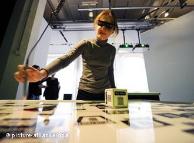
Digital artworks have been part of museum collections for years, and it's a trend likely to expand. But when old software or hardware faces compatibility issues or breaks, what can museums do?
See the full story here
It's all too easy to tweak ourselves online. Changing to become closer to the way we wish others perceived us, only the most flattering pictures, falsely modest statuses and painstakingly crafted tweets make the cut. Although we may not mean to, we end up crafting a fictitious persona in the process. James Alliban and Keiichi Matsuda capture the bizarre translation from physical to digital self with their installation piece 'Cell.'
Using 4 Xbox Kinects, the work tracks viewers as they enter a room, projecting a cloud of descriptive identifiers on a virtual mirror that follows their movements. The descriptors were collected through the data mining of various social networking and online dating websites, projecting identifiers such as 'atheist', 'hipster' and 'meat-eater.' There are also other interests and states like 'ghostbusters', 'tattoo' and 'unnaturally high tolerance for alcohol.' The online tags form data clouds of fabricated personas which adhere to the viewers' movements and grow over time.
Read the story with video here:
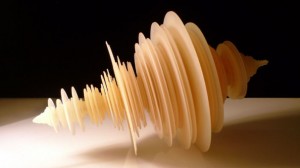 [Philip Lelyveld comment: I think this adds little to understanding because it isn't presented in a context of what a normal non-earthquake signal is like.]
Called the "Tōhoku Japanese Earthquake Sculpture," the piece is 11 inches long by seven inches wide and is made of frosted beige-yellow rings. Jerram constructed the piece by taking the design from a nine minute span of seismometer data from the earthquake and creating a 3D image with a computer aided design program. Then he printed the design using a rapid prototyping machine. ...
Read the full story here:
Video game players from around the world recently solved a puzzle that baffled scientists for more than fifteen years — and they did it in less than 10 days.
| Using an online game developed by researchers at the University of Washington called Foldit , a team of 35 citizen-scientists dubbed "The Contenders" collaborated to decipher the molecular structure of an enzyme that is responsible for the spread of AIDS in rhesus monkeys. This discovery provides important information that will help medical researchers design retroviral drugs to stop the AIDS virus in its tracks. |
In order for medical researchers to develop drugs such as these that can tackle an enzyme, a type of complex protein that catalyzes specific biochemical reactions in the body, they must first understand the enzyme's structure. However, with the millions of possible configurations of an enzyme's atoms and bonds, this task can take years and often stumps even the world's most accomplished scientists.
The University of Washington team saw an opportunity to capitalize on the enthusiasm surrounding collaborative game play to create a human "supercomputer" that could uncover these protein structures more quickly. Foldit enlists the help of gamers worldwide and challenges players to fold virtual protein molecules into different formations to obtain the highest-scoring, or lowest-energy, models. The monkey-virus puzzle is just one of several scientific mysteries on Foldit.
This most recent discovery highlights the power of Foldit and other science-oriented video games to channel human intuition to solve a wide range of scientific challenges. You can tap into your own puzzle-solving skills and help advance scientific research by playing Foldit at http://fold.it/portal/puzzles.
 From Neon 3D Printable Accessories to 3D Printed Fossils
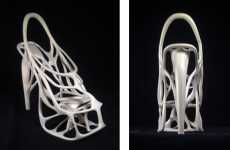
Not too long ago, the concept of 3D printing seemed outrageous; today, innovations in 3D printing are far and many. Designers use 3D printing technology for different reasons, but most agree that it is just a faster and more affordable way to manufacture certain products. Essentially, 3D printing allows designers to print different parts of something and assemble it together afterward. ...
See the full story here
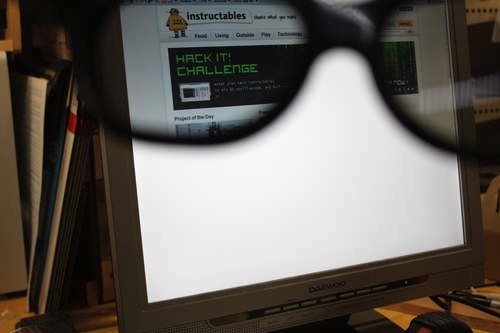 You've always wanted a bit more privacy with your monitor (porn jokes notwithstanding) and if you're willing to tear apart a spare LCD monitor and a pair of 3D theater glasses (thanks, Dreamworks and Pixar!), you'll get it. In lieu of a thicker tinfoil hat, Instructables' dimovi suggests removing the LCD's frame, cutting out its polarized film with a utility knife before removing the screen's film adhesive with a combination of cleaner and paint thinner and reassembling the monitor. Once complete, grab the glasses, cut out the lenses and combine them with the plastic film removed from the monitor before inserting them back into their frames. The result is an LCD monitor that displays a white screen to anyone not wearing the customized glasses, your actions being confidential, no matter what they might happen to be. Check the how-to video embedded after the break, or hit the source link for full instructions
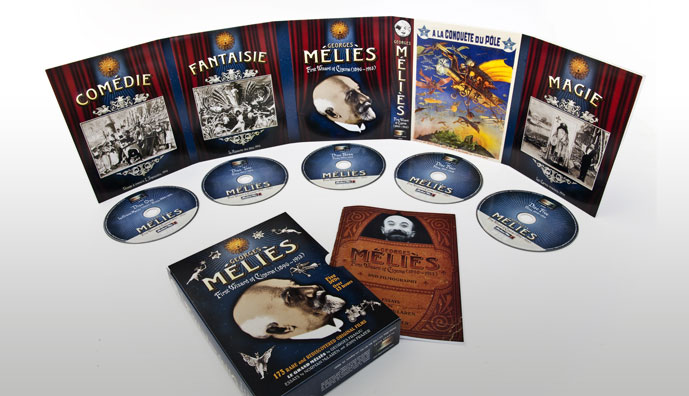 If you want to see the source material that inspired Scorsese, get the magnificently restored 5 DVD(!) boxed set of Melies's films here.
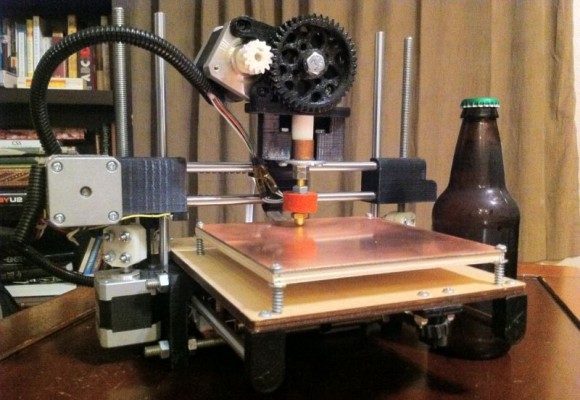 ... Brook Drumm aims to change that with a new Kickstarter project for his 3D printer called the Printrbot. The project managed to collect 100% of the funding he required in just 46 hours, ...
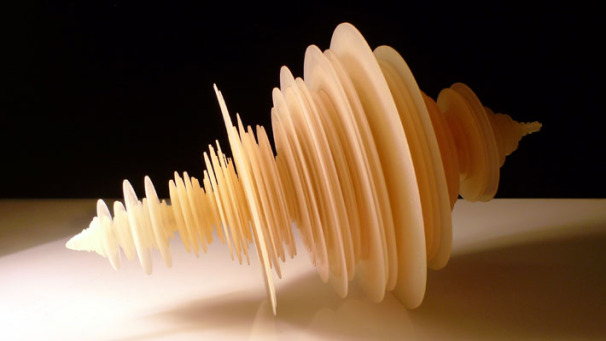 [Philip Lelyveld comment: I think this adds little to understanding because it isn't presented in a context of what a normal non-earthquake signal is like.]