YouTube has long been pushing for more professional content, with a wide variety of tools: The site has given out free equipment to some of its producers, invited others to classes to learn more about video production and given sizable advances to select partners. There’s some dispute about the effectiveness of these measures, especially since YouTube chose not to renew more than 60 percent of its premium channels.
Of course, traditional TV networks cancel shows all the time — and YouTube increasingly seems to take its cues from the studios. Case in point: The video service opened a sizable production facility in Los Angeles earlier this year that’s open to YouTube producers to shoot their shows.
See the full story here: http://gigaom.com/2013/07/26/video-game-high-school-season-2/?utm_source=General+Users&utm_campaign=2aaf914dab-c%3Amed+d%3A07-29&utm_medium=email&utm_term=0_1dd83065c6-2aaf914dab-99190873
In order to create lifelike objects that are hard, soft, reflect light and conform to touch, users must currently specify the material composition of the object they wish to replicate. That's no easy task, as it's often easier to define the desired end-state of an object -- for example, saying that it needs to be soft -- than to determine which materials should be used to make it.
See the full story here: http://www.hispanicbusiness.com/2013/7/27/mit_looks_to_movie_cgi_to.htm
 The primary technologies that we saw showcased the most were 3D printing, Augmented Reality, Virtual Reality and 4K. The latter is no surprise when you consider how long 4K has been slowly filtering into the film industry and would inevitably make its way into the professional graphics industry where most of the VFX artists are already doing a lot of work in 4K. Naturally, we saw a plethora of 4K displays ranging from arrays of 4K monitors, to extra large 4K TVs and even 120 Hz 4K 3D Projectors from Christie.
See the full story here: http://www.brightsideofnews.com/news/2013/7/26/siggraph-2013-3d-printing2c-virtual-reality2c-augmented-reality-and-4k.aspx
[Philip Lelyveld comment: that didn't take long. The Rift isn't even on the market yet.]
 Erotic games are not new to the Oculus Rift and some of you might have heard of Wicked Paradise, so technically this update to Custom Maid 3D will make it the second erotic game to support the Oculus Rift headset. While we have to play the game for ourselves, and with no plans to at the moment, we can’t really comment on what the experience is like, but assuming it was pleasurable before, we can only imagine the sensation will be kicked up a notch thanks to a more immersive gameplay.:
See the full story here: http://www.ubergizmo.com/2013/07/erotic-game-custom-maid-3d-gets-oculus-rift-support/
[Philip Lelyveld comment: Is the quote "creativity loves constraints?" The new challenge for the creative industries may be developing innovative experiences that fit within both the isolated interests of the target populations and the analyzed elements of what works in the entertainment that they seek out.]
You fired up your Netflix device a couple Fridays ago, happened across Orange is the New Black in your Netflix recommendations, started watching the first episode and then wondered why you’d never heard of it. Netflix’s other original programming — House of Cards and Arrested Development— received huge preavailability marketing, and they weren’t even this good.
The answer to your question, like the answer to so many other questions these days, is data. Netflix didn’t have to spend millions of dollars advertising the new show hoping you would tune in — it knew you’d see it in the recommendations, it knew you’d give it a try and it knew you’d like it. According to the company during its earnings call on Monday, “Orange is the New Black” actually had more viewers watching more hours than during its first week than its predecessors had.
Read the full story here: http://gigaom.com/2013/07/25/at-netflix-big-data-can-affect-even-the-littlest-things/?utm_source=General+Users&utm_campaign=d35ea9670d-c%3Amed+d%3A07-26&utm_medium=email&utm_term=0_1dd83065c6-d35ea9670d-99190873
Sony's 3D head-mounted displays have been asking for a place in your film-watching and gaming routines since 2011, but now their latest HMD is volunteering to act as the viewing end of medical endoscopes. Hirai and Co. have just unveiled what amounts to a retooled HMZ-T2, dubbed the HMM-3000MT, which helps surgeons peek inside a patient's body in 2D or 3D -- the latter of which is said to improve precision. By eliminating the need to keep tabs on an external screen, the electronics giant thinks doctors won't have to restrict their posture and movement.
Though the hardware carries the same 720p 0.7-inch OLED panels as its sibling, it's been tweaked for use in a standing position with beefed up support for balance and comfort.
See the full story here: http://www.engadget.com/2013/07/23/sony-surgical-3d-head-mounted-display/
 The Science Museum and the Design Museum are to examine the explosion of creativity among innovators the 3D printing may lead to.
Read the full story here: http://www.telegraph.co.uk/technology/news/10197370/3D-printing-museums-examine-the-future.html

The theaters are expected to lower the company’s traveling costs for its artists who are frequently required to visit other countries for their fans’ demands as the company expects that the holographic theaters will allow the bands to perform live in different places simultaneously. Also, overseas fans can satisfy their eager for seeing their favorite hallyu stars in their nations if the theaters are set up there.
|
See the full story here: http://www.koreatimes.co.kr/www/news/culture/2013/07/386_139321.html
Also see the follow-up story here: http://www.fastcolabs.com/3014670/weird-hologram-concerts-allow-k-pop-artists-to-transcend-space-time?partner=rss&utm_source=feedburner&utm_medium=feed&utm_campaign=Feed%3A+fastcompany%2Fheadlines+%28Fast+Company%29&curator=MediaREDEF
Infinity though, seems to be all about the possibilities presented by these characters and stories. It is like mainlining Disney magic.
Infinity uses the same basic recipe: you buy the game as a starter kit, with a USB plinth – or Infinity Base – and a collection of three figures: Captain Jack Sparrow from Pirates of the Caribbean, Mr Incredible from The Incredibles and Sulley from Monsters University. Each figure opens up a different narrative adventure within the game – and buying more Playsets gets you access to new quests. Plus, as in Skylanders, each action figure toy retains the player's data, so they're handy save files too.
The responsibility for Disney is in ensuring that each purchase provides plenty of playability. So in Infinity, when you buy a Playset from a new franchise, it opens up a dedicated adventure in the game.
And really, Infinity seems to be what Disney games should always have been – an imaginative platform that is genuinely for the whole family. It is filled with fun little ideas and features that my kids probably won't even get; for example, the Wreck It Ralph cherry bombs in the Toy Box mode that generate 2D sprite-based explosions like old school shoot-'em-ups. While most previous Disney games have reduced the franchises into conventional, boring action adventures, Infinity appears to be infused with the Pixar spirit of 'plussing' – adding new features, gestures and elements at every stage of production.
This will probably be the best Disney game since the Mega Drive era, since the brilliant Castle of Illusion and Dave Perry's wonderful Aladdin tie-in. But standing as it does, at a crossroads between LittleBigPlanet, Skylanders and Minecraft, it has the potential to be much, much more.
See the full story here: http://www.guardian.co.uk/technology/gamesblog/2013/jul/22/disney-infinity-hands-on-preview?curator=MediaREDEF
[Philip Lelyveld comment; Innovation is never stifled, it is only (re)directed by business, legal, tech, and social influences. This expiring patent that 'held back innovation' was the largest source of revenue for a group at UT Austin, hardly a patent troll org.]
In February 2014, key patents that currently prevent competition in the market for the most advanced and functional 3D printers will expire, says Duann Scott, design evangelist at 3D printing company Shapeways.
These patents cover a technology known as “laser sintering,” the lowest-cost 3D printing technology. Because of its high resolution in all three dimensions, laser sintering can produce goods that can be sold as finished products.
See the full story here: http://qz.com/106483/3d-printing-will-explode-in-2014-thanks-to-the-expiration-of-key-patents/
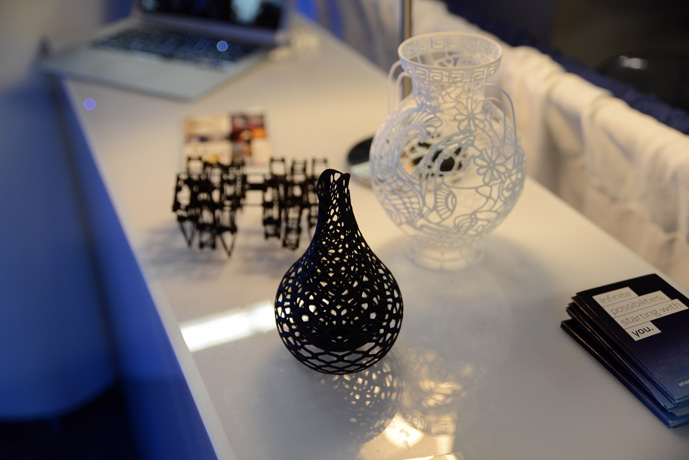 The primary technologies that we saw showcased the most were 3D printing, Augmented Reality, Virtual Reality and 4K. The latter is no surprise when you consider how long 4K has been slowly filtering into the film industry and would inevitably make its way into the professional graphics industry where most of the VFX artists are already doing a lot of work in 4K. Naturally, we saw a plethora of 4K displays ranging from arrays of 4K monitors, to extra large 4K TVs and even 120 Hz 4K 3D Projectors from Christie.
 Erotic games are not new to the Oculus Rift and some of you might have heard of Wicked Paradise, so technically this update to Custom Maid 3D will make it the second erotic game to support the Oculus Rift headset. While we have to play the game for ourselves, and with no plans to at the moment, we can’t really comment on what the experience is like, but assuming it was pleasurable before, we can only imagine the sensation will be kicked up a notch thanks to a more immersive gameplay.:

 The Science Museum and the Design Museum are to examine the explosion of creativity among innovators the 3D printing may lead to.
