XPAND 3D’S NEW PASSIVE SYSTEMS RESET EXPECTATIONS IN SPECTACULAR FASHION!
[Philip Lelyveld comment: Xpand, a leader in active shutter tech in the entertainment and education market, goes for passive polarized tech as well.]
In a move to provide cinema industry professionals with more quality and choice than ever before possible, XPAND 3D - the leader in multidimensional imaging and pioneer of active shutter technologies - today introduced a new passive solution that delivers performance, comfort and commercial versatility to new, broader markets. The new XPAND Polarizer and Color Spacer passive systems will feature stunning new glasses that are lighter, more ergonomic and certainly more stylish than anything on the market today.
XPAND 3D passive glasses reflect well on the theater and make for a more comfortable viewing experience. The new XPAND Infinity glasses are high-end 3D glasses, which provide the brightest, most vivid and realistic 3D images available. XPAND Infinity glasses are also optimized to work with laser projectors, making it the optimal future-proof 3D system. The glasses are available in adult and children sizes. ...
See the full story here: http://hometoys.com/news/2012/10/05/xpand-3ds-new-passive-systems-reset-expectations-in-spectacular-fashion/19999983
Digital Out-of-home Entertainment Network Association Conference stresses Immersion, Engagement, and Creativity
[This story is permanently posted as a pdf here.]
By Philip Lelyveld
Representatives of all parts of the Digital Out-of-Home Entertainment (DOE) Industry met last week at the second annual DOE Network Association (DNA) Conference, held at USC’s Davidson Conference Center. Many of the attendees are involved in pressing the limits of digital technology and physical design to greatly expand the storytelling and engagement possibilities of out-of-home venues.
The DOE industry defines itself as covering the professional theme park, educational and edutainment (museums, visitors centers, science centers), arcade, retail and mall advertising and enhancement, ‘exergaming’ (workout experiences), and other public pay-to-play, ticketed, and free entertainment experiences. These experiences span the spectrum from fully real, physical equipment and spaces such as hands-on museum ‘sandbox’ exhibits, to fully virtual immersive gameplay.
Consultant Randy White of White Hutchinson Leisure gave some troubling statistics specific to the arcade industry. While other forms of discretionary entertainment spending, such as movie attendance, has been holding relatively steady, 60% of arcade dollars have shifted to home entertainment and ‘stay-cations’ in the last five years.
BMI Gaming’s David Young said that one of the arcade industry’s responses has been to encourage and recognize innovation through an international design competition. This year’s winner was Speed of Light; a vertical, button-based, two-player version of wack-a-mole with a lot of flashing lights.
Americans go to the movies on average 4 times per year. But they eat out approximately 167 times per year. Dining is a highly social experience. The top 20% of income households account for 48% of out-of-home spending. Mr. White recommended that arcades redesign their facilities to attract this upscale market with restaurants, wifi-equipped lounges, and games that allow for more group social and competitive activities. One audience member noted that this would redefine the businesses that arcades compete with to include coffee shops, shared work spaces, hotel lobbies, and other social gathering spots.
Kevin Williams, the organizer of the DNA conference, spoke forcefully of the DOE industry’s need to embrace technology to a far greater degree than it has to date. There is no reason, he argued, why devices could not recognize players when they return to a facility, coordinate communications as they interact with devices throughout the facility, and – if they opt-in – connect them with people who have similar interests and skill levels anywhere on the planet. The technology already exists to offer experiences outside of the physical environment to patrons that could motivate them to return to the facilities. The DOE industry can compete with rapidly improving home and personal entertainment options by offering attractive, safe locations to socialize, access high-end specialized devices, and have location-specific blended physical and virtual experiences. It is critical, he added, that equipment be software-upgradeable so that experiences can be regularly refreshed.
One example of a business doing this is MagiQuest (http://magiquest.com), a Harry Potter-like world with home-play, clan-building, and location-based components. Players can buy physical objects, like wands and capes, as well as virtual goods that aid in gameplay. With 15 physical locations in the US and Japan, MagiQuest offers a unique, integrated on-site and virtual game and social experience.
The ETC’s Phil Lelyveld moderated a panel on 3D Interactive Entertainment Experiences in Public Places, which more accurately covered 3D, 4D, 5D, 6D, and 7D experiences. 3D is stereoscopic visuals. 4D adds motion and effects, while 5D includes a live performance component. Interactivity in addition to all of the above is called 6D. 7D, as one vendor stated, is for customers who want more than 6D - Spinal Tap’s ‘the dial goes to 11.’
The immersive theatrical, walk-through, and cart-based experiences that the companies at this conference have developed match or exceed those found in the major theme parks. In fact, many of these companies have been involved in developing attractions for those parks. For example, Alterface developed an interactive 6D dark ride in Germany that, they claim, predates and is more complex than Toy Story Mania at Disney California Adventure. Thinkwell Design’s installation at the Fernbank Nature Quest, Atlanta, Ga., makes very effective use of augmented reality and simulations in their educational experience design – including a scientifically accurate, interactive river simulation walkway with fish, plants, and turbulance. (Watch a Fernbank video here: http://fernbankmuseum.org/naturequest/ )
3D projections onto building surfaces, ‘the other 3D,’ are increasingly in demand for both event programming and advertising. Oscura Digital discussed their amazing projection over the Zayed Mosque, the second largest mosque in the world, in Abu Dhabi, UAE (Video http://www.youtube.com/watch?v=WfOyK_lxKbQ , story http://www.youtube.com/watch?v=WfOyK_lxKbQ ). Pearl Media, which proudly self-brands itself as a ‘guerilla marketing firm,’ discussed how they always get permits, but do not always ask permission from the building owner when they install their temporary work. They have developed real-time rendered 3D projections that crowds can interact with via tablet controllers. Their projection onto a bagel store in Austin, TX during the SXSW conference increased bagel sales three-fold at the location. Pearl Media also does very clever interactive storefront installations that capture pedestrians’ attention and imagination (see http://www.pearlmediaus.com/interactive.php )
To sustain and grow the DOE sector, and to compete with other experiences, a number of show developers framed their work in terms of preshow, show, and post-show components (See photo). In some locations, the preshow has become so engaging that patrons have to be encouraged to move on when the main attraction is ready for them.
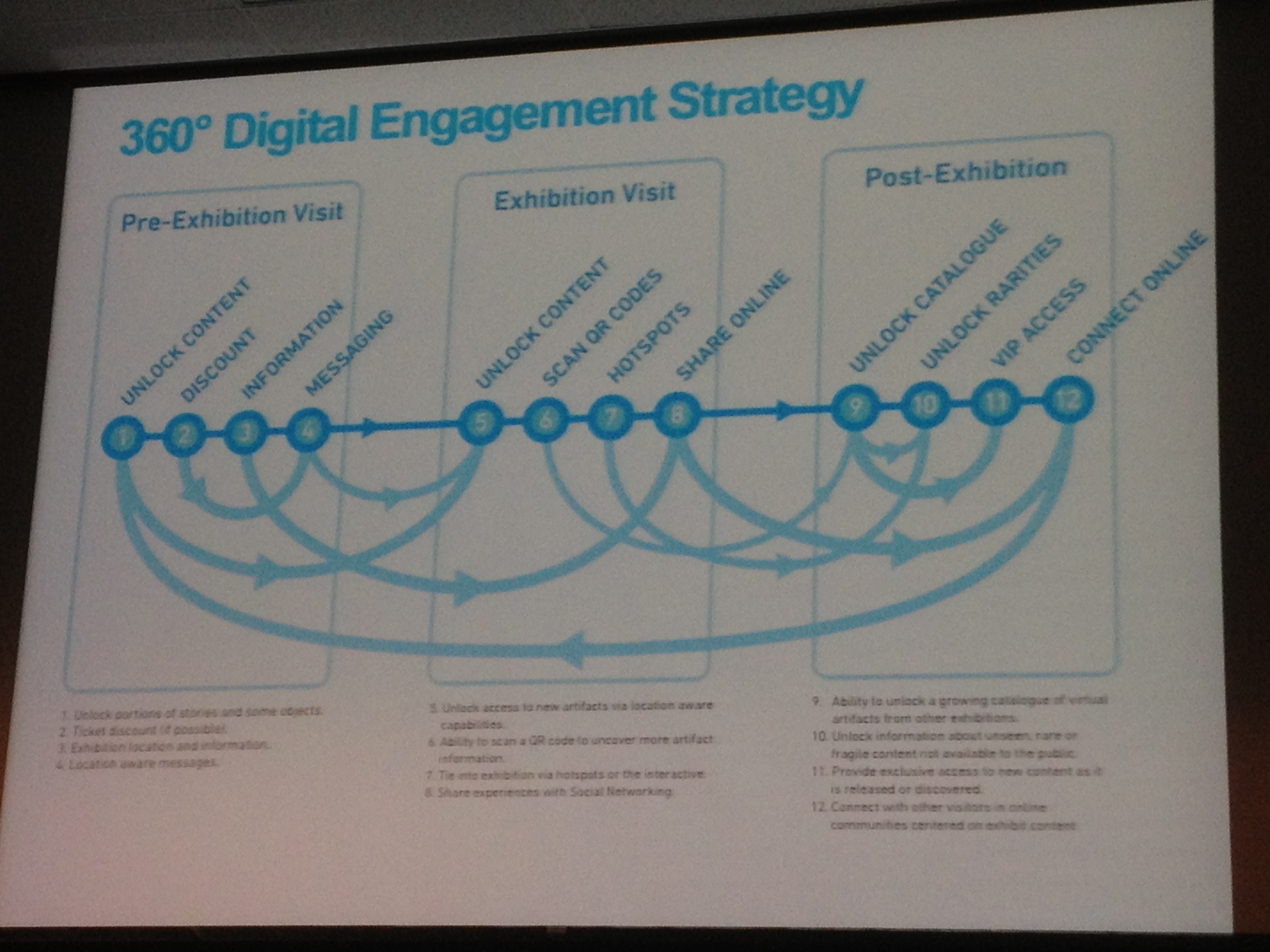
The key presentations given at this conference will be edited and distributed as both a physical book and e-book. Overall, the DNA conference was an interesting window into an industry that is using digital tools to create engaging storytelling, learning, and advertising experiences. Their work can inform what the traditional entertainment and CE industry is planning.
The next meeting of the DNA will probably be held in San Francisco in the first half of 2013. Go to http://www.thestingerreport.com/dna.html for more information.
Key companies represented at the DNA conference include;
Simiosys (http://www.simiosys.com , Chris Stapleton)
New Models of Ineractivity in Movie Theaters
Timeplay Entertainment ( http://timeplay.com , John Race)
Vortex Immersion Media (http://www.vorteximmersion.com , Ed Lantz)
Maximizing Social Media
Snibbe Interactive (http://www.snibbeinteractive.com , Graham Plumb)
Augmented Reality’s Next Stage in Leisure Facilities
Thinkwell Design (http://www.thinkwellgroup.com , Craig Hanna)
Ogmento (http://www.ogmento.com/team , Brian Selzer)
3D Interactive Entertainment Experiences in Public Places
Triotech (http://www.trio-tech.com , Ernest Yale)
Super 78 Studio (http://www.super78.com , Brent Young)
Mediamation (http://www.mediamation.com , Dan Jamele)
Alterface (http://www.alterface.com/en/home/ , Benoit Cornet)
3D Interactive Marketing in Public Places
Obscura Digital (http://obscuradigital.com , Barry Threw)
Pearl Media (http://www.pearlmediaus.com , Joshua Cohen)
Disney develops 3D-printed lighting for toys
[Philip Lelyveld comment: ok, this is VERY cool!]
Karl D.D. Willis of Disney Research tweeted last night to show off some awesome 3D printed optics that his group has been working on.
The overall idea was to explore the future of 3D printed interactive objects, using technology available right now. So although there are some non-printed components used (like LEDs and CCDs), the research paper describes how, eventually, entire electronic devices might be entirely 3D printed.
See the full article here: http://www.bbc.co.uk/news/technology-19818815
and here: http://blog.ponoko.com/2012/10/03/disney-research-experiments-with-3d-printed-optics/
Warner Bros. Converting Classic ‘The Wizard Of Oz’ To 3D For Yet Another Home Video Release
 WB revealed that they are converting "The Wizard Of Oz" from 2D to 3D for a forthcoming home video release.
Read the full story here: http://blogs.indiewire.com/theplaylist/warner-bros-converting-classic-the-wizard-of-oz-to-3d-for-yet-another-home-video-release-20121004
3D Craze Marks Start of Technology Disruption
[Philip Lelyveld comment: this story lists 2D and 3D printer companies and has a slider-controlled graphic showing their ROI over the last two years. The story mentions all the DIY/start-up activity, but focuses on established players - which is probably not where the next big thing will come from.]
Business Trends
3D technology is not yet catching on for investment firms or traditional printing companies like HP. The potential for this technology to change how things are made is enormous. MIT is expected to launch a 3-D printer, too. Ping Fu, founder and CEO of Geomagic, thinks that in five years department stores could be using 3-D printers. Imagine: A 3D printer could be used to print out the goods customized for customers, and tweak existing products to produce just the right fit.
Business Section: Investing Ideas
There are a number of players in the 3D printing space. Here are the three that investors should add to their watch-list of 3D companies:
Read the full story here: http://wire.kapitall.com/investment-idea/3d-craze-marks-start-of-technology-disruption/
Sony TV Patent Lets Users Watch TV And Play Games Simultaneously
 According to the patent description, future SimulView supported television will not just allow two gamers to share a scree, but a third person as well. While two people game, one person can watch TV, all on the same television each viewing their content as though they were watching it on a separate screen. Audio will be transmitted wirelessly through the 3D glasses, so no sounds will conflict. The image attached with the patent (see below) reveals that users will require two PS3′s (one for each gamer), as well as a separate receiver/DVD/Blu-ray player for the person watching television.
See the full story here: http://gamerant.com/sony-tv-watch-play-games/