‘Hobbit’ preview divides CinemaCon auds
 The "Hobbit" reel looked distinctively sharper and more immediate than everything shown before it, giving the 3D smoother movement and crisp sharpness, while losing the cinematic glow of the industry-standard 24 fps. The realism gave CG characters a distinct presence, but human actors seemed overlit and amplified in a way that many compared to modern sports broadcasts (as high as 60 fps in HD) and daytime television. ...
See the full story here:
The truth about ‘hyper-realistic’ video games as war simulators
While video game simulators are increasingly used to augment real-world training of fighting forces, the technology behind them includes the sorts of advancements that would be impossible to replicate in a person's home. And the minutia of detail they rely on is often shed when a game is created for entertainment. ...
Special Forces units at Fort Bragg, for instance, use the Laser Shot Virtual Shoot House. The building is designed to allow soldiers to blow in doors, fire live ammo at life-sized enemies and feel the thump of shots being fired back. The latest version of these shoot houses, designed by Texas-based Laser Shot, include smell emulators and a new technology that can project in the middle of a room, moving, life-sized holograms that can react to being shot.
The holograms are created by projecting video onto a fine wall of mist sprayed into a specific spot in a room. A complex 3D algorithm then tracks bullets fired by training soldiers, determining when a round has pierced the image and the avatar reacts accordingly, said Kevin Bass, director of software development at Laser Shot. Other enemies appear on the building's interior walls, which are high-tech video screens that can self-seal after a bullet passes through them.
"The hologram stuff is still in its infancy," Bass said. "The idea is that instead of looking into a screen of characters, you become part of that virtual world."
In California, some of the shoot houses are designed to increase the interior temperature to more than 100 degrees during training.
"Military training is about how to do what you need to do under the fatigue and cognitive strain you will be under," Herz explains.
But both forms of military simulator concentrate on teaching things like the rules of engagement or how to tactically approach a specific conflict. Video games, at their best, deliver not a realistic experience, but a hyper-realistic one, Herz says. ...
See the full story here:
CinemaCon 2012: Panel Says Opportunities Surround Live and 3D Alternative Content
 Alternative content will see growth and account for an estimated $315 million globally during 2012, projected IHS Screen Digest senior analyst for cinemaDavid Hancock, Monday at CinemaCon.
During an alternative content panel, stakeholders discussed potential opportunities in genres from sports to opera, and Brad LaDouceur, vp of alternative programming for Cineplex Entertainment, emphasized that “we truly believe live in 3D will be a game changer.” ...
Sony and All England Lawn Tennis Club have a three-year partnership aimed at bringing Wimbledon to 3D-ready digital cinemas around the world. Live 3D coverage, in partnership with Wimbledon host broadcaster BBC, is also offered to broadcasters. ... Sony is targeting at least 400 screens worldwide for the live finals....
Dan Diamond, senior vp, NCM Fathom Events, which had roughly 19,000 screens in its in-theater network, said, “We need to create diversity. Showing opera over and over again is not enough.”
Fathom broadcasts a 3D Metropolitan Opera series that resulted in nearly 900,000 tickets sold during its 2010-11 season.
Diamond reported that Fathom is also working with Hollywood studios to turn ”classic movie anniversaries into events.”
In sports, upcoming Fathom events including the Floyd Mayweather Jr. and Miguel Cotto fight, May 5 in Las Vegas. ...
An estimated 75,000 digital cinema screens are now installed worldwide, with roughly 40,000 offering 3D capabilities. ...
See the full story here:
The LG Home Theater 3D Sound Campaign You’ll Actually Want to Look At
 The ad campaign LG put out for their new Home Theater 3D Sound is really pretty brilliant. To convey the idea that you'll be hearing your movie from every angle, they've recreated iconic movie posters, juxtaposing the original with their alternate angle view. Check the gallery.
See the original post with more images here:
Cameron tapped for China’s 3D film
 James Cameron's 3D team, behind the worldwide success of 2009 sci-fi blockbuster ‘Avatar’, is being tapped to assist in shooting ‘The Art of War’, a film about ancient Chinese strategist and philosopher Sun Tzu.
Cameron's team is expected to provide technical support to the 3D shooting. Other details of the deal were not disclosed.
According to previous media reports, 'The Art of War', produced by an international team, is estimated to cost between $80 million and $100 million. ...
See the full story here:
Target offers 3D body scanner to measure customers
 $1 million 3D body scanner in Target store
Machine will take customer's measurements
Results can be used to buy clothes online
Alvanon Group chief Janice Wang said the 20,000 scans would be analysed to determine the most common shapes and produce size charts. Target will use the information to make clothes.
Those scanned will receive their measurements to take home, which can be used to buy clothes online.
Read the full post here:
Apple Invents a Killer 3D Imaging Camera for iOS Devices
 Apple has invented a killer 3D imaging camera that will apply to both still photography and video. The new cameras in development will utilize new depth-detection sensors such as LIDAR, RADAR and Laser that will create stereo disparity maps in creating 3D imagery. Additionally, the cameras will use advanced chrominance and luminance Sensors for superior color accuracy. And if that wasn't enough, the new cameras will not only include facial recognition but also facial gesturing recognition. Intel discussed the coming 3D revolution back in 2010 and it appears that Apple wants to be one of the first to introduce this killer 3D camera. While others may have beaten Apple to market first, the technology described in today's invention will definitely provide iOS devices with the ability to view killer 3D images that could only be appreciated on Apple's "Resolutionary" Retina Display. Apple's resolutionary experience has only begun. With the ability to view stunning 3D imagery, photos and videos on our new iPad displays, the resolutionary experience is only going pop our brains even further. ...
See the full article here
3D printers could create customised drugs on demand
Scientists are pioneering the use of 3D printers to create drugs and other chemicals at the University of Glasgow.
Researchers have used a £1,250 system to create a range of organic compounds and inorganic clusters - some of which are used to create cancer treatments.
Longer term, the scientists say the process could be used to make customised medicines.
They predict the technique will be used by pharmaceutical firms within five years, and by the public within 20.
The 3D printing process involves the use of a robotically controlled syringe which builds an object out of a gel-based "ink", into which chemicals and catalysts are mixed.
"Chemists normally put chemicals in glassware ...
Read the full story here:
Regal Entertainment Group teams up with Sony to bring subtitle glasses to US theaters
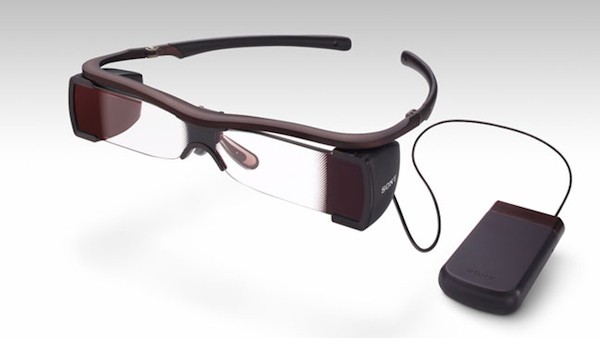 [Philip Lelyveld comment: these head mounted displays can be used for viewing 3D content and for augmented reality. This may help them gain broader acceptance among all consumers.]
We've been hearing about glasses that only display subtitles to those who need them for years (most recently with a trial run in the UK), but it looks like they're now finally about to enter the US market in a fairly big way. Regal Entertainment Group announced today that it's partnered with Sony Entertainment to bring the company's Access Glasses to "practically all" of its digital theaters in the US (that includes the vast majority of its 500+ theaters and more than 4,700 screens in all). Those glasses work with both 2D and 3D movies (the latter courtesy of a clip-on filter), and can provide closed-captioned text in up to six different languages for the hearing impaired, as well as descriptive audio for the visually impaired when they're paired with headphones. According to Regal, the glasses are already rolling out to some theaters this month, and it says they should be everywhere by the first quarter of 2013.
See the original post here:
The next (r)evolution: Audio and the future of the cinema experience

...Now in its 13th year—yes, indeed, it was way back in 1999 when the first DLP Cinema® solutions were introduced to the industry with Star Wars Episode 1—digital cinema is now deployed on more than 50 percent of the world’s 140,000+ screens. ...
Sound from all around
Combining various directional sound sources in an auditorium to recreate sounds as experienced in nature augments the realism of a film’s soundtrack. This concept recognizes the subconscious’s ability to determine the origin of a sound without necessarily seeing the physical occurrence.
A three-layer approach to recreating 3D sound more precisely achieves this effect than the current configurations of 5.1 and 7.1 found in most of today’s cinemas. The lower layer built on traditional 5.1 delivers directs sounds from actions in a horizontal plane around the listener. The second height layer adds important acoustical reflections from around and above the listener…just like we experience in real life. Adding a third layer to relay sounds emanating directly above patrons (used mostly for effects like birds chirping, plane fly-bys, etc.), completes the 3D experience to create a sense of full immersion.
...
Read the full story here: