Epson’s 3D Moverio glasses reviewed
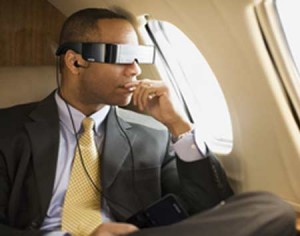 Epson has just released its first generation of see through multimedia glasses, the Moverio BT-100, and we got a pair into the office to try out.
The first thing that strikes you about the glasses is that they are quite bulky and incredibly ugly. In a consumer world filled with beautiful Apple devices, this is already a difficult obstacle to overcome.
Essentially, the glasses project an image in front of you allowing you to watch movies or browse the web whilst still keeping track of your surroundings.
Iain Friar, marketing service manager for Epson UK told us that they’re targeting the device at business travelers. “There are other products out there that are fully immersive but research tells us that users feel threatened using such products in public and the see through nature of the glasses allows you to keep track of things around you and watch the screen simultaneously,” he said.
3D Imaging
The product works very well. The projected screen is designed to emulate the experience of watching an 80 inch screen from five metres away, and although the image didn’t look that big to me it was quite impressive. The QHD display resolution equates to a quarter of full 1080p HD. It comes with Dolby stereo sound and also boasts 3D imaging. The glasses project two separate images to either eye giving the illusion of 3D and it certainly works as well as any 3D television set. The glasses are Wi-Fi enabled and come equipped with a web browser. ...
Big price tag
The final problem is the price tag. ...
See the full story here:
NAB – Dolby/Philips autostereo 3D display (Philip Lelyveld rpt.)
[by Philip Lelyveld]
The centerpiece of the Dolby booth at NAB is a large screen autostereo display prototype jointly developed with Philips. It is the best autostereo display that I have seen to date. The large 4K screen produces the 3D effect via a lenticular overlay and proprietary software. According the Dr. Joop Talstra of Philips, the set takes a normal 2-view feed from a Blu-ray or other source and both interpolates and extrapolates in real time to create 28 views spanning the full 180 degrees in front of the screen. As I moved sideways across stereo pair boundaries the expected distortion was much less than that of other displays I have seen. They did not demo 2D content, but because the lenticular overly is not removable or neutralizable, it will produce a less-than full HD 2D image. Content from Hugo, Captain America, and a Red Bull snow skiing video was used for demo material. High quality Dolby audio reproduction complemented the video.
The Dolby/Philips autostereo technology was also demonstrated on tablet-size and cellphone displays. One of these smaller displays had an active liquid crystal lenticular overlay, so the lens could be neutralized for displaying 2D content. The 3D effect was also adjustable on that device.
There is only one large prototype display unit, and it is being shipped back to the lab after NAB. No shipping dates for any of these units were announced. I was told to expect the smaller screens to be out on the market first, because they are easier to manufacture. Also, the liquid crystal active autostereo overlay makes them more useful for general purpose display situations.
More information is available at http://dolby.com/glassesfree3D
Philip Lelyveld
Innovation & Display Driving TV sales Not 3D
Samsung Australia, who has more than 41% of the Australian TV market, is tonight set to deliver a brand new Smart TV platform they claim is “unequalled” anywhere in the world. They also claim that 3D has become a “mandatory” technology in TVs.
Consumers, who invest in the newSamsung platform which is available on TVs up to 75", will have access to 3D a new voice activated technology, along with the ability to click a picture on a Samsung Wi Fi enabled digital camera or smartphone and see the image it immediately on a TV screen. ...
The TVs which have a video camera built in also have face recognition technology which allows users to stand in front of the TV and, within seconds, their favourites are shown on the screen. It will also open up the right Skype account. ...
See the full story here:
ACE – the Advances in Computer Entertainment Conference
For those looking to justify a business trip to Nepal, this is for you!
ACE 2012 home page http://www.ace2012.info/

Sticker 3D Vision
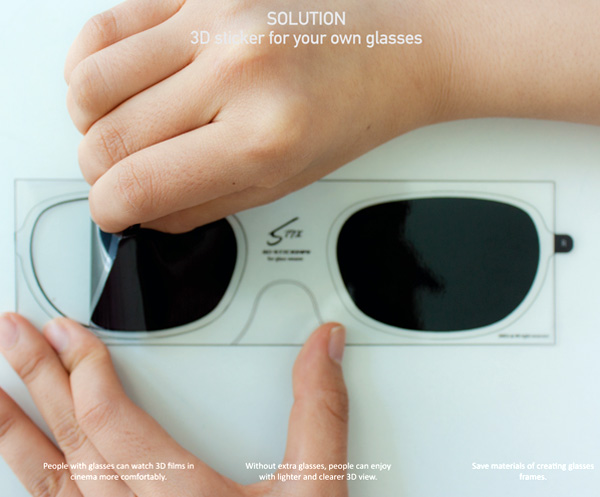 [Philip Lelyveld comment: they appear to have a very dark tint!]
Viewing 3D cinema is a truly gripping experience but for the 3D glasses! Besides being heavy and awkward for those already wearing numbered glasses, they are a material waste and pose a health hazard. Stix offers an easy solution by being a pair of self-adhesive sticker 3D viewing films. Simply slap them onto your current numbered glasses and enjoy your 3D movie.
The stickers are cut out a shape bigger than average glasses to ensure they cover till the rim. The concept’s approach resonates with me, since I wear glasses too and find wearing additional glasses a hassle. Hopefully the sticker in Stix will be easy to peel off and then we are assured of a winner here!
See the full story here;
Digital Cinema Initiatives, LLC, Announces Higher Frame Rate Review
Digital Cinema Initiatives, LLC (DCI), announced today that it is currently reviewing the development of voluntary guidelines or specifications related to the distribution of motion pictures in stereoscopic 3D at frame rates above the current 24 frames per second per eye.
DCI seeks to work cooperatively with industry participants to establish reasonable requirements to maximize quality and interoperability of equipment that can process and project higher frame rate content.
DCI's analysis will consider other system aspects related to frames rates, including compression bit rates, flash rates, and screen luminance when in 3D mode.
See the original press release here:
Pirates romp is Richard’s labour of love
 BRITISH animation studio Aardman’s latest stop-motion masterpiece The Pirates! In An Adventure With Scientists is proving to be another smash hit at the box office – but few viewers will realise just how much work went into producing each scene.
The film took a staggering five years to make. And according to Harlow-born animator Richard Haynes, who has worked for the Bristol-based studio for almost three years, the painstaking production process yielded a mere six seconds of footage per week. ...
Each foot-high puppet used in the film had to be repositioned up to 24 times per second of footage to create the illusion of near-seamless movement, with 33 animators working flat-out to piece together the 88-minute movie – the first of its kind to be shot in 3D.
"As it’s the closest animation gets to live action it’s important to make each puppet’s movement and personality as seamless and believable as possible, especially when the film’s being shot in high-definition 3D," Richard explained. ...
Read the full story here:
Stephen Colbert drills James Cameron about his fears for ‘Titanic 3D’
When James Cameron appeared on “The Colbert Report” Thursday night, host Stephen Colbert didn’t waste much time before voicing a few concerns he had with the filmmaker’s choice of movie content.
“You’re one of these Hollywood elites, OK? Poisoning the minds of our children with your escapist fantasy movies…Case in point, ‘Titanic,’” the talk show host began after introducing himself to the director as the “world’s shallowest” man.
Colbert continued. “That movie, I think, has got a terrible message ...
Watch the video here:
Why Hollywood loves 3D printing
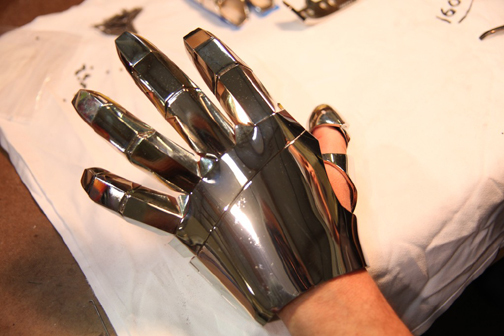 The movie industry is beginning to see how much value 3D printing offers, especially on effects-heavy films that are made with huge numbers of 3D digital models.
If you've seen "Iron Man 2," you've seen 3D printing in action at a very high level.
When director Jon Favreau and Paramount Pictures were making the hit 2010 film, they needed to find the best way to put together a physical Iron Man suit for certain scenes in the movie that couldn't be computer generated.
Rather than build models by hand, as was long the practice in Hollywood, the filmmakers turned to 3D printing, one of the hottest technologies around.
Indeed, in the film's scenes that were done in live-action -- as opposed to CGI (computer-generated imagery) -- its star, Robert Downey, Jr., can be seen wearing a suit that was first digitally modeled, then produced in pieces on a sophisticated 3D printer, and then painted.
Though it's not a technique that's much discussed outside the industry, 3D printing is increasingly being adopted as a way to help make movies more efficiently and quickly than ever, according to Jason Lopes, a system engineer at Legacy Effects, an Oscar-nominated effects studio. ...
Read the full story here: