Lytro camera – Walt Mossberg review
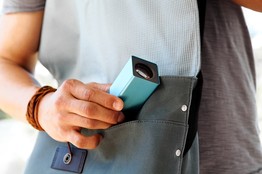 The consumer point-and-shoot camera has just been reinvented—not tweaked, or remodeled, but actually re-thought from top to bottom. A Silicon Valley start-up called Lytro is shipping this week a camera that looks like no other and actually lets you focus or refocus your pictures on a computer after you take them.
Not only that, but the company is promising that pictures you take with the camera today will be able to be manipulated after the fact in additional ways in coming months. For instance, you'll be able to snap into focus everything at once, regardless of depth. Or change the perspective from which the picture is seen, and switch a photo back and forth between 2-D and 3-D. That's why it calls the images "living pictures."
This $399 camera, also called Lytro, can do all this because it is a so-called light-field camera, which is based on a different technology than traditional digital cameras. In simple terms, it uses a modified sensor, plus proprietary software, to capture and process more, and different, information about the light hitting its lens than other cameras do. This includes the direction of light rays. The result is a richer picture file that software, on the camera and on a computer, can use to manipulate images in new ways. Lytro doesn't even classify its camera by the familiar megapixel measure. Instead, the company says it has a resolution of 11 megarays—in other words, it can capture 11 million light rays. ...
But as in most revolutions, there are some downsides and trade-offs to the Lytro, at least at launch. For instance, it doesn't shoot video. Its "living pictures" can't be imported into standard photo software, only to its own accompanying software. And that Lytro software—necessary to store and share the photos—works only on Macs; a Windows version is due later this year. (However, Lytro pictures uploaded from the Mac software to Lytro's photo service, or to Facebook, can be viewed and refocused on Windows PCs and mobile devices via a Web browser.) ...
When I uploaded these pictures via my Mac to Lytro.com, the company's free photo-sharing site, or to a test account on Facebook, I was able to change the focus again—even on a Windows PC or an iPad—and so will my friends who see them. You can email friends links to your Lytro.com photos. ...
The Lytro is an exciting and novel leap in digital photography, but because it still has some missing features, like flash and a file format that works in other software, buyers should consider it a second camera, at least for now.
See the full story here:
World’s First Active 3D LED Projector Launched – SIM2 M.150 is Just £19,995
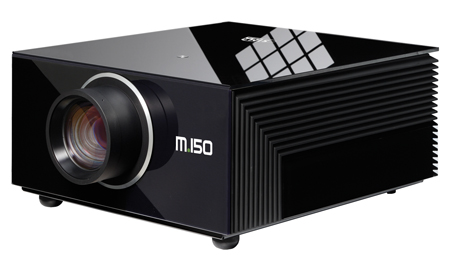 The world’s first Active 3D projector to use LED lighting has gone on sale for a whopping £19,995 apiece.
Italian electronics company SIM2 has crafted the product – the M.150 – to usher in a new era of projector technology. The M.150 uses LED lighting rather than the traditional bulb that is used in nigh on all projectors today, and it offers many advantages.
See the full post here
Everything You Wanted to Know About 3D Printing But Were Too Afraid to Ask
"We can already print semiconductors, and one printer prototype I know can already print batteries — if you have batteries and semiconductors, you have devices.”
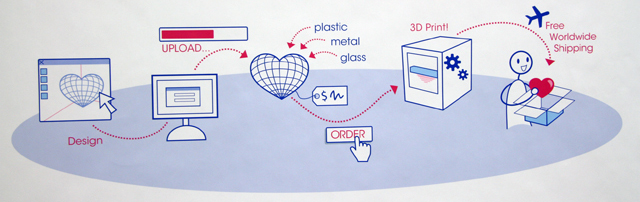
How It Works
What Can Be Printed?
To Print or Not To Print?
The Challenges of 3D Printing
The Future of 3D Printing
What’s in store for 3D printing? Weijmarshausen is adamant that it’s not a need-based business, but a want-based one — you don’t need a 3D-printed bikini, but some people like the idea of cocreation and partaking in the design of the things they own. The items have stories behind them and become conversation starters. So for Shapeways, the mission is to spread that gospel. “We keep growing our proposition to make it easier and more accessible for people,” Weijmarshausen explains.
...
As for the industry as a whole, it’s very much a wild west. “We just got started, we don’t really know what we can do — it’s like the early Internet years, when we couldn’t imagine web browsing or Facebook or Twitter orSkype,” says Weijmarshausen. “We’ll get more exciting materials, we’ll get a mix-up of materials. We can already print semiconductors, and one printer prototype I know can already print batteries — if you have batteries and semiconductors, you have devices.”
Though there are current limitations, a burgeoning 3D-printing industry can let imaginations run wild in the years to come.
“A lot of things — even things we don’t know and that aren’t yet possible — will be 3D printed.”
Read the full post here
Google’s Schmidt gleeful at 3D-capable personal robots
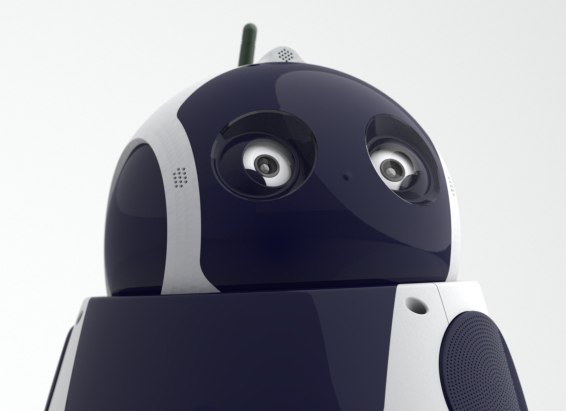
Google chairman Eric Schmidt has presented his vision of the future and technology, describing a world where people have their own personal robot that can represent them remotely and from which they can see a remote 3D visual stream. “We’re beginning to see science fiction become a reality” Schmidt said during his MWC 2012 keynote. ”Look at Star Trek or, my favorite, Hitchhikers Guide to the Galaxy.”
As Schmidt described it, people would have access to compact telepresence robots, small enough to carry in a bag and deploy at will. They would then be able to beam back a 3D picture to a portable 3D-capable screen, part of huge mesh networks of devices talking to each other. “We can look forward to a future of essentially unlimited speed and unlimited processing power … tiny, powerful sensors will be embedded in everything. By 2020, fiber networks will be deployed in every city.”
MIXING POSITIONAL AUDIO AND WEBGL – HTML5 Rocks Tutorial
[Phil Lelyveld comment: this article is a deep dive into HTML5 coding.]
SUMMARY
In this article you learned how to add positional audio to your 3D scenes using the Web Audio API. The Web Audio API gives you a way to set the position, orientation and velocity of audio sources and the listener. By setting those to track the objects in your 3D scene, you can create a rich soundscape for your 3D applications.
To make the audio experience even more compelling, you can use the ConvolverNode in the Web Audio API to set up the general sound of the environment. From cathedrals to closed rooms, you can simulate a variety of effects and environments using the Web Audio API.
Read the full post here:
PRESIDENT OBAMA IS BECOMING QUITE THE 3D FAN
 More recently, the President also reportedly had the film ‘Up’ in 3D screened there.
The White House is pretty tight lipped about what tech is in the White House Theater, but clearly 3D projection is now part of the equipment.
The history of the theater is pretty interesting. The theater was converted from a cloakroom in 1942 during the construction of the east wing. It overlooks the sculpture garden established by Hillary Clinton, and for years had white curtains with a red floral design. In 2004 it was converted to the current bright red color. The first film shown at the White House was ‘Birth of A Nation’ in 1915, but there was no formal theater then.
President Eisenhower loved westerns, and screened more than 200 films during his time in office. A favorite was ‘High Noon’.
President Kennedy loved historical films, and was particularly fond of ‘El Cid’. Before the President left for his fateful appointment in Dallas in 1963, he watched Charlton Heston in ‘55 Days at Peking’.
President Reagan loved ‘The Sound of Music’, while President Clinton was a fan of ‘Fight Club’ and ‘American Beauty’.
As far as I can tell the first 3D screenings have been during the Obama administration. While there was both anaglyphic 3D and the polarized variety available beginning in the 60’s I can’t find any evidence that 3D films were shown at the White House in any format.
Read the full story here:
$350 3D printer may come to your desk sooner than you think
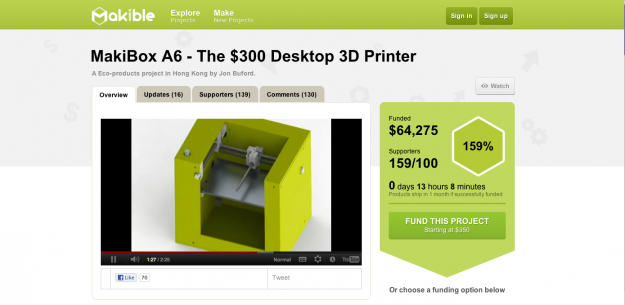 In just one month from today, you can own your own portable and affordable 3D printer at a fraction of the cost of the famous MakerBot printer.
Since its premiere, 3D printers have been make huge progress in a variety of industries, from printing tiny plastic models to prosthetic jaws for medical reconstructive surgeries. Culinary institutions have even tried to 3D print food like cake icing and ramen noodles. But the reason 3D printers have only been in experimentation is because most machines cost upward of $1000. MakiBox wants to change that by affording you the opportunity to own a portable 3D printer for as low as $350.
The MakiBox is currently hosted on Makible, a site similar to Kickstarter but aimed specifically toward craft makers who need funding for their projects.
See the original post here:
We’re Dreaming of a 3D iPad
... Regardless of what happens next week, Apple's been working on 3D screens for years. While the company likely started thinking about how to do 3D way back in the 80s, when Apple emerged as the leading computers for image-manipulation. But the patent applications for 3D technology have only really started flowing in the past three years.
 The most recent 3D-related patent that Apple was awarded basically turns your computer screen into a room that you can play around in. However, in an separate application filed on February 9, the company described new technology as a "three dimensional user interface effects on a display by using properties of motion." In other words, it's a screen that produces 3D images without glasses. How, you might ask? It tracks your eyeball movement. "Once this continuous frame of reference is known, the position of a user's eyes may either be inferred or calculated directly by using a device's front-facing camera," the patent application reads. "With the position of the user's eyes and a continuous 3D frame-of-reference for the display, more realistic virtual 3D depictions of the objects on the device's display may be created and interacted with by the user." (See Figure 8 to the right or check out the full application in PDF format here.) An iPhone is used in the patent application, but an iPad is just one big iPhone. We wrote about some more Apple 3D patents last year, if you're interested in reading more.
This month's application comes in addition to 14 other patents Apple was awarded a couple of weeks before Steve Jobs's death in November. Among them are a couple of mobile 3D screen-related inventions, one of which Patently Apple described as "a patent for Motion Plane Correction for MEMs-Based Input Devices -- which utilizes a form of nanotechnology." In plain English, the blog says that "the invention could equally be used in context with a remote or game pad." ...
See the full post here:
Is The $300 3D Printer Finally Here? Makible Thinks So
MakiBox is a riff on the open source RepRap 3D printer that fits a print head and motor inside a box about the length and width (but not the thickness, silly) of a sheet of paper. The MakiBox kit will start at $350 while an assembled kit will cost $550.
Watch the short video below. See the full story here: http://tinyurl.com/7to24ez
Neonode 3D touch headed to tablets and phones: Hands-on
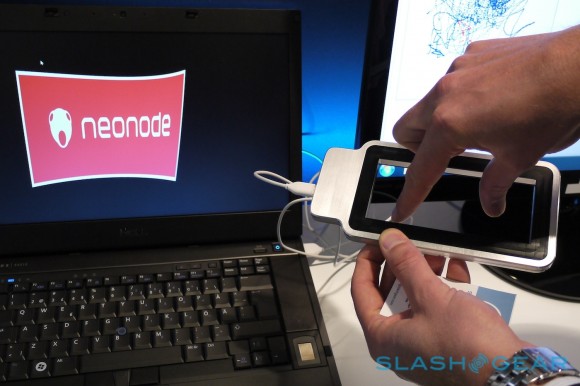 Announced last week, the new finger-tracking kit uses light rather than physical touch sensors: in Neonode’s demo, you can reach through the frame and control on-screen graphics. However, Neonode envisages special cutaway sections showing up on tablets, phones and laptops, allowing us to more precisely interact with the device UI. ...
By layering several of the optical sensors into the body of the new frame, however, the new tech can track far more than just pressure – it can follow motion of two fingers in 3D space. Neonode only develops the hardware technology, not the software – that’s left up to the company’s manufacturing partners...
Neonode says its optical touch sensors are cheaper to implement than even resistive traditional touchscreens, at less than a dollar apiece, and even the new frame version should be a similar price. It’s also artificially thick in this demo implementation: the final design could be as little as 2mm thick. ...
See the full post here: