Aardman Animations moves into 3D with Nintendo 3DS collaboration
 In a world of CGI and digital special effects, the plasticine farmyard of Shaun the Sheep has shown that sometimes it’s better to keep things simple. But, like bringing a combine harvester to a shire horse convention, the series is going hi-tech.
In collaboration with gaming giant Nintendo, the stop-motion characters from Aardman Animations will appear in three dimensions on the 3DS handheld console. On a weekly basis from March 7, 15 one-minute episodes, featuring Shaun, Timmy, Bitzer and The Farmer, will be available to download for free. ...
The one-minute episodes have plenty of harmless adult references, despite being aimed at eight to ten-year-olds. An episode where Shaun turns into a platform-style Super Mario character to an eight-bit soundtrack is a team favourite – even if the idea of making Shaun 2D for a 3D episode seems contradictory.
‘Before 3D, we didn’t have to worry about what we had in the background,’ says Malone. ‘But shooting in 3D, you really can see the space between the characters. ...
I ask Sproxton what kind of games Shaun would play on it.
‘Probably a game involving wool, a knitting game, perhaps, or a grass maze,’ he laughs. ‘It would involve food at some point.’
See the full story here:
Korean LG 3DTV commercial
[Philip Lelyveld comment: watch a recent LG 3DTV commercial with K-pop stars Girls’ Generation and actor Won Bin.]
Microsoft demos Kinect-powered transparent 3D desktop
Researchers at Microsoft's Applied Sciences Group have used a transparent OLED screen, a Kinect and "some software magic" to build a prototype 3D desktop you can manipulate with your hands.
The demonstration shows a pop-up monitor arm, which holds a see-through Samsung display. The user puts their hands behind the screen, and a Kinect -- Microsoft's body-tracking camera for Xbox 360 -- detects finger movements and gestures.
This allows you to rifle through a digital filing cabinet of windows and documents, and use a pinch gesture to make a window fill the screen. ...
The prototype also uses Kinect for head-tracking, so as you look around the screen the 3D perspective changes. This lets you size-up a stack of documents just by tilting your head and seeing how far the digital pile goes into the distance. ...
See the full story here:
3D technology to be used in museums across Turkey
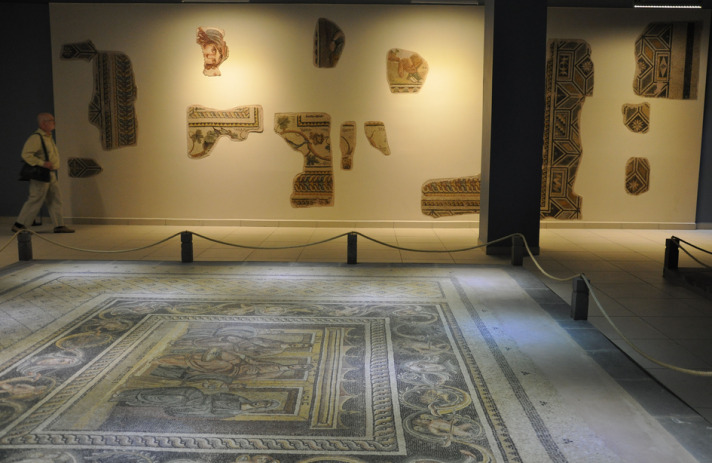 The Ministry of Culture and Tourism announced on its website on Wednesday that it will install three-dimensional visual systems in museums in Turkey to make them more attractive to visitors.
By installing 3D visual effect technology, the Ministry of Culture and Tourism aims to attract more visitors to museums. The first museum that will see this technology installed will be the Zeugma Museum in Gaziantep province, which contains an internationally renowned Turkish mosaic depicting a gypsy girl titled “Çingene Kızı” (Gypsy Girl) that is frequently used in promotional films about Turkey.
Through this new project, museum visitors will be able to see artworks three-dimensionally with the help of 3D simulator glasses. The Ministry of Culture and Tourism has started a bidding process for companies to produce 3D simulator glasses that will be given to visitors to view the artworks in 3D.
After the Zeugma Museum, the ministry plans to install the same 3D technology in two other museums, the Hacıbektaş Külliye (complex) and Archeology Museum and the famous Galata Mevlevihane (dervish lodge) in İstanbul's Beyoğlu district.
See the original post here.
The Basics of Shooting Stereoscopic 3D – Part 5: The Cut-Out Effect, Scene Focus and Viewing Distance
 Conclusion
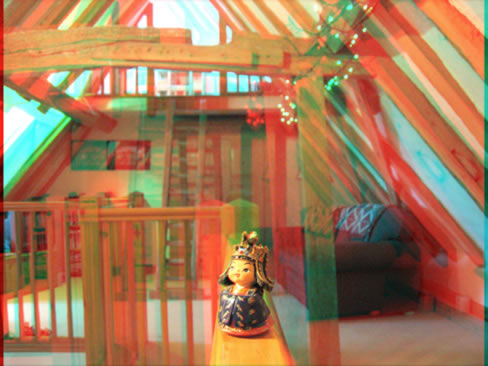
Using long lenses to provide close-ups on distant objects is often unavoidable, but it will result in image foreshortening. However, while it is tempting to increase the interocular distance in order to compensate for this, as I have shown in the above examples, this can in fact make the problem worse.
The issue of focus is even more important with objects in the foreground, as these are closer to the viewer, and the brain knows that these should be clearer than images further away. However, focus can be used to guide the audience to specific locations within the image, as demonstrated on a number of occasions in Martin Scorsese’s film Hugo.
As also shown above, the ratio of the viewer from the screen, based on the screen size, needs to be understood in determining the amount of stereoscopic effect that will be apparent. Again, there are all sorts of calculations for this, but as was stated at the beginning of this series, our industry is about the image, not about strict mathematics!
In my final part of this series next month, I will discuss projection and displays, and headache-inducing problems.
See the full story here:
Technology: Disparity-aware Stereo 3D Production Tools
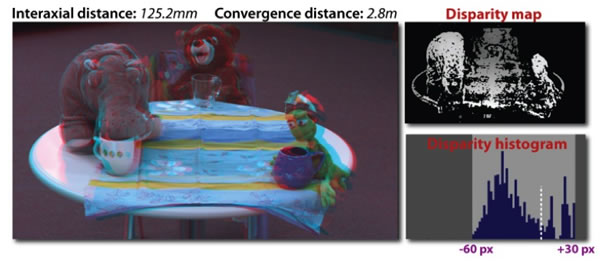 Stereoscopic 3D (S3D) has reached wide levels of adoption by consumer and professional markets. The current success of S3D technology is due to the fact that technology and understanding about content creation has reached a high level of maturity. However, production of high-quality S3D content is still a difficult and expensive art.
S3D production has to consider fundamentals of human 3D perception as well as capabilities and limitations of 3D displays, and combine them with artistic intent. To help with this, Disney Research Zurich has developed advanced S3D production tools, algorithms, and systems, a key component of which is awareness of disparity or depth composition of the input S3D content
Fundamentals and limitations of stereo 3D perception
Computational stereo camera
Stereoscopic analyser
Nonlinear disparity mapping by image-domain warping
Stereo to multiview conversion
Interactive 2D-to-3D conversion using discontinuous warps
Automatic 2D-to-3D conversion for sports
Conclusion
Producing high-quality S3D requires highly-skilled and experienced individuals, and can be an expensive and difficult process. By developing tools for estimating disparity, either by involving some user interaction or being fully automatic, we are confident that we can help in the drive to make the production process easier and keep costs down, while ensuring the best possible experience for the audience.
See the full article with many illustrations here:
3D in Advertising – Bringing the Wow Factor to Campaigns
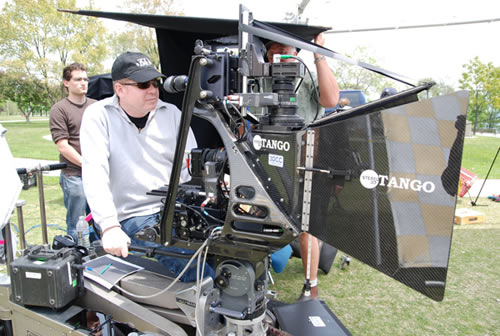 As far as cost, for live-action 3D production, my estimate is 10 to 25 percent above shooting a typical spot in 2D (or a ‘flattie’). For bigger-budget campaigns, 3D will cost less because you have already invested in higher production value. Given the entire workflow is digital (acquisition to post to projection), you can expect some upfront costs here too.
This article is adapted from the article ’3D: It Is Where The Puck Is Headed’, first published in Strategy Magazine.
See the original post here:
Madam Butterfly in 3D, fresh angles
 It is the most subtle of facial gestures that matter when you go to see a live performance. However, when you go to a grand venue and your seat is not at the front of the house for reasons of being tardy in obtaining your ticket or lack of inclination to pay a premium, you will suffer a major blow. You will miss those crucial details.
...
That is why I say opera in 3D cinemas is a good experience and removes the obstacle of distance that is a common opera house problem. And it’s more accessible because of its lower price tag.
Madam Butterfly 3D is such an example. The 3D format – if you can forgive the clunky glasses – creates an intimacy that resembles front row viewing. It goes one level up when the camera hovers overhead and pans across, giving a sensation that wouldn’t be possible for a human being without powers of flying in low speed.
...
This is the second collaboration between London’s Royal Opera House and RealD that captures a live performance with 3D cameras and brings it for worldwide cinema screenings. The first experience was Carmen 3D.
...
Madam Butterfly 3D is directed for cinema by Julian Napier and produced by Phil Streather. The original stage production was directed by Moshe Leiser and Patrice Caurier with costume designs by Agostino Cavalca and set designs by Christian Fenouillat. The music is by Giacomo Puccini and the libretto by Giuseppe Giacosa and Luigi Illica. It was filmed in RealD 3D during live performances at the Royal Opera House in July 2011. It will be released in the UK March 5.
See the full story here
NPD DisplaySearch Finds 3D TV Gaining Momentum in Western Europe and China
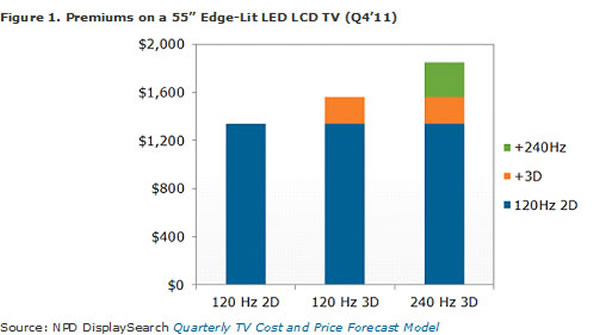 Premiums Falling for LED, 120/240Hz and 3D, but Still High, NPD DisplaySearch Reports
... ”We were surprised to find that 3D appears to be a far more popular feature in China than North America,and the penetration rate was two times higher in the last quarter,” said Paul Gray, Director of TV Electronics Research, NPD DisplaySearch. “Our report also indicates that North American and Japanese 3D penetration is lower than the Middle East.”
The report finds that North American consumers favor large, inexpensive TV sets with fewer features, unlike other regions. Chinese consumers are enthusiastic about richly-featured sets with 3D, LED backlighting and smart TV capabilities. ...
This theme of simultaneous new technology adoption is also clear in digital broadcasting. While developed markets have not only introduced digital terrestrial and largely completed analog switch-off, a second generation of digital broadcast (DVB-T2) is now being adopted in Europe, the Middle East and Asia. ...
”By 2015 the number of DVB-T and DVB-T2 sets shipped will be equal,” added Gray. “The decision by the Russian and Indian governments to move to T2 has given the industry a huge boost in confidence, and it will kick-start a virtuous cycle of rapid adoption and cost reduction.” ...
Read the full story here: