The Next Privacy Crisis
But most of them promise a uniquely powerful combination of three features.
- Their hardware is wearable, hands-free, and potentially always on — you don’t have to grab a device and put it away when you’re done using it
- Their images and audio can blend with or compensate for normal sensory perception of the world, rather than being confined to a discrete, self-contained screen
- Their sensors and software can collect and analyze huge amounts of information about their surroundings — through geolocation and depth sensing, computer vision programs, or intimate biometric technology like eye-tracking cameras
...Writer and researcher Erica Neely says that laws and social norms aren’t prepared for how AR could affect physical space....
Augmentation also doesn’t just mean adding things to a wearer’s surroundings. It also means letting a computing platform capture and analyze them without other people’s consent.
Take facial recognition — a looming crisis at the heart of AR. ...
It’s not clear how AR systems will make money either — and what kinds of behaviors the resulting business models will encourage. ...
Even basic AR applications, like mapping an apartment to place a virtual screen, could potentially gather a huge amount of information. (What’s the size of your living space? Which books are on your shelves? How healthy are the snacks on your kitchen counter?) Without robust privacy protections, it will be incredibly tempting to use that data for ads....
Facebook Reality Labs announced a set of Responsible Innovation Principles designed to allay fears about trust, privacy, and consent that have dogged the company. It also awarded a series of academic grants to study specific issues in AR, selecting proposals like “Social Tensions with Always-available AR for Accessibility” and “Anticipating Virtual Gossip — What are (Un)Intentional Dark Patterns in a Ubiquitously Augmented Reality?” ...
“It’s very typical that developers of a technology have one kind of idea about what its uptake in society might be, and then the actual uptake turns out to be something quite different,” says University of Washington professor and human-computer interaction expert Batya Friedman. A good system is flexible enough to adapt to these unexpected uses. ...
See the full story here: https://www.theverge.com/22746078/ar-privacy-crisis-rethink-computing

The Culture DAO launches the $CULTUR social token at the Virtual Beings Summit
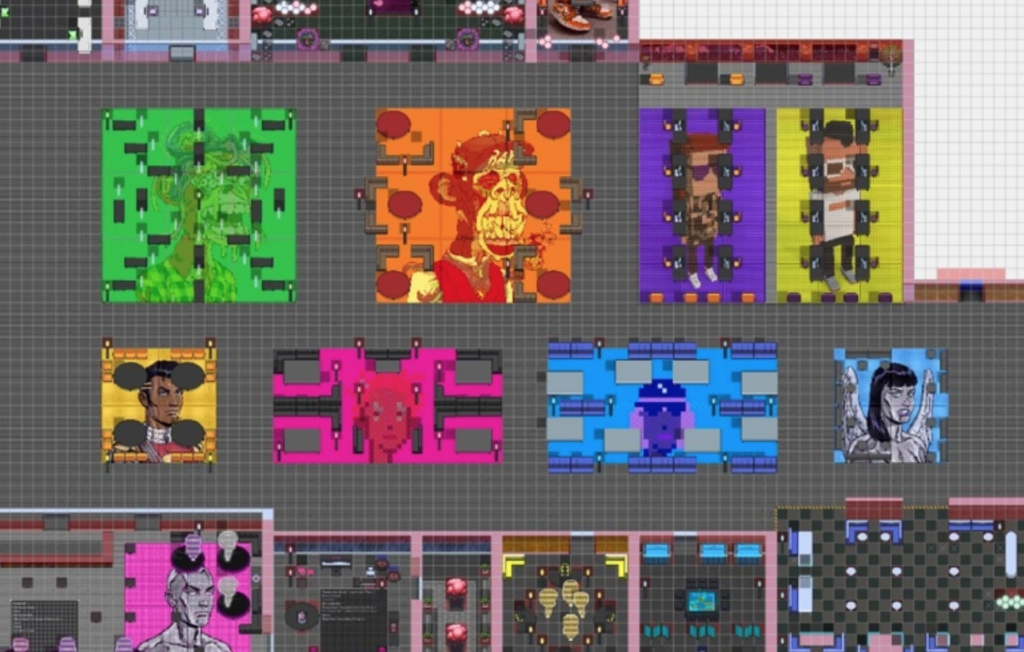
And this year, blockchain culture has invaded the event. The Culture DAO(decentralized autonomous organization) is launching its social token, dubbed $CULTUR, at the event. And that may stir as much talk as the Virtual Beings Summit itself (the event takes place today and tomorrow). ...
DAOs are like companies without leaders. They’re a bunch of people who come together on a project and take ownership of it through control of tokens. The creators get so many tokens. But so do fans and investors and other who acquire tokens. And everybody gets to influence the fate of the project. Edward Saatchi, organizer of the Virtual Beings Summit, believes that these kinds of blockchain-inspired concepts will be intertwined with the success of virtual beings. A DAO, for instance, might create a character as complex as Hamlet and run that virtual being’s life, or it might collectively figure out how to create the next Pixar.
...This guild believes that the resonant characters of the future aren’t being built by centralized studios but by innovative technologists and artists — and fans who are involved in co-creating story of the character NFTs they buy.
...The Culture guild is about the living, digital portraits that the rapidly emerging metaverse class will use to announce themselves and find community in digital societies. The Culture Guild’s role is to create and innovate around virtual beings and this metaverse transition.
...Membership of the Culture DAO and Discord is normally 25 $CULTUR (1 $CULTUR can be swapped for ETH at a rate of around $25 at time of writing) alongside an application process; membership provides access to a token gated Discord with other founders, engineers, academics, artists across the Virtual Beings space as well as the ability to earn through hunting bounties (theculturedao.com/bounties).
See the full story here: https://venturebeat.com/2021/10/29/the-culture-dao-launches-the-cultur-social-token-at-the-virtual-beings-summit/
‘5D’ storage could fit 500TB on a CD-sized glass disc
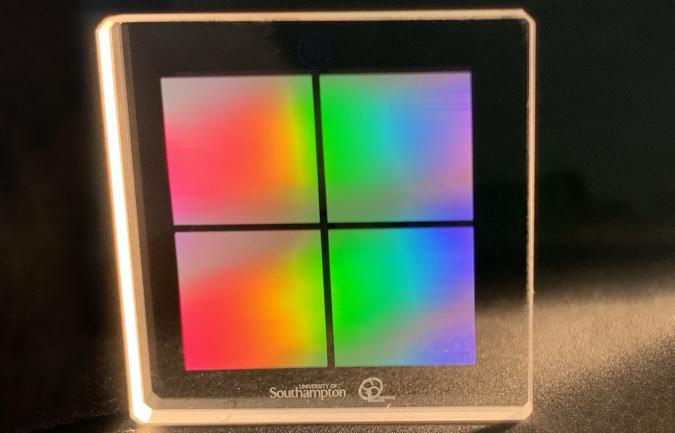
With 5D optical storage, each file is uses three layers of nanoscale dots. The dots' size, orientation and position within the three standard dimensions, make up the five "dimensions." The dots change the polarization of light travelling through the disc which is read using a microscope and polarizer.
...To overcome the speed problem, researchers used a femtosecond laser with a high repetition rate. Rather than writing directly in the glass, they used the laser to produce a phenomenon called near-field enhancement, that creates tiny structures using a few weak light pulses. Those can be used to enhance the circular voids generated by a more powerful, single-pulse "micro-explosion."
...They were also able to write at speeds or around a million voxels per second, or about 230 KB per second.
That might sound slow, but by introducing parallel writing, you could feasibly fill a 500TB disc in about 60 days. That could provide a way to backup reams of valuable data, essentially forever.
See the full story here: https://www.engadget.com/5-d-storage-could-fit-500-tb-on-cd-sized-disc-095039455.html
Market Map of the Metaverse
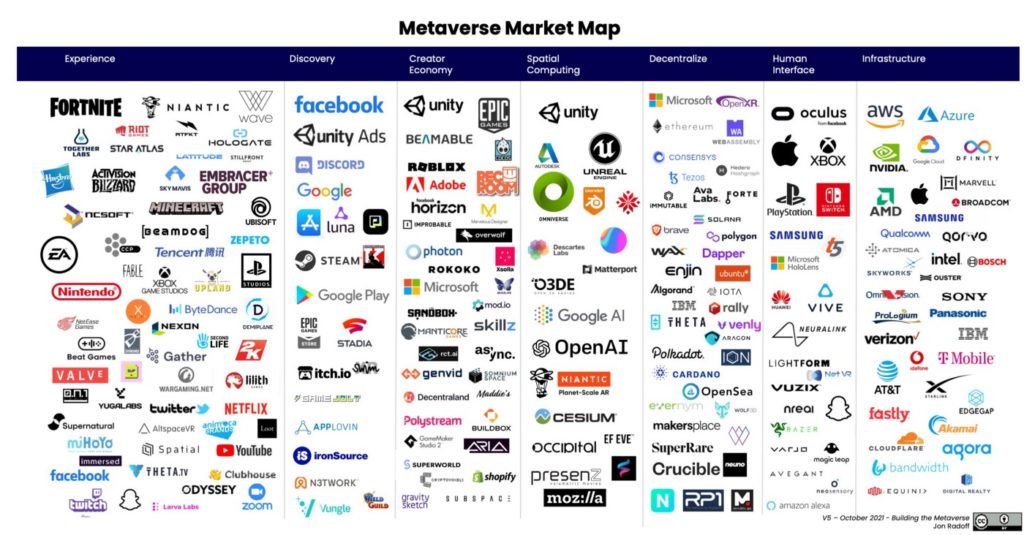
- Experience is what we actually engage with: games, social experiences, live music, etc.
- Discovery is how people learn that an experience exists.
- The Creator Economy is everything that helps creators make and monetize things for the metaverse: design tools, animation systems, graphics tools, monetization technologies, etc. Read The Evolution of the Creator Economy for more insights on how these markets evolve.
- Spatial Computing refers to the software that brings objects into 3D, computing into objects in the world, and allow us to interact with them. It includes 3D engines, gesture recognition, spatial mapping, and AI to support it.
- Decentralization is everything that is moving more of the ecosystem to a permissionless, distributed and more democratized structure.
- Human Interface refers to the hardware that helps us access the metaverse — everything from mobile devices to VR headsets to future technologies like advanced haptics and smartglasses.
- Infrastructure is the semiconductors, material science, cloud computing and telecommunications networks that make it possible to construct any of the higher layers.
See the full story here: https://medium.com/building-the-metaverse/market-map-of-the-metaverse-8ae0cde89696
Patenting the AI pipeline: intellectual property for AI before standardisation
Patenting the AI pipeline: intellectual property for AI before standardisation
[PhilNote: this is an excellent overview of current patent considerations related to AI.]
It seems likely that AI will evolve from a profusion of specific, single-purpose tools into a handful of general-purpose platforms and systems that serve as the bedrock for later development. Given such evolution, it is worth discussing the many different aspects of AI that may provide patentable value all along the AI pipeline. As a starting point, it is useful to examine the industry’s moves towards standardisation and SEPs.
Standardisation
While it remains an open issue, the calls for AI standardisation are both national and international in scope:
- China – the China Electronics Standardisation Institute issued the Artificial Intelligence Standardisation White Paper in 2018, with input from more than two dozen corporations and research entities.
- United States – the National Institute of Standards and Technology has been tasked with developing a plan for US engagement in the development of technical standards and related tools in support of reliable, robust and trustworthy systems that use AI technologies (Executive Order 13859, 2019).
- Germany – the Institute for Standards launched the German Standardisation Roadmap on Artificial Intelligence in November 2020.
- European Union – in 2021, CEN-CENELEC (the European standards associations) established a joint technical committee to develop and support AI standardisation in the European Union.
....
In general, AI-based inventions can be split into three basic categories, each of which has a place in a well-thought-out patenting strategy:
- applications of AI to specific use cases and systems;
- improvements in fundamental AI technologies; and
- AI-supportive technologies, including technologies for managing and storing the data that powers AI systems.
...
AI and patentable subject matter: considerations in some key jurisdictions
At a high level, many jurisdictions require that the subject matter of a patent demonstrate a ‘technical effect’ or a ‘practical application’:
- The European Patent Convention (EPC) prohibits patents that claim a computer program ‘as such’, unless the claimed invention “causes a further technical effect beyond those effects which occur inevitably when any program is run” (the EPC, Article 52).
- In the United States, claims that are directed to a ‘judicial exception’ without ‘significantly more’, are considered patent-ineligible. However, recent guidance from the USPTO suggests that, if a judicial exception is integrated into a practical application, the claim is patent-eligible.
- In China, under guidance released in 2017, a ‘computer program-related invention’ with ‘technical characteristics’ may be eligible for patent protection.
See the full story here: https://www.iam-media.com/patenting-the-ai-pipeline-intellectual-property-ai-standardisation
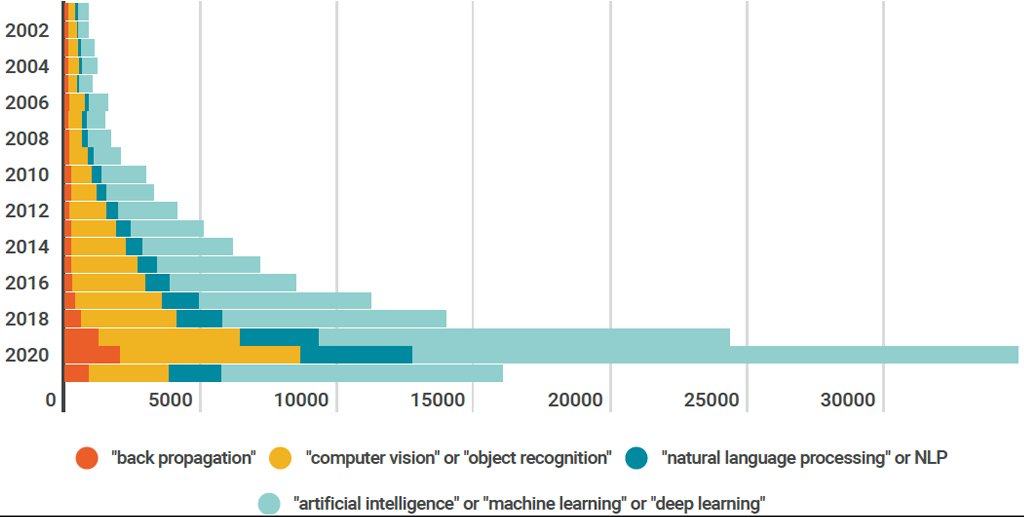
Figure 1. US patents granted each year with AI terms in the description.
This AI Predicts How Old Children Are. Can It Keep Them Safe?
Now London-based digital identity company Yotibelieves its AI-powered age estimation can predict how old someone is if they’re aged anywhere from 6 to 60. For the first time, it claims, it can accurately determine whether children are under or over 13, the minimum age many social media firms require their users to be. ...
Yoti says its age estimation technology, which it has developed over the past three years, has a margin of error of 2.79 years across its total 45-year age range. For under 25s the margin of error drops below 1.5 years.
...The company itself is unsure what facial features its AI uses to determine people’s age. “We have to be honest,” Tombs says, “we don't really know whether it's to do with wrinkles or saggy eyes or quite what. It has just done so many that it is now very good at it.” ...
See the full story here: https://www.wired.com/story/ai-predicts-how-old-children-are/