The new Stanford AI100 report is the second in a series following the inaugural AI100 report published five years ago in September 2016. Stanford plans to continue to publish the A1100 report once every five years for a hundred years or longer.
The vision and direction of the 2021 AI100 report was set by the standing committee members consisting of Chairperson Peter Stone at The University of Texas at Austin and Sony AI, along with Erik Brynjolfsson, Russ Altman, and Percy Liang at Stanford University, Vincent Conitzer at Duke University and the University of Oxford, Mary L. Gray at Microsoft Research, Barbara Grosz at Harvard University, Ayanna Howard at The Ohio State University, Patrick Lin at California Polytechnic State University, James Manyika at McKinsey & Company, Sheila McIlraith at the University of Toronto, Liz Sonenberg at The University of Melbourne, and Judy Wajcman at the London School of Economics and The Alan Turing Institute.
“In the last five years, the field of AI has made major progress in almost all its standard sub-areas, including vision, speech recognition and generation, natural language processing (understanding and generation), image and video generation, multi-agent systems, planning, decision-making, and integration of vision and motor control for robotics,” wrote the researchers. “In addition, breakthrough applications emerged in a variety of domains including games, medical diagnosis, logistics systems, autonomous driving, language translation, and interactive personal assistance.”
“Whereas AI research has traditionally been the purview of computer scientists and researchers studying cognitive processes, it has become clear that all areas of human inquiry, especially the social sciences, need to be included in a broader conversation about the future of the field,” the researchers concluded.
Amazon’s planned department stores will leverage technology to boost clothing sales. The company is testing concepts such as having customers use their phones to scan QR codes of apparel they’re interested in so employees can place the items in a dressing room. Customers could then request alternative items using a touchscreen that may prompt with additional suggestions based on their taste. Amazon is considering opening department stores next year, primarily as a way to sell clothing from Amazon’s private labels as well as select third-party brands that sell on Amazon.com.
“Amazon wants to see if the potential department stores can improve the brand recognition of its apparel while addressing some of the irritants of both online and bricks-and-mortar clothes shopping,” The Wall Street Journal says, noting the dressing rooms may be configured so employees could come and go discreetly, without face-to-face contact, and that eventually “robots or other forms of automation” could be used.
Stanford geophysicist Biondo Biondi says that the waves of energy sent forth by an earthquake cause fiber optic cables to stretch and contract ever so slightly. Using precise mathematical algorithms, experts like Biondi can measure earthquake intensity, making every meter of fiber optic cable a potential seismograph and dramatically increasing the data experts can gather in a day.
The US District Court for the Eastern District of Virginia on Wednesday ruled that an artificial intelligence (AI) machine cannot be an inventor under the Patent Act. The action was a motion for summary judgement concerning two patent applications filed by Stephen Thaler for an AI machine called DABUS.
DABUS was listed as the inventor for Neural Flame—a light beacon that flashes in a new and inventive manner to attract attention—and Fractal Container—a beverage container based on fractal geometry. Thaler’s patent applications were rejected by the US Patent and Trademarks Office (USPTO) and he challenged this refusal as “arbitrary, capricious, an abuse of direction and not in accordance with the law”.
He filed this action seeking a declaration that a patent application should not be rejected only on grounds that there is no natural person identified as the inventor and that a patent application for an invention by AI should list the AI as the inventor when the criteria for inventorship has been fulfilled by the AI.
The court rejected Thaler’s contentions, holding that the definitions provided by Congress for “inventor” within the Patent Act reference an “individual” whose ordinary dictionary and statutory meaning is a natural person or a human being. Further, the usage of personal pronouns such as “himself or herself” and the verb “believes” in adjacent terms modifying the word “individual” makes it clear that Congress was referencing a natural person.
The court acknowledged that Thaler had provided several policy considerations, such as incentivising innovation and its disclosure as well as preserving the value of human inventorship. However, it held that the ultimate decision would lie with Congress.
In July, the South Africa patent office issued a patent listing DABUS as the inventor. Two days later, a federal judge from Australia also held that a nonhuman can be named as the inventor of a patent. However, US federal courts have consistently held that inventors must be natural persons. As AI technology evolves in sophistication, the US lawmakers and the judiciary will be increasingly grappling with the questions of expanding the scope of patent law.
The goal is to create theatrical performances — viewed around the world — that blend AR or virtual reality experiences with live performances in Broadway venues. The project is targeted for completion by next year. ...
“What we are trying to do as we move into the metaverse, as creators and developers, is view the theater as a digital venue, an augmented theatrical venue.” ...
Odeon’s Augmented Theatrical Venue is a physical venue freed from real-world constraints, Riggs said. She said it will transform any location into a stage by seamlessly integrating traditional production elements such as light, sound, and sets with augmented reality content. The platform will work with a range of existing theatrical software and can run on multiple audience-facing hardware platforms, including mobile devices or head-mounted displays. ...
LAST MONTH, STANFORD researchers declared that a new era of artificial intelligence had arrived, one built atop colossal neural networks and oceans of data. They said a new research center at Stanford would build—and study—these “foundational models” of AI.
Critics of the idea surfaced quickly—including at the workshop organized to mark the launch of the new center. Some object to the limited capabilities and sometimes freakish behavior of these models; others warn of focusing too heavily on one way of making machines smarter.
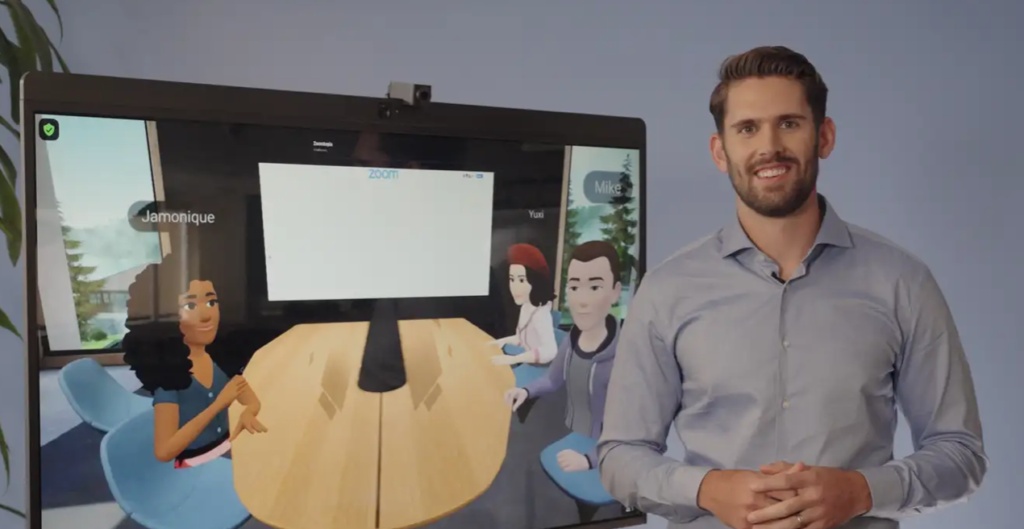
As part of its Zoomtopia 2021 conference, Zoom announced its first move into virtual reality. Zoom’s Whiteboard gives workers the ability to collaborate more effectively online, and the company plans to split it off into its own standalone service. As a result of this, it’ll become available in Facebook’s Oculus Horizons Workrooms. You, your co-workers, and your computer-generated avatars will eventually interact with one another in a stark white virtual conference room. Instead of a mouse cursor, you’ll use your hands to pan around the whiteboard, according to the preview images. Sounds... great.
The company is aiming automatic live transcription support for 30 languages by the end of 2022. The transcription engine will also include translation for 12 languages for paid accounts by the end of next year, though there are no specifics on which would be first.
Advances in machine learning have been spectacular in the last five years. This form of artificial intelligence has led to very significant progress is areas such as autonomous driving, machine translation (to and from multiple languages) and automated text generation.
And yet… Useful as Google Translate is, it still makes some fairly basic mistakes. For example, it correctly renders “the window that I have shut” as “la fenêtre que j'ai fermée”, but incorrectly translates “the key that I have found” into French as “la clé que j'ai trouvé”.
Anyone with a French A-level will tell you that, with the avoir verb, the past participle must agree with the direct object when it precedes the verb. “Clé” is feminine, so the extra ‘e’ is also needed on the end of the participle. Testing with similar examples gives a phrase translation accuracy of around 50 per cent, which isn’t great.
To someone like me who has been working in machine learning (ML) for the past 30 years, this is not surprising. Translation is only as good as the data fed to the ML algorithm during the learning phase. Google Translate has no understanding of French grammar: it learns through brute repetition of exemplar sequences. Evidently there are not enough examples in Google’s training data of phrases with feminine nouns as objects preceding avoir for the correct translation to be given every time.
During the daytime, Dreamverse is an public interactive digital art experience featuring the most prominent NFT artworks and artists in both digital and virtual formats. The Gallery will feature work by over 150 artists, curated by 10 seminal NFT artists, TIME, and Metapurse.
One of the continually cited benefits of “try before you buy” AR and VR product visualization is how it can increase conversions and reduce returns. We’ve covered plenty of proof points for conversions, but return rates have always lingered in theoretical and speculative territory.