Walt Disney Studios’ experimental live action 3D film “Make/Believe” will be shown at NAB in Las Vegas next month. Currently in the final stages of post production, the 10-minute 3D short was shot with a new trifocal camera system. ”Make/Believe” was produced by German research institute Fraunhofer HHI with Disney and Berlin firm Real Life Films using Fraunhofer’s hybrid camera system and software. The film will be shown in the Fraunhofer booth at NAB.
 “The system, which comprises a rig mounted with two satellite mini-cams either side of the main ARRI Alexa camera, is used to record 2D pictures and to generate depth maps for creating stereoscopic 3D in post,” reports Adrian Pennington for TVBEurope.
Benefits of the system include the ability to shoot 3D on the same schedule as 2D. “The second benefit is that compared to native stereo 3D you do not first burn in your target screen size. You can do that in post,” said Tanger. “Also, you can create all 3D creative decisions and adjustments for disparity in post so that you do not need a stereographer on set.”
See the full story here: http://www.tvbeurope.com/main-content/full/first-trifocal-3d-film-on-show-at-nab/#.Uyu88txiBrg
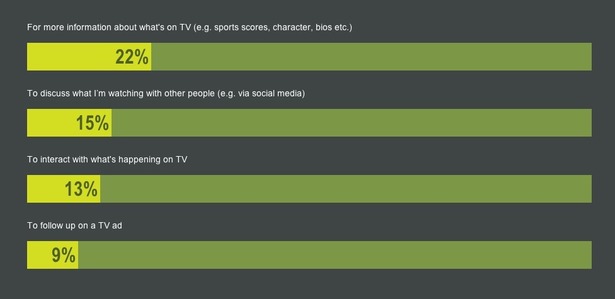
 ...the study also found that only a quarter (24%) of the time spent multiscreening involves looking at related content, which the report refers to as ‘meshing’.
This obviously means that 76% of simultaneous use is spent looking at unrelated content. So basically people are using their smartphones to look at things that have nothing to do with what’s on TV.
As a result then, the report really underlines what most of us suspected anyway, namely that Google and Twitter stand to be the main beneficiaries of second screening.
Millward Brown’s AdReaction study surveyed, via smartphone or tablet, more than 12,000 16-44 year old multiscreen users across 30 countries.
See the full story here: https://econsultancy.com/blog/64538-76-of-second-screeners-aren-t-looking-for-tv-related-content-report?utm_source=2nd+Screen+Authority&utm_campaign=c264ee5ef5-my_google_analytics_key&utm_medium=email&utm_term=0_41ed43776d-c264ee5ef5-87094753
The three features that are vital for viewing forthcoming 4K content from Netflix, Blu-ray, Satellite/Cable and elsewhere are HDMI 2.0, HDCP 2.2 and HEVC.
HDMI 2.0 is the latest version of the High-definition Multimedia Interface. Version 2.0 is backward-compatible with all previous HDMI versions. According to the HDMI organization, 2.0 supports up to 60 fps (frames-per-second) content at 3840 x 2160 resolution. On the audio side, it permits up to 32 channels, 1536-kHz sampling and up to simultaneous streams for multiple users. Other features include simultaneous delivery of dual video streams on the same display; support for 21:9 aspect ratio content and displays; dynamic synchronization of video and audio streams; and expanded command and control.
While UHD content shot at 60 fps doesn’t exist yet (a few PC games excepted), that format is expected to be used for future UHD sports content. However, if your set isn’t HDMI 2.0-capable, you will be limited to viewing UHD at a maximum of 30 fps. Content recorded on film, a medium with sufficient resolution to be converted to UHD, will remain at 24 fps, though it’s anticipated that movies shot with Ultra HD cameras will eventually migrate to 60 fps.
HDCP 2.2 (High-bandwidth Digital Content Protection) is the latest version of the encryption/decryption scheme used by HDMI to prevent copying of audio/video content as it travels from a source through additional devices (an A/V receiver, for example). At present, there is no content containing HDCP 2.2 encryption, though we expect that next-generation 4K Blu-ray discs and players will use it.
While we have yet to get our hands on any HDCP 2.2-equipped gear, we anticipate that some compatibility issues might arise when routing a HDCP 2.2 source like Blu-ray through an HDMI 1.4 or earlier A/V receiver or video switcher.
HEVC stands for High Efficiency Video Coding (also known as H.265). HEVC is said to be about twice as efficient as MPEG-4 coding, which in turn means a higher compression ratio for more manageable streaming of native 4K content. Netflix has already announced that it will provide HEVC-compressed 4K programming to subscribers starting this spring. But here’s the catch: UHDTVs that lack HEVC decoding won’t be able to display 4K content using the set’s built-in app, and will instead require an external HEVC-capable media receiver.
Read the full story here: http://hdguru.com/three-must-have-4k-tv-features/comment-page-1/
“Surprisingly, consumers of alternative news, which are the users trying to avoid the mainstream media ‘mass-manipulation’, are the most responsive to the injection of false claims,” they conclude.
Conspiracy theories seem to come about by a process in which ordinary satirical commentary or obviously false content somehow jumps the credulity barrier. And that seems happen through groups of people who deliberately expose themselves to alternative sources of news.
Of course, there may be other ways that conspiracy theories emerge. Some theories may well be truths that have been deliberately suppressed by higher powers such as governments corporations and so on. But this work reveals that there is also a plausible mechanism through which false stories become thought of as true.
The question now is how to exploit this new understanding to improve the flow and labeling of information, whatever its source.
See the full story here: http://www.technologyreview.com/view/525616/data-mining-reveals-how-conspiracy-theories-emerge-on-facebook/?utm_campaign=newsletters&utm_source=newsletter-daily-all&utm_medium=email&utm_content=20140319
[Philip Lelyveld comment: Its interesting how technology "can't be stopped" when it comes to content piracy, but technology can be stopped when it comes to pornography and hate speech. Selective innovation based on short-term self-interest, rather than long-term thinking.]
Video piracy is on the verge of having its Napster moment. A piece of software appeared last week called Popcorn Time. It makes watching pirated movies as easy as firing up Netflix. Everything is free. There’s no mess or fuss — you press play.
And Popcorn Time isn’t alone. A site called FliXanity essentially cloned Netflix’s look and streams pirated content, albeit at a really low resolution. Another called MovieHive is an Android app that’s a far cry from the selection and ease of use of Popcorn Time. Plus it has ads. But it works. It streams pirated content for free.
See the full story here: http://techcrunch.com/2014/03/17/popcorn-time-is-hollywoods-worst-nightmare-and-it-cant-be-stopped/?ncid=tcdaily
 “For better or worse,” said Steven A. Edwards, a policy analyst at the American Association for the Advancement of Science, “the practice of science in the 21st century is becoming shaped less by national priorities or by peer-review groups and more by the particular preferences of individuals with huge amounts of money.”
This is philanthropy in the age of the new economy — financed with its outsize riches, practiced according to its individualistic, entrepreneurial creed. The donors are impatient with the deliberate, and often politicized, pace of public science, they say, and willing to take risks that government cannot or simply will not consider.
Yet that personal setting of priorities is precisely what troubles some in the science establishment. Many of the patrons, they say, are ignoring basic research — the kind that investigates the riddles of nature and has produced centuries of breakthroughs, even whole industries — for a jumble of popular, feel-good fields like environmental studies and space exploration.
Initially, Dr. Apple said, he, too, saw the donors as superrich dabblers. Now he believes that they are helping accelerate the overall pace of science. What changed his mind, he said, was watching them persevere, year after year, in pursuit of highly ambitious goals.
“They target polio and go after it until it’s done — no one else can do that,” he said, referring to the global drive to eradicate the disease. “In effect, they have the power to lead where the market and the political will are insufficient.”
At times, groups of distinguished experts weigh in on how to advance whole fields, recommending, for instance, the construction of large instruments and laboratories costing billions of dollars.
By contrast, the new science philanthropy is personal, antibureaucratic, inspirational.
See the full story here: http://www.nytimes.com/2014/03/16/science/billionaires-with-big-ideas-are-privatizing-american-science.html?_r=0
 Virtual reality is closely linked to 3-D technology, which has long been used in movie theaters and is spreading rapidly to other applications. Companies such as Valve Corp., famous for its "Half-Life" and "Portal" videogame franchises, developed products for using this technology in videogames. Virtual-reality goggles instead have built-in displays to help convey the effect of entering a simulated world, instead of relying on transparent 3-D glasses for viewing a movie or TV screen.
It's unclear how the market might react to more combinations of goggles and videogames. Consumers have shown little excitement so far about 3-D television, in part because of the need to wear glasses that augment images on the display.
See the full story here: http://online.wsj.com/news/articles/SB10001424052702303546204579439864044706836?mg=reno64-wsj&url=http%3A%2F%2Fonline.wsj.com%2Farticle%2FSB10001424052702303546204579439864044706836.html&fpid=2,7,121,122,201,401,641,1009
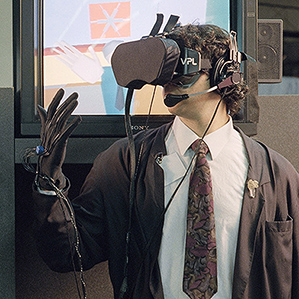 “One recent study demonstrated that an intense and altruistic VR experience such as flying around like a superhero to save a child’s life caused people to be more helpful in the physical world towards someone that had an accident. Another demonstrated that allowing someone to walk a mile in another person’s shoes, for example by using the technology to simulate a visual disability, caused people to increase the amount of time they spent volunteering to help others who are visually impaired.”
See the full story here: http://www.technologyreview.com/news/525301/virtual-reality-startups-look-back-to-the-future/?utm_campaign=newsletters&utm_source=newsletter-daily-all&utm_medium=email&utm_content=20140314
Disney/ABC Television Group, while being totally supportive of 4K shooting and production for its own content, is less keen on 4K/Ultra-HD transmission.
A high-profile broadcasters’ panel at the Satellite 2014 show in Washington DC, heard tepid enthusiasm from two speakers as far as Ultra-HD is concerned. Martin Breidsprecher, CEO of TV Azteca’s Azteca America operation, said he did not see Ultra-HD coming to Mexico terrestrially for five-to-seven years, “and perhaps even longer”. He explained that Mexico was only just embracing HDTV, and the conversion from analogue to digital TV was taking longer – and was more challenging – than expected.
Vince Roberts, EVP/Global Operations & CTO at Disney/ABC Television Group, was also sceptical, saying he did not see 8K taking hold in the US in any sort of time frame. “We have only just converted some of our channels to HD here. The roll-out of UHD-1 or UHD-2 is going to take some time. The way we see it moving is pretty much the way Netflix is going. Cable operators with adequate bandwidth will offer the first iteration [of 4K]. For us to even contemplate a whole channel in 4K… is [difficult], there simply are not enough eyeballs out there to make a business case. Now if a cable or DTH satellite operator offered us a [decent] per month subscription then it might be a different argument.”
Roberts stressed Disney’s library was ready, and top-rated shows such as Criminal Minds were already coming out of ABC Studios in 4K. “We are building that archive. And we don’t feel that we as broadcasters should be subsidising the [display and Consumer Electronics] industry so that they can sell more sets.”
See the original post here: http://advanced-television.com/2014/03/12/disneyabc-cool-on-4k/
 ...the study also found that only a quarter (24%) of the time spent multiscreening involves looking at related content, which the report refers to as ‘meshing’.
 “For better or worse,” said Steven A. Edwards, a policy analyst at the American Association for the Advancement of Science, “the practice of science in the 21st century is becoming shaped less by national priorities or by peer-review groups and more by the particular preferences of individuals with huge amounts of money.”
 Virtual reality is closely linked to 3-D technology, which has long been used in movie theaters and is spreading rapidly to other applications. Companies such as Valve Corp., famous for its "Half-Life" and "Portal" videogame franchises, developed products for using this technology in videogames. Virtual-reality goggles instead have built-in displays to help convey the effect of entering a simulated world, instead of relying on transparent 3-D glasses for viewing a movie or TV screen.