Structure Sensor: iPad 3D Scanner that can capture a whole room!
The Structure Sensor can be used on anything and you don’t have to stand still or place an object into a 3D scanner machine. This device is added on to your iPad, and you can literally walk around and scan entire objects or environments down to the smallest detail. Not only does it scan, meaning creating a wireframe mesh out of the things it sees, but it textures it naturally so it looks like a photorealistic copy of the real thing at the same time. It is a mind-boggling thing to see and to think that it is all possible with a little device added onto your iPad is just an unearthly feeling.
The Structure Sensor is currently being refined and perfected for the consumer market but you can pre-order it over at Occipital, the developer of the device, for the price of $349.00.
See the full story here: http://www.bitrebels.com/technology/structure-sensor-ipad-3d-scanner/
New Display Panels from AUO Spark Speculation of 4K Apple Displays
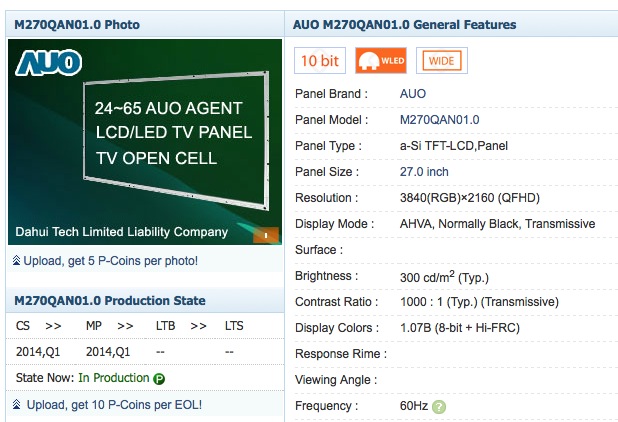 Also in question is whether Apple would even use 16:9 3840 x 2160 panels for a 4K display, as some have suggested that the company may prefer to push Thunderbolt 2 to its limit and support the wider 4096 x 2160 "Cinema 4K" standard given that the display will undoubtedly be targeted at professionals, many of whom in the film industry will be working with content using that resolution standard adopted for film production.
See the full story here: http://www.macrumors.com/2013/11/26/new-display-panels-from-auo-spark-speculation-of-4k-apple-displays/
‘Gravity’ Short Film ‘Aningaaq’ Reveals Other Half Of Key Scene
[Philip Lelyveld comment: this is brilliant transmedia content that doesn't scream - hey, I'm transmedia content.]
 "Gravity" fans interested in a look at larger world created by the film would be wise to check out co-writer Jonas Cuaron's short film, "Aningaaq." THR.com debuted the short on Wednesday, which shows what happens on the other end of a key conversation that distressed astronaut Ryan Stone (Sandra Bullock) has during the course of the blockbuster feature.
"They're having a conversation, but they don't understand each other," director Alfonso Cuaron, Jonas' father, told HuffPost Entertainment about "Aningaaq" before the release of "Gravity." Indeed, Jonas' film focuses on an Inuit fisherman living in Greenland. (Subtitles are provided in the short film, but not in "Gravity"; whether knowledge of his attempted communication with Stone deepens the meaning of the scene will depend on the individual viewer.)
See the complete short video here: http://www.huffingtonpost.com/2013/11/20/gravity-short-film-aningaaq_n_4310647.html?ref=topbar&utm_hp_ref=fb&src=sp&comm_ref=false
Apple filed five Liquidmetal patents, two are 3D printing related #3DThursday #3DPrinting
[Philip Lelyveld comment: I'm pretty sure that there is prior art for both of these filings. Maybe they're just trying to see what they can get past the reviewers.]  The US Patent & Trademark Office published today a new series of five Liquidmetal patent applications from Apple which were originally filed in Q2 2012. Two of Apple’s inventions are related to 3D printing. They are methods of construction a part with build metallic glasses (BMG – Liquidmetal) layer by layer.
In one embodiment, a layer of BMG powder is deposited to selected positions and then fused to a layer below by suitable methods such as laser heating or electron beam heating. The deposition and fusing are then repeated as need to construct the part layer by layer. One or more layers of non-BMG can be used as needed. In one embodiment, layers of BMG can be cut from one or more sheets of BMG to desired shapes, stacked and fused to form the part.
Another method is to selectively deposite molten bulk metallic glass (BMG). In one embodiment, a continuous stream or discrete droplets of molten BMG is deposited to selected positions. The deposition can be repeated as needed layer by layer. One or more layers of non-BMG can be used as needed.
See the full story here: http://www.adafruit.com/blog/2013/11/21/apple-filed-five-liquidmetal-patents-two-are-3d-printing-related-3dthursday-3dprinting/
Google’s Vint Cerf defines Internet of Things challenges
 He also listed seven key challenges facing the Internet of Things, including:
- Standardized interfaces - such as IPv6
- Configuration of massive of amount devices
- Strong access control and authentication
- Privacy and safety
- Instrumentation and feedback
- Dealing with software errors vulnerabilities and software updates
- Potential opportunities for third party businesses
For its part the FTC was looking for answers to its own key questions: For example:
- What are the significant developments in services and products that make use of this connectivity (including prevalence and predictions)?
- What are the various technologies that enable this connectivity (e.g., RFID, barcodes, wired and wireless connections)?
- What types of companies make up the smart ecosystem?
- What are the current and future uses of smart technology?
- How can consumers benefit from the technology?
- What are the unique privacy and security concerns associated with smart technology and its data? For example, how can companies implement security patching for smart devices?
- What steps can be taken to prevent smart devices from becoming targets of or vectors for malware or adware?
- How should privacy risks be weighed against potential societal benefits, such as the ability to generate better data to improve health-care decision-making or to promote energy efficiency?
- Can and should de-identified data from smart devices be used for these purposes, and if so, under what circumstances?
See the full story here: http://www.networkworld.com/community/node/84296/
CES 2014: 3D Printing Ready to Dominate in Las Vegas
 While 3D printing is a technology with endless possibilities, it will also present ethical challenges. Those issues will be on display at CES 2014.
Since 3D printing promises to send a lot of our heads spinning with possibilities and potential problems, CES 2014 will feature Bre Pettis, CEO and co-founder of MakerBot, as a keynote speaker.Pettis has led MakerBot as CEO since its beginning in 2009 and helped to build the company into a leader in desktop 3D printing.
See the full story here: http://www.craveonline.com/lifestyle/articles/606435-ces-2014-3d-printing-ready-to-dominate-in-las-vegas