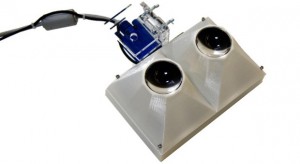
 For the sheer variety of virtual reality headsets available, there's been few resources available for those who want to craft their own devices. USC wants to save us the effort of searching around. Its MxR Lab has just launched a showcase of creations and modifications that DIY enthusiasts can build, including open source code for both the devices and integrating full-body motion control throughKinect for Windows or OpenNI. The most ambitious is Socket HMD, a complete 1,280 x 800 headset that involves a 3D-printed shell and custom-assembled electronics. If your own ambitions don't stretch that far, you can still build the VR2GO viewer, which uses iPhones and iPod touch players as the eyepieces, as well as mods for the Oculus Rift developer kit that add stereo cameras or increase the field of view. Yes, you'll need a 3D printer and a knack for programming to get most of these projects going, but you won't have to wait for someone to make them for you -- a big help when many ready-made VR displays are either in development or priced out of reach for the average person.
See the full story here: http://www.engadget.com/2013/03/17/usc-starts-a-web-hub-for-diy-open-source-virtual-reality-projects/
Disney D23, the official Disney fan club has announced it will be letting its members be amongst the first to experience Disney’s new ‘Second Screen Live’ experience at a special screening of Tim Burton’s Nightmare Before Christmas at the Palms Casino Resort in Las Vegas, NV on April 15, 2013.
Although the event is free to members and their guests, each attendee must bring a personal iPad will be required to partake in the ‘Second Screen Live’ experience. Using the iPad, there will be special challenges, speed trivia, sing-alongs and more for the chance to win prizes and play against other fans in the audience. The required app will be emailed to participants who successfully sign up when tickets become available March 20 at 1 pm PT. As is the custom, guests will also receive a special gift for attending the event.
See the original post here: http://www.stitchkingdom.com/disney-second-screen-live-d23-61439/?utm_source=2nd+Screen+Authority&utm_campaign=508fd7173a-my_google_analytics_key&utm_medium=email
President Obama met with an invited group of 13 chief executives at the White House on Wednesday to discuss growing concerns about cybersecurity and enlist them to get behind his proposed legislation to combat the threat of computer warfare and corporate espionage.
Among those present were Rex W. Tillerson of Exxon Mobil, Randall L. Stephenson of AT&T, Wesley G. Bush of Northrop Grumman, Brian T. Moynihan of Bank of America, and Jamie Dimon of JPMorgan Chase, which had been attacked by foreign hackers as recently as Tuesday.
White House officials said the meeting in the White House Situation Room was intended as a “two way” information exchange. Aides said Mr. Obama wanted to hear directly from industry leaders about how vulnerable their companies were to computer attacks. The president also wanted to discuss efforts the government was taking to address threats.
See the full story here: http://bits.blogs.nytimes.com/2013/03/13/obama-discusses-computer-security-with-corporate-chiefs/
The Mobile Symphony Orchestra in Alabama introduced its “tweet seats” late last year during a performance of Beethoven’s Eroica symphony. The seats are located in the back row of the auditorium and are made available to those who wish to text or tweet during the performance. This type of move is representative of many arts organizations’ attempts to encourage audiences to engage technologically with performances.
“That means prepping your audience ahead of time, debriefing them afterwards, and giving them opportunities to comment or participate as well as observe. In some cases, audience engagement means inviting people to sing, play, or dance along with the performers; in others, to split their attention between the stage and (very small) screen,” the article explains.
See the full story here: http://www.psmag.com/culture/arts-organizations-twitter-live-tweet-interaction-53746/
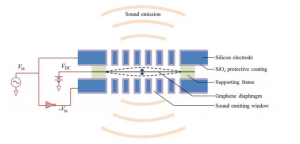 Most loudspeakers work using a diaphragm that creates pressure waves in air by mechanically vibrating. “For human audibility, an ideal speaker or earphone should generate a constant sound pressure level from 20 Hz to 20 kHz, ie it should have a flat frequency response,” say Qin Zhou and Alex Zettl who are both at the University of California, Berkeley.
Today, these guys unveil an earphone-sized speaker that more or less matches this requirement. What’s unusual about this speaker is that the diaphragm is made from a few layers of graphene, the carbon chicken-wire material that is revolutionising everything from transistor design to particle physics experiments.
The new speaker is simple. It consists of a graphene diaphragm sandwiched between a couple of electrodes that create an electrical field. When this field oscillates, it causes the the graphene to vibrate too and this generates sound.
See the full story here: http://www.technologyreview.com/view/512496/first-graphene-audio-speaker-easily-outperforms-traditional-designs/?utm_campaign=newsletters&utm_source=newsletter-daily-all&utm_medium=email&utm_content=20130314
 Wilde was in Austin to promote her romantic comedy “Drinking Buddies” and noted that serving as a producer on the film made her more aware of the need for social media engagement. “It really allows me to be a more effective producer,” she said. “It becomes the responsibility of everyone involved in a film, particularly a small film, to speak up for it.”
Wilde, whose Twitter account has 815,000 followers, said “you feel you are launching the film from your personal social networking space. It’s changed everything in terms of feeling responsible for a small film.” Janego added: “…one of the first things we do once we are working on a film is reach out to the cast and crew and ask them about engaging their various followers.”
See the full story here: http://www.hollywoodreporter.com/news/sxsw-olivia-wilde-kicks-panels-427130
Panelists from the company spoke about the need to monetize mobile, as more than 50 percent of its views are coming from mobile devices, negatively affecting revenue streams. Additionally, “studios like Maker, even with their enormous number of page views, are realizing that they need to become even bigger to compete with television. The reason? Advertisers believe they need to hit all those eyeballs in a short time frame for maximum impact,” explains the article.
“One irony of Maker’s success, though, is that the YouTube system has in many ways become as impossible to break into as Hollywood’s,”...
See the full story here: http://www.hollywoodreporter.com/news/sxsw-maker-studios-execs-turning-427405
[Philip Lelyveld comment: This is a BRILLIANT use of technology for social good. Use a silly telephone game to teach an illiterate population how to use customer service commands (press # for...), and then give them audio job listings which they can search using the same commands.]
In Pakistan, researchers are using a silly voice game to motivate hundreds of thousands of people to master an automated voice system—and then move on to scroll job listings this way, too.
The effort, led by researchers at Carnegie Mellon University and Pakistan’s Lahore University of Management Sciences, started last May, when just five people in service jobs at Lahore University were given a phone number to get started playing the game. As of this week, the game has more than 156,000 users involving nearly 600,000 calls, including 27,000 inquiries to a job service, all of it sustained by viral spreading alone.
In the game, called Polly, a person calls the game’s phone number and the system calls right back, gives commands to record a message to a friend, plays it back with funny effects added, and allows the person to forward the goofy version to a friend, all in the native Urdu language.
Doing this means following voice and key commands: you are instructed to say something, after which you must press #. After hearing the funny effect, you press 1 to hear it again, 2 to send it to a friend, 3 to try another effect; to send the funny message to your friend, you must enter the friend’s phone number and press #.
Thus, the user has just been trained in the basics of using a customer service line or other automated voice system. And after hooking users, the researchers scanned Pakistani newspapers for jobs appropriate to low-skilled, low-literate workers, recorded them in Urdu, and made them available for audio-browsing. In just four months, users forwarded listings to friends 22,000 times.
See the full story here: http://www.technologyreview.com/news/512156/viral-phone-game-helps-illiterate-pakistanis-find-job-listings/?utm_campaign=newsletters&utm_source=newsletter-daily-all&utm_medium=email&utm_content=20130313
Tony DeRose, Pixar’s senior scientist, gave a lecture on “Math in the Movies” at New York’s Museum of Mathematics. His job consists of translating principles of arithmetic, geometry and algebra into computer software that can render objects or power physics engines. He gave the talk in part to explain why aspiring animators and game designers need to have a solid base in mathematics.
 DeRose has far more than just a basic understanding of math. He earned a PhD in computer science, focusing on computational physics and spent a decade as a professor of computer science and engineering at the University of Washington.
“Computer animation, DeRose says, frequently deals with modeling objects at greater scale and detail than even physicists typically deal with in their computations,” ... Thus, most of his work revolves around finding better algorithms to create that type of scale efficiently.
See the full story here: http://www.theverge.com/2013/3/7/4074956/pixar-senior-scientist-derose-explains-how-math-makes-movies-games
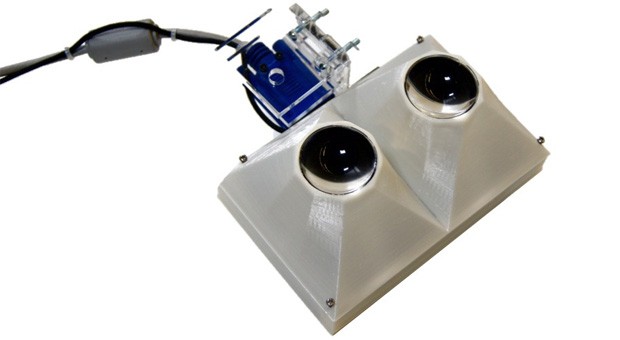 For the sheer variety of virtual reality headsets available, there's been few resources available for those who want to craft their own devices. USC wants to save us the effort of searching around. Its MxR Lab has just launched a showcase of creations and modifications that DIY enthusiasts can build, including open source code for both the devices and integrating full-body motion control throughKinect for Windows or OpenNI. The most ambitious is Socket HMD, a complete 1,280 x 800 headset that involves a 3D-printed shell and custom-assembled electronics. If your own ambitions don't stretch that far, you can still build the VR2GO viewer, which uses iPhones and iPod touch players as the eyepieces, as well as mods for the Oculus Rift developer kit that add stereo cameras or increase the field of view. Yes, you'll need a 3D printer and a knack for programming to get most of these projects going, but you won't have to wait for someone to make them for you -- a big help when many ready-made VR displays are either in development or priced out of reach for the average person.
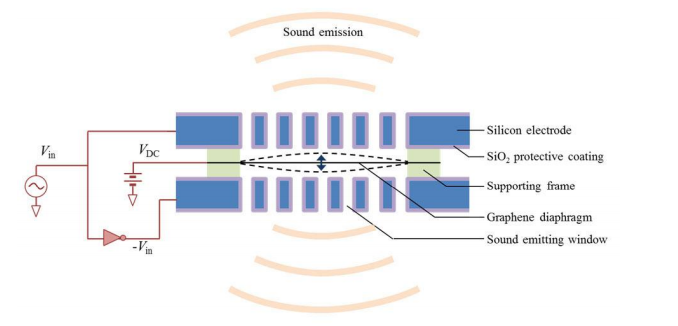 Most loudspeakers work using a diaphragm that creates pressure waves in air by mechanically vibrating. “For human audibility, an ideal speaker or earphone should generate a constant sound pressure level from 20 Hz to 20 kHz, ie it should have a flat frequency response,” say Qin Zhou and Alex Zettl who are both at the University of California, Berkeley.
 Wilde was in Austin to promote her romantic comedy “Drinking Buddies” and noted that serving as a producer on the film made her more aware of the need for social media engagement. “It really allows me to be a more effective producer,” she said. “It becomes the responsibility of everyone involved in a film, particularly a small film, to speak up for it.”