Holographic Nanoscale Microscopy Allows Watching Living Cells in 3D
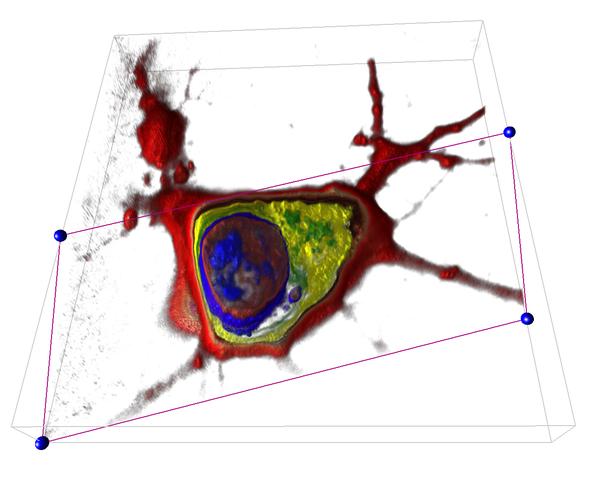 Real time observation, of living cells, in 3D, and at the nanoscale - this are the incredible and groundbreaking features of a new holographic microscopy prototype developed by two young scientists at the Swiss Technology University EPFL.
In the world of microscopy, "this advance is almost comparable to the leap from photography to live television." Going beyond conventional microscopes by using a low-intensity laser for scanning combined with advanced computational image processing, it can acquire images of living cells in just a minute (and becoming much faster still as it is further developed) at a resolution of less than 100 nanometers — without using contrast dyes or fluorescents, to avoid distortion by the presence of foreign substances.
Being able to capture a living cell from every angle like this lays the groundwork for a whole new field of investigation. “We can observe in real time the reaction of a cell that is subjected to any kind of stimulus,” explains researcher Yann Cotte.
See the full story here: http://www.scienceworldreport.com/articles/4893/20130211/holographic-microscopy-nanoscale-watching-living-cells-3d.htm
Erik Huggers: Intel will launch its own TV service this year
 Intel Media boss Erik Huggers finally broke his silence about the company’s TV plans at All Things Digital’s Dive into Media conference in Dana Point, California Tuesday, confirming reports from GigaOM and others that the company is working on a TV service, which it plans to launch later this year.
The offering will include a consumer electronics device, which Intel will sell through retailers as well as through its own website. “It is an Intel-powered device… with beautiful industrial design,” he said.
But the device is only part of the package. It will be paired with a TV service run by Intel that is going to launch under a new brand, which has yet to be revealed.
See the full story here: http://tinyurl.com/ayq8y49
MIT INITIATIVE EXPLORES IMPACT OF EMERGING DIGITAL ECONOMY
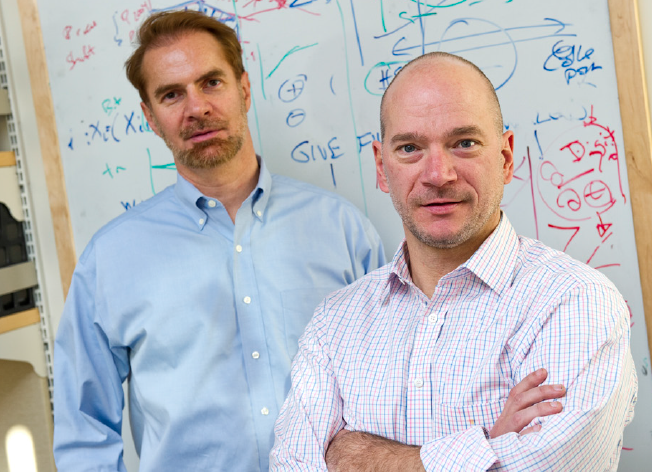 MIT has launched the new “Initiative for the Digital Economy” to address the impact of existing and emerging digital technologies. The initiative’s three primary objectives are to analyze the potential of digital technologies to change businesses, the economy, and society; to engage students and faculty in programs related to the digital revolution; and to make practical recommendations to industry leaders and policymakers regarding the digital economy.
“The physical and the digital now blend into each other over porous boundaries, as people, institutions and things are all becoming interconnected. A 21st century digital economy is indeed now emerging in this hyperconnected, inclusive, and increasingly smart world,” writes guest contributor Irving Wladawsky-Berger for the Wall Street Journal.
...this Initiative has three main goals:
1. To rigorously analyze the potential of digital technologies to transform businesses, the economy, and society;
2. To engage students and faculty in educational programs relevant to the digital revolution, keeping MIT Sloan at the forefront of management education;
3. To make grounded recommendations to industry leaders and policymakers about the digital economy and job growth.
Read the full press release here: http://digital.mit.edu/ide/initiative/init.v2.pdf
Read the WSJ article here: http://blogs.wsj.com/cio/2013/02/02/the-economy-may-face-technological-unemployment/
Return to Oz – DISNEY AND GOOGLE LAUNCH STUNNING IMMERSIVE CHROME PROJECT
 Google and Disney have teamed with UK app and Web developer Unit 9 to launch a Chrome Experiment to promote Disney’s upcoming film, “Oz the Great and Powerful.” Wired describes it as “Hollywood marketing machine meets tech evangelism in the future of online storytelling.” The project illustrates “the sort of immersive experiences possible when using Web technologies such as WebGL, CSS3, WebAudio, WebRTC, and other HTML5 tools.”
See the full story here: http://www.wired.com/gadgetlab/2013/02/disney-google-chrome-find-your-way-to-oz/
The Startup Slumber Party: How Living With Your Cofounders Can Save Your Company
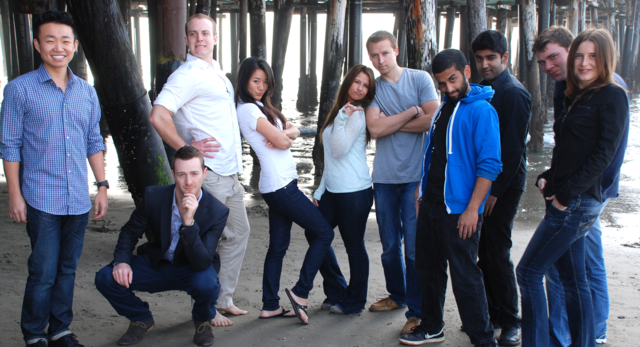 [Philip Lelyveld comment: this interesting approach to a startup is part permanent retreat, part extended college experience, and part sweat shop.]
What happens when an 11-person startup team decides to cohabitate? "I actually think the company would have failed if we didn’t live together," says CEO Nanxi Liu.
Almost all the employees are engineers under 25, a heavily sought-after demographic for corporate recruiters, head-hunters, and other startups looking for technical founders. While many startups struggle to keep their teams together, Enplug decided to align their personal lives with their work so much that togetherness is a non-issue. In doing so, they've taken on the risks of being too cramped, too personal, and too vulnerable in front of their teammates--a gamble they say has paid big dividends for their nascent company culture. “We’ve all been poached at least once," says CEO Nanxi Liu. "Our CTO was offered a corner office by a gaming company. He told them, I actually have a great office: It’s my house in Bel Air.”
See the full article here: http://www.fastcompany.com/3005041/startup-slumber-party-how-living-your-cofounders-can-save-your-company
Coming and Going on Facebook
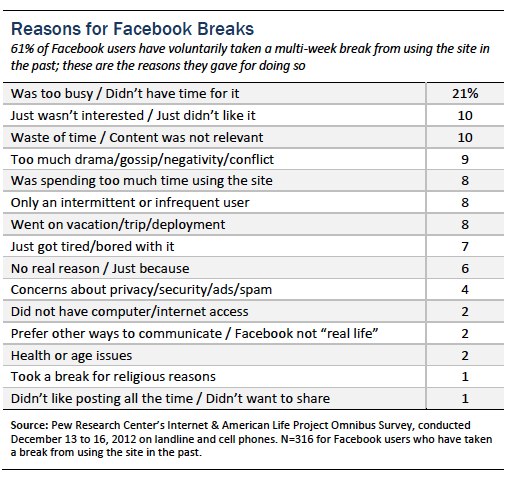 About two-thirds (67 percent) of American adults currently use Facebook according to the Pew Research Center’s Internet & American Life Project. The research also indicates that 61 percent of current Facebook users have voluntarily taken a break of at least several weeks from the social network in the past, and 20 percent of the non-Facebook using adult population (or about 5 percent of the total adult population) once used Facebook and now do not.
See the full report here: http://www.pewinternet.org/Reports/2013/Coming-and-going-on-facebook/Key-Findings.aspx