Microsoft Research crafts wrist-worn device that tracks hand gestures in 3D space (video)
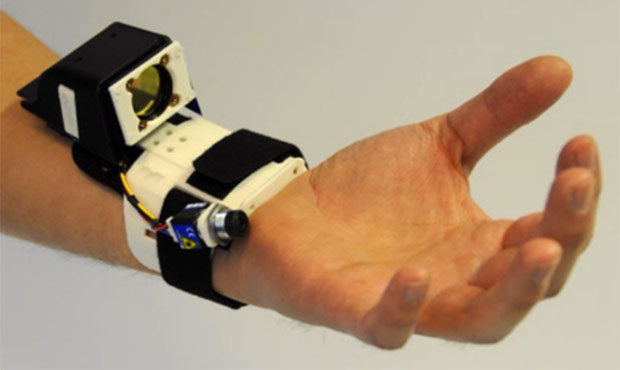 A team led by researchers at Microsoft's UK-based R&D lab has crafted a system that tracks the full 3D pose of a user's hand without the need for a pesky glove. Dubbed Digits, the Kinect-inspired rig latches onto a user's wrist and utilizes a diffuse infrared light, IR laser, camera and inertial measurement unit to track fingertips and just five key points of a hand.
Digital Out-of-home Entertainment Network Association Conference stresses Immersion, Engagement, and Creativity
[This story is permanently posted as a pdf here.]
By Philip Lelyveld
Representatives of all parts of the Digital Out-of-Home Entertainment (DOE) Industry met last week at the second annual DOE Network Association (DNA) Conference, held at USC’s Davidson Conference Center. Many of the attendees are involved in pressing the limits of digital technology and physical design to greatly expand the storytelling and engagement possibilities of out-of-home venues.
The DOE industry defines itself as covering the professional theme park, educational and edutainment (museums, visitors centers, science centers), arcade, retail and mall advertising and enhancement, ‘exergaming’ (workout experiences), and other public pay-to-play, ticketed, and free entertainment experiences. These experiences span the spectrum from fully real, physical equipment and spaces such as hands-on museum ‘sandbox’ exhibits, to fully virtual immersive gameplay.
Consultant Randy White of White Hutchinson Leisure gave some troubling statistics specific to the arcade industry. While other forms of discretionary entertainment spending, such as movie attendance, has been holding relatively steady, 60% of arcade dollars have shifted to home entertainment and ‘stay-cations’ in the last five years.
BMI Gaming’s David Young said that one of the arcade industry’s responses has been to encourage and recognize innovation through an international design competition. This year’s winner was Speed of Light; a vertical, button-based, two-player version of wack-a-mole with a lot of flashing lights.
Americans go to the movies on average 4 times per year. But they eat out approximately 167 times per year. Dining is a highly social experience. The top 20% of income households account for 48% of out-of-home spending. Mr. White recommended that arcades redesign their facilities to attract this upscale market with restaurants, wifi-equipped lounges, and games that allow for more group social and competitive activities. One audience member noted that this would redefine the businesses that arcades compete with to include coffee shops, shared work spaces, hotel lobbies, and other social gathering spots.
Kevin Williams, the organizer of the DNA conference, spoke forcefully of the DOE industry’s need to embrace technology to a far greater degree than it has to date. There is no reason, he argued, why devices could not recognize players when they return to a facility, coordinate communications as they interact with devices throughout the facility, and – if they opt-in – connect them with people who have similar interests and skill levels anywhere on the planet. The technology already exists to offer experiences outside of the physical environment to patrons that could motivate them to return to the facilities. The DOE industry can compete with rapidly improving home and personal entertainment options by offering attractive, safe locations to socialize, access high-end specialized devices, and have location-specific blended physical and virtual experiences. It is critical, he added, that equipment be software-upgradeable so that experiences can be regularly refreshed.
One example of a business doing this is MagiQuest (http://magiquest.com), a Harry Potter-like world with home-play, clan-building, and location-based components. Players can buy physical objects, like wands and capes, as well as virtual goods that aid in gameplay. With 15 physical locations in the US and Japan, MagiQuest offers a unique, integrated on-site and virtual game and social experience.
The ETC’s Phil Lelyveld moderated a panel on 3D Interactive Entertainment Experiences in Public Places, which more accurately covered 3D, 4D, 5D, 6D, and 7D experiences. 3D is stereoscopic visuals. 4D adds motion and effects, while 5D includes a live performance component. Interactivity in addition to all of the above is called 6D. 7D, as one vendor stated, is for customers who want more than 6D - Spinal Tap’s ‘the dial goes to 11.’
The immersive theatrical, walk-through, and cart-based experiences that the companies at this conference have developed match or exceed those found in the major theme parks. In fact, many of these companies have been involved in developing attractions for those parks. For example, Alterface developed an interactive 6D dark ride in Germany that, they claim, predates and is more complex than Toy Story Mania at Disney California Adventure. Thinkwell Design’s installation at the Fernbank Nature Quest, Atlanta, Ga., makes very effective use of augmented reality and simulations in their educational experience design – including a scientifically accurate, interactive river simulation walkway with fish, plants, and turbulance. (Watch a Fernbank video here: http://fernbankmuseum.org/naturequest/ )
3D projections onto building surfaces, ‘the other 3D,’ are increasingly in demand for both event programming and advertising. Oscura Digital discussed their amazing projection over the Zayed Mosque, the second largest mosque in the world, in Abu Dhabi, UAE (Video http://www.youtube.com/watch?v=WfOyK_lxKbQ , story http://www.youtube.com/watch?v=WfOyK_lxKbQ ). Pearl Media, which proudly self-brands itself as a ‘guerilla marketing firm,’ discussed how they always get permits, but do not always ask permission from the building owner when they install their temporary work. They have developed real-time rendered 3D projections that crowds can interact with via tablet controllers. Their projection onto a bagel store in Austin, TX during the SXSW conference increased bagel sales three-fold at the location. Pearl Media also does very clever interactive storefront installations that capture pedestrians’ attention and imagination (see http://www.pearlmediaus.com/interactive.php )
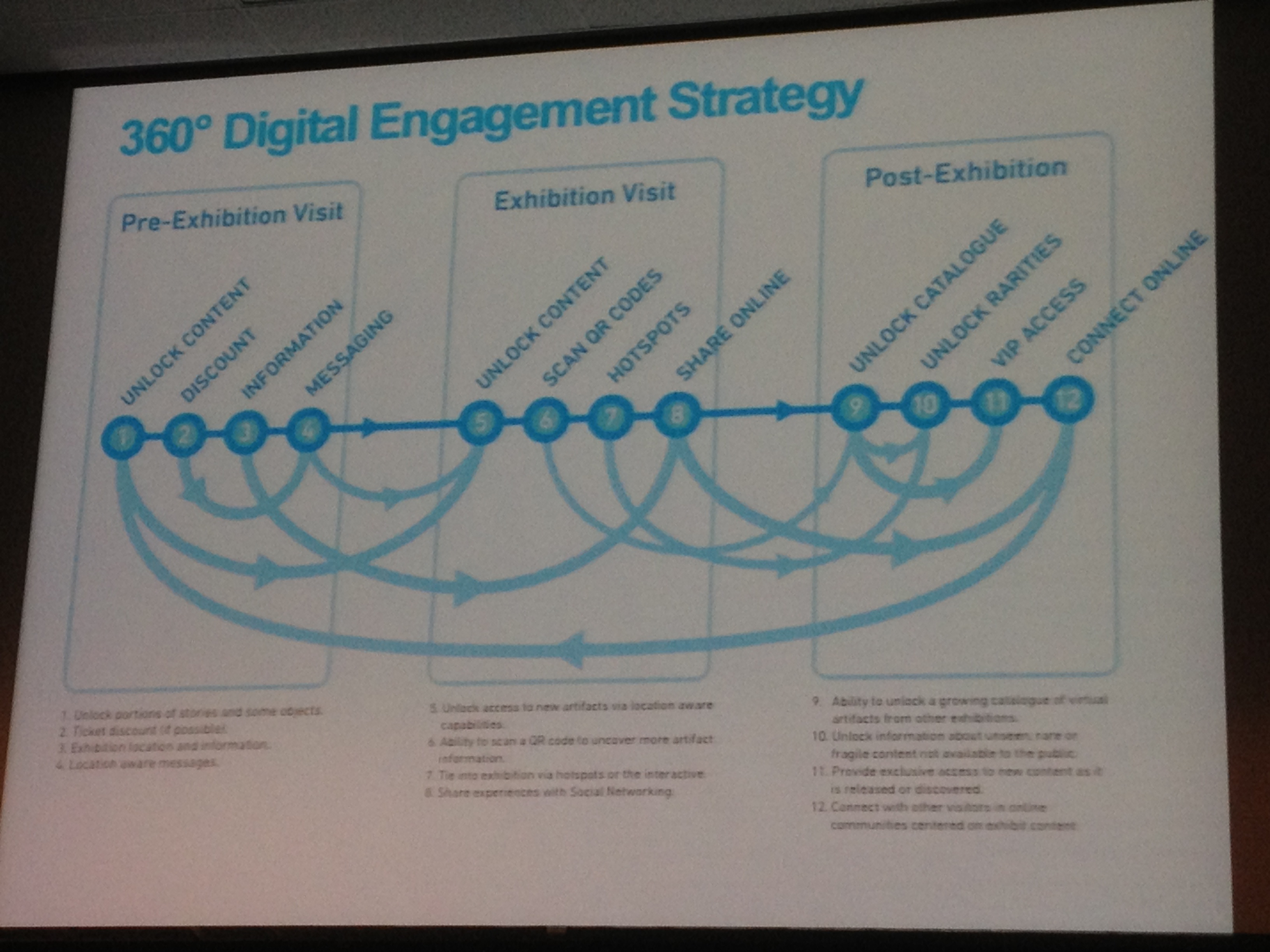
To sustain and grow the DOE sector, and to compete with other experiences, a number of show developers framed their work in terms of preshow, show, and post-show components (See photo). In some locations, the preshow has become so engaging that patrons have to be encouraged to move on when the main attraction is ready for them.
The key presentations given at this conference will be edited and distributed as both a physical book and e-book. Overall, the DNA conference was an interesting window into an industry that is using digital tools to create engaging storytelling, learning, and advertising experiences. Their work can inform what the traditional entertainment and CE industry is planning.
The next meeting of the DNA will probably be held in San Francisco in the first half of 2013. Go to http://www.thestingerreport.com/dna.html for more information.
Key companies represented at the DNA conference include;
Simiosys (http://www.simiosys.com , Chris Stapleton)
New Models of Ineractivity in Movie Theaters
Timeplay Entertainment ( http://timeplay.com , John Race)
Vortex Immersion Media (http://www.vorteximmersion.com , Ed Lantz)
Maximizing Social Media
Snibbe Interactive (http://www.snibbeinteractive.com , Graham Plumb)
Augmented Reality’s Next Stage in Leisure Facilities
Thinkwell Design (http://www.thinkwellgroup.com , Craig Hanna)
Ogmento (http://www.ogmento.com/team , Brian Selzer)
3D Interactive Entertainment Experiences in Public Places
Triotech (http://www.trio-tech.com , Ernest Yale)
Super 78 Studio (http://www.super78.com , Brent Young)
Mediamation (http://www.mediamation.com , Dan Jamele)
Alterface (http://www.alterface.com/en/home/ , Benoit Cornet)
3D Interactive Marketing in Public Places
Obscura Digital (http://obscuradigital.com , Barry Threw)
Pearl Media (http://www.pearlmediaus.com , Joshua Cohen)