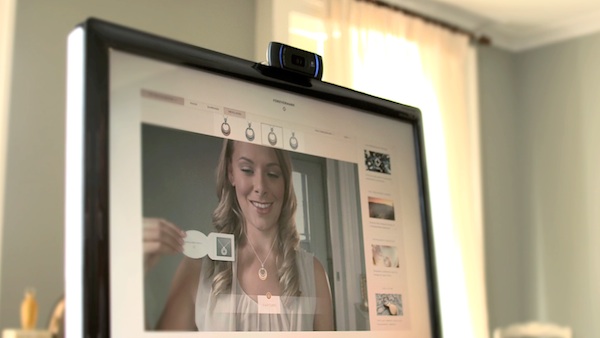
 What’s the future of retail, and how far away is it? Turns out that in the next couple of years, customers will be able to try on clothes and products at home with no shipping required. Technology will allow shoppers to virtually wear garments — smelling, hearing and feeling the fabric as if it were real.
Sound crazy? It’s not, when you look deeply into the world ofaugmented reality (AR). Augmented reality technology typically overlays the virtual world on top of the real-world environment through a device, such as a mobile phone or a tablet. But certain companies are redefining the bounds of virtual reality experiences by home-growing their own unique AR technologies and platforms. ...
“You’ll be virtually wearing the item or the garment that this clever smart store algorithm has suggested you try on that day,” Murray says. “The key thing is this holistic-thinking principle about where we’re going with augmented reality and really looking to take AR quite literally out of the developers’ hands.”
See the full story here: http://mashable.com/2012/06/20/augmented-reality-retail/
[Philip Lelyveld comment: tracking, de-anonymizing, and analytics of personal data online is a much larger threat to privacy, but photos make an easier soundbite than metadata.]
US Senator Charles Schumer has voiced his concern with Google's and Apple's new 3D maps, warning that they could infringe upon the public's privacy.
Senator Schumer has written a letter to both Apple chief executive Tim Cook and Google chief executive Larry Page asking them to rethink their implementation of new 3D mapping technology.
"By taking detailed pictures of individuals in intimate locations such as around a pool, or in their backyard, or even through their windows, these programmes have the potential to put private images on public display,"he said.
"We need to hit the pause button here and figure out what is happening and how we can best protect peoples' privacy, without unduly impeding technological advancement." ...
Read the full story here: http://www.v3.co.uk/v3-uk/news/2185596/senator-calls-apple-google-3d-mapping-systems
 Undeterred by a flop in 3-D TV and a failure of Internet-connected TVs to boost sales, Samsung Electronics Co. and LG Electronics Inc. are hoping "OLED" technology will keep them ahead. The intensely competitive business has already caused Sony's TV business to lose money for the past eight years.
For as long as I've had this bully pulpit I've preached the pleasures of the theatrical experience. You know the litany—movies are meant to be a social medium, you haven't really seen a feature film unless you've seen it on a big screen. Like many zealots, however, I've lapsed into private hypocrisy. Some movies look pretty darned good—and sound good, too—on the flat-panel TV in my living room. Now I want to make another confession, though I'd rather think of it as sharing a revelation. Watching movies on the new iPad can be a marvelous experience. ...
Read the full essay here: http://online.wsj.com/article/SB10001424052702303901504577462850818454084.html
[Philip Lelyveld comment: this is about augmented experiences and transmedia experiences, but '2nd screen' is an easier soundbite.]
A new industry group has been launched to meet the needs of the rapidly evolving ecosystem for companion screen viewing of broadcast television and home entertainment. The 2nd Screen Society (S3) will represent and facilitate dialogue among an emerging industry of established corporations and start-ups that are defining the new second screen experience.
Chuck Parker, former Technicolor Chief Commercial Officer, has been named chairman of the group, which will include representatives from the content, applications, device and distribution communities. While at Technicolor, Parker held multiple senior roles including President of their digital division as well serving as head of their international DVD division and CIO.
“S3 will serve as a platform for discussion among the various stakeholders who are defining the way that televised entertainment will be experienced by millions of viewers worldwide in the years to come,” Parker explains. “Among our first initiatives, we will help member companies facilitate API and web services integration between apps, smart TVs, tablets, mobile devices and set-top boxes to simplify development as well as to help our members create a social, seamless and stimulating viewer experience.”
S3 Advisory Board member companies include: BluFocus, BuddyTV, Civolution, Digitalsmiths, Dijit, Dome Productions, KIT digital, Magic Ruby, Mobovivo, Red Bee Media, SocialTV, TVplus, Twentieth Century Fox and zeebox. Sports Video Group (SVG) has announced their support of S3 as a founding partner specifically engaged in bringing the 2ndscreen ecosystem to the sports broadcast/production community. ...
Read the full story here: http://www.2ndscreensociety.com/?utm_source=2nd+Screen+Authority&utm_campaign=00f3df2fb0-my_google_analytics_key&utm_medium=email
... "One of the biggest reasons that online streaming of TV shows in particular has taken off like crazy is that networks are finally embracing the fact that this is where their audience is," said Melanie Shreffler, Ypulse editor in chief.
Younger viewers are avid fans. But networks are having trouble adapting to their fickle viewing habits.
Television networks such as the CW are at the nexus of the forces reshaping the entertainment industry. Launched six years ago, the CW initially approached its audience like any other television network — expecting viewers to tune in at appointed times to watch its shows.
They didn't. Instead they began watching episodes online, through illicit pirate sites. So the CW began offering such shows as "Gossip Girl" and "The Vampire Diaries" on the Internet within hours of an episode's TV airing. A new mobile application allows viewing on iPhones, iPads and Android and Kindle devices. ...
Read the full story here: http://www.latimes.com/business/la-fi-digital-kids-20120617,0,694372.story
The company's social scientists are hunting for insights about human behavior. What they find could give Facebook new ways to cash in on our data—and remake our view of society.
For one example of how Facebook can serve as a proxy for examining society at large, consider a recent study of the notion that any person on the globe is just six degrees of separation from any other. The best-known real-world study, in 1967, involved a few hundred people trying to send postcards to a particular Boston stockholder. Facebook's version, conducted in collaboration with researchers from the University of Milan, involved the entire social network as of May 2011, which amounted to more than 10 percent of the world's population. Analyzing the 69 billion friend connections among those 721 million people showed that the world is smaller than we thought: four intermediary friends are usually enough to introduce anyone to a random stranger. "When considering another person in the world, a friend of your friend knows a friend of their friend, on average," the technical paper pithily concluded. That result may not extend to everyone on the planet, but there's good reason to believe that it and other findings from the Data Science Team are true to life outside Facebook. ...
One of Marlow's researchers has developed a way to calculate a country's "gross national happiness" from its Facebook activity by logging the occurrence of words and phrases that signal positive or negative emotion. ...
Recently the Data Science Team has begun to use its unique position to experiment with the way Facebook works, tweaking the site—the way scientists might prod an ant's nest—to see how users react. Eytan Bakshy, who joined Facebook last year after collaborating with Marlow as a PhD student at the University of Michigan, wanted to test whether our Facebook friends create an "echo chamber" that amplifies news and opinions we have already heard about. So he messed with how Facebook operated for a quarter of a billion users. Over a seven-week period, the 76 million links that those users shared with each other were logged. Then, on 219 million randomly chosen occasions, Facebook prevented someone from seeing a link shared by a friend. Hiding links this way created a control group so that Bakshy could assess how often people end up promoting the same links because they have similar information sources and interests. ...
Social Engineering
Marlow says his team wants to divine the rules of online social life to understand what's going on inside Facebook, not to develop ways to manipulate it. "Our goal is not to change the pattern of communication in society," he says. "Our goal is to understand it so we can adapt our platform to give people the experience that they want." But some of his team's work and the attitudes of Facebook's leaders show that the company is not above using its platform to tweak users' behavior. Unlike academic social scientists, Facebook's employees have a short path from an idea to an experiment on hundreds of millions of people. ...
Read the full story here: http://www.technologyreview.com/featured-story/428150/what-facebook-knows/?nlid=nldly&nld=2012-06-13
Gracenote, the Emeryville-based provider of music and video content and technologies, said on Tuesday it has acquired Mountain View, Calif.-based Bulldog United, a developer of video fingerprinting technology for smart TVs. Financial terms of the deal were not disclosed.
Gracenote said the acquisition will allow it to incorporate a combination of video fingerprinting technology and its existing audio fingerprinting technology into its automatic content recognition platform, known as Gracenote Entourage.
This will allow next generation smart TVs to identify movies, TV programs and commercials from any source, including cable and satellite boxes, Blu-ray players and streaming services. Once the content is recognized, the TVs would then be able to steer viewers to VOD services to view related movies and TV programs, or interact with apps and advertising promotions.
Read the full story here: http://www.dmwmedia.com/news/2012/06/12/gracenote-acquires-bulldog-to-expand-av-fingerprinting
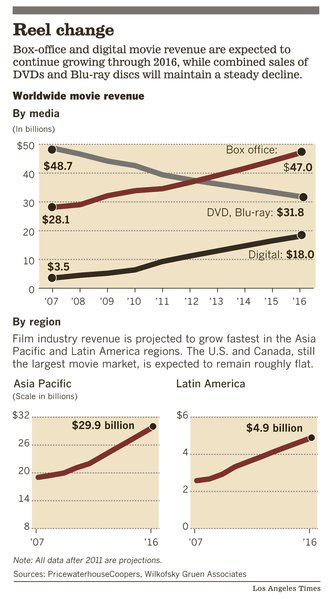
 Movie ticket sales will boom 20% over a five-year span ending in 2016, but continuing revenue drops in the home entertainment sector will keep the overall U.S. and Canadian film business treading water, according to a new study byPricewaterhouseCoopers.
The consulting firm’s filmed entertainment outlook, set to be released Tuesday, predicts an acceleration over the next five years of trends with which Hollywood has recently been grappling. Those include growing digital revenue that can't keep pace with falling DVD sales and rentals, and faster growth of movie-related revenue in Latin America and Asia than in the rest of the world.
But a long-running trend of stagnant attendance at movie theaters will turn around as exhibitors, stung by consumers’ resistance to paying a premium price for 3-D films, will not boost prices as much as they have in the past, PricewaterhouseCoopers predicts.
See the full story here: http://www.latimes.com/entertainment/envelope/cotown/la-et-ct-pwc-film-study-20120611,0,2023536.story
MultiTouch Ltd., the leading developer of modular multitouch LCD displays, today announced that it has created the first interactive multitouch application for ‘Angry Birds’ content. MultiTouch has developed an ‘Angry Birds Space’ augmented reality (AR) application that is played on the 55” MultiTaction® Cell with Embedded Windows 7.
The MultiTaction ‘Angry Birds Space’ AR application enables players to play the game on the display and use the Mighty Eagle plush toy to switch from the game to augmented reality mode. In AR mode, the players can place ‘Angry Birds’ plush toys on the display to access character specific content. Players can then switch back to the game using the same Mighty Eagle toy.
(press release)
 Movie ticket sales will boom 20% over a five-year span ending in 2016, but continuing revenue drops in the home entertainment sector will keep the overall U.S. and Canadian film business treading water, according to a new study byPricewaterhouseCoopers.