Thinking Forward: Vivek Wadhwa on Singularity University
 Vivek Wadhwa is Vice President of Academics and Innovation at Singularity University, an institution that educates a select group of leaders about exponentially growing technologies. He is also a Visiting Scholar, School of Information, UC-Berkeley; Director of Research, Center for Entrepreneurship and Research Commercialization, and Exec in Residence, Pratt School of Engineering, Duke University; Senior Research Associate, Labor and Worklife Program, Harvard Law School; Distinguished Visiting Scholar, Halle Institute of Global Learning, Emory University. Outside of academia, Wadhwa is a regular columnist for The Washington Post, Bloomberg, and BusinessWeek, and writes occasionally for several international publications. His work has been cited in more than 2,000 national and international media outlets over the past five years and has garnered the attention of policy makers.
In this interview for HPCwire, conducted by Daniel Araya of the Institute for Computing in the Humanities, Arts and Social Sciences, Wadhwa describes his thoughts on the culture of Silicon Valley, Singularity University, the rising costs of education, and the rapid evolution of technology.
Read the full story here.
Nielsen study finds 56% of US households have Xbox 360, PS3 or Wii
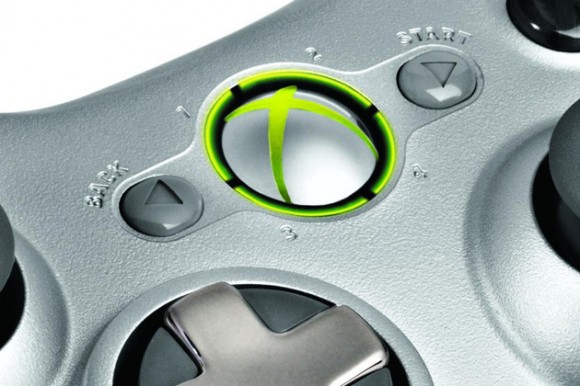 The group found that only 44% of US households are completely devoid of the current round of consoles, all of which have been on the market for more than five years. The Xbox 360 has been available since 2005.
According to Nielsen, overall gaming activity increased by 7%, a number that also included smartphone and tablet games. That is what the company sees as a potential major trend for 2012. It also expects cross-platform connectivity between different devices to explode this year. And its last prediction for the future – in-game monetization will be a big trend.
See the full story here
Dutch designer melts refrigerators to create 3D printed chairs
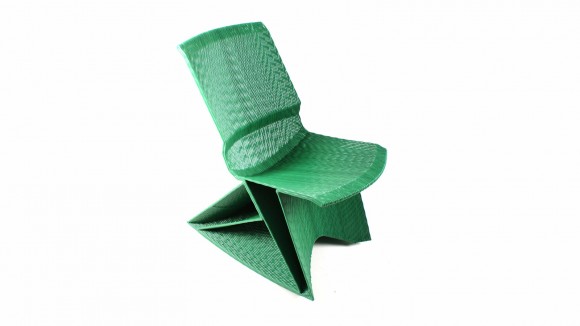 3D printing is making huge strides forward as a technology. As the printing method continues to mature, we are seeing more companies begin to release products that have been mass-produced using extrusion. Depicted in the video above is the brainchild of dutch designer Dirk Vander Kooij: a robot that is capable of creating 4,000 3D printed chairs a year. The best part? He uses nothing but recycled materials.
Vander Kooij built his 3D printing robot out of a modified industrial machine that was no longer being used. As you can see from the video, it looks very similar to one you might see on an automotive assembly line. Because the industrial machine uses a similar method of control programming to commercial 3D printers, Vander Kooij was able adapt it pretty easily. By refitting the robot with an extrusion head and a material feed, he was able to create a very large 3D printer capable of creating furniture.
Read the full article here.
Ten Technology Trends that Will Change the World in the Next Ten Years
 Dave Evans, Cisco's Chief Futurologist:
The number of Internet-connected things will reach 50 billion by 2020
By 2015, 91% of Internet data will be Video
By 2020, one-third of all data will live in or pass through the cloud
Network speeds will increase three million times in the next 10 years
Middle East - February 12, 2012: At Cisco Live 2012, an annual flagship event in Europe, Dave Evans, Cisco's chief futurist and chief technologist for the Cisco Internet Business Solutions Group (IBSG), outlined what he sees to be the top 10 technology trends that will change the world in the next decade. According to him, 3D printers, sensor networks, virtual humans, and other technologies under development will drastically change our world in the decade to come.
Trend 1: The Internet of Things
The Internet is the most powerful communications tool in history. The Web has evolved from informational and transactional mediums, to a social web that enables immediate knowledge sharing and wisdom of a crowd. Today, more things are connected to the Internet than people on the planet. We are at an inflection point-a new beginning-an era of dramatic and accelerated innovation of new technology applications that will benefit humanity.
The number of Internet-connected things will reach 50 billion by 2020, which equates to more than six devices for every person on Earth. Many people in the developed world already have three or more full-time devices connected to the Internet when factoring in PCs, smartphones, tablets, television devices and the like. Next up are sensor networks, using low-power sensors that "collect, transmit, analyze and distribute data on a massive scale.
Trend 2: The Zettaflood Is Coming
About 5 exabytes of unique information were created in 2008. That's one billion DVDs. Currently 1.2 zettabytes are being created, with one zettabyte equal to 1,024 exabytes. This is the same as every person on Earth tweeting for 100 years, or 125 million years of your favorite one-hour TV show. The love of high-definition video accounts for much of the increase. By Cisco's count, 91% of Internet data in 2015 will be video.
Trend 3: Wisdom of the cloud
By 2020, one-third of all data will live in or pass through the cloud. Global cloud services revenue will jump 20% per year, and IT spending on innovation and cloud computing could top $1 trillion by 2014. With the cloud comes the ability to mine human knowledge and to put an intelligent front on it.
In addition to video, the computing power of the cloud delivered to endpoint devices changes our ability to communicate with things like real-time translation. More intelligence is expected to be built into communication. Things like contextual and location-based information.
With an always-connected device, the network can be more granular with presence information, tapping into a personal sensor to know that a person's asleep, and route an incoming call to voicemail. Or knowing that person is traveling at 60 mph in a car, and that this is not the time for a video call.
Trend 4: The Next Net
Network speeds in the home have increased by 170,000 times since 1990, they will continue to increase three million times in the next 10 years. In line with this, networks will scale to meet future demands.
Trend 5: The World is Flat... So Is Your Technology
With always-on connectivity, social networking has the power to change cultures. Social influences will continue to move rapidly between cultures. In 10 years anyone will be able to broadcast anywhere on any device, providing unprecedented transparency.
Trend 6: The Power of Power
The human population also continues to grow, and Evans estimates that a city with one million inhabitants will be built every month over the next two decades. More efficient methods to power those cities are becoming a necessity, particularly solar energy.
In the next decade people will be able to harness alternative energy and become smarter in our use of power.
Trend 7: It's All About You
More items will move from physical to virtual. Today, people download e-books and movies, rather than bound books and DVDs.
Examples on that are gesture-based computing, interactive TV, facial recognition, and always on technologies that will soon be able to be incorporated into glasses and contact lenses - all of which will be connected to the cloud and our social graphs for personalized content streaming.
Trend 8: The Next Dimension
Virtual humans, both physical (robots) and online avatars will be added to the workforce.
Between now and then, augmented reality and gesture-based computing will enter classrooms, medical facilities and communications, and transform them as well.
Trend 9: Another Family Tree
In the next 10 years, medical technologies will grow vastly more sophisticated as computing power becomes available in smaller forms. It is predicted that it will be possible to make a conscious computer with super human intelligence before 2020.
Trend 10: You... Only Better
According to Evans, humans are crossing the threshold from discovery into controlling our own destiny, where technology results in fundamental changes to us as a society and species.
In July 2009 -- Spanish researchers discovered substance for photographic memory. In October 2009 -- Italian and Swedish scientists developed the first artificial hand with feeling. In March 2010 -- Retina implanted restore vision to blind patients. In June 2011 -- Texas Heart Institute developed a "spinning" heart with no pulse, no clogs and no breakdowns.
While the early use of these technologies were to repair unhealthy tissue or fix the consequences of brain injury, eventually designer enhancements will be available to all. Ultimately, humans will use so much technology to mend, improve or enhance their bodies to live much longer - up to 200 years in the near future.
Read the original post here:
The Pirate Bay makes good on 3D pirated content
 [Philip Lelyveld comment: this is the start of the great battle over the future of patents, copyrights, and trademarks, since a digital file can now be rendered as audio, a video, or a physical object.]
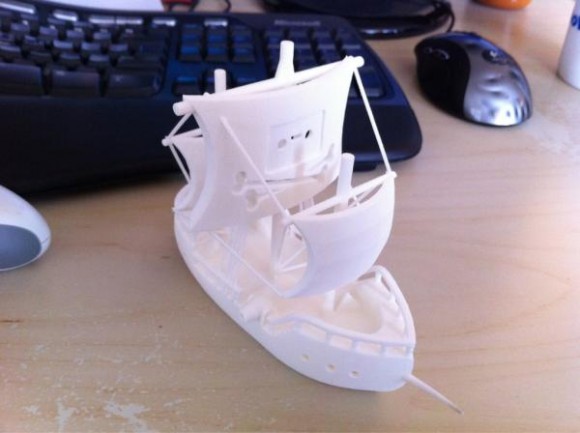
The Pirate Bay is literally taking digital piracy to the next dimension, and the process has already begun. The online downloading company told users last month that in addition to the requisite slate of movies, music, and TV show content it offered through means of copyright infringement, it wanted to add files that could be used for 3D printers. So in essence, users are now able to swap physical products in addition to digital products, without recognizing the original owner of the content.
See the full article here