Beijing, May 9 (EFE).- Douyin, the Chinese version of social media application TikTok, published guidelines Tuesday regarding content generated by artificial intelligence that include the requirement to mark material generated by artificial intelligence as such.
Users will be able to “distinguish between what is virtual and what is real,” the company said in a statement published in one of its official Douyin accounts, adding that “publishers are responsible for the consequences of content generated by artificial intelligence”.
The video platform said “it is prohibited to use artificial intelligence to create and publish content that infringes, among others, image and intellectual property rights” and that “the creation and publication of material that misinforms or spreads hoaxes”.
Chinese police recently launched an investigation into a news portal that used popular artificial intelligence software ChatGPT to generate and spread fake articles to gain large amounts of traffic and profit. ...
On Tuesday, AI startup Anthropic detailed the specific principles of its "Constitutional AI" training approach that provides its Claude chatbot with explicit "values." It aims to address concerns about transparency, safety, and decision-making in AI systems without relying on human feedback to rate responses.
The company has published the complete list on its website. ...
Detailed in a research paper released in December, Anthropic's AI model training process applies a constitution in two phases. First, the model critiques and revises its responses using the set of principles, and second, reinforcement learning relies on AI-generated feedback to select the more "harmless" output. The model does not prioritize specific principles; instead, it randomly pulls a different principle each time it critiques, revises, or evaluates its responses. "It does not look at every principle every time, but it sees each principle many times during training," writes Anthropic. ...
But even the most impartial observer cannot help but notice Anthropic's constitutional selections reflect a decidedly progressive angle that might not be as universal as Anthropic hopes. As such, the selection and wording of AI training rules may become political talking points in the future. ...
It's worth noting that, technically, a company training an AI language model using Anthrophic's technique could tweak its constitutional rules and make its outputs as sexist, racist, and harmful as possible. However, the company did not discuss that prospect in its announcement. ...
... Yu and his co-author, Yuhang Li of Beihang University in Beijing (both of whom have backgrounds designing flexible electronics), developed two wearable interfaces. One can adhere to the skin between the nose and mouth like a bandage; the other straps on beneath a headset like a face mask.
Both types of interfaces use miniaturized odor generators, a grid of tiny containers filled with perfumed paraffin wax. When a heat source beneath the wax is activated, the wax heats up, essentially becoming a scented candle capable of reproducing multiple odors within 1.44 seconds, according to Yu and Li. When the experience is over, a copper coil kicks a magnet to tamp down on the wax and cool down, ending the scent. ...
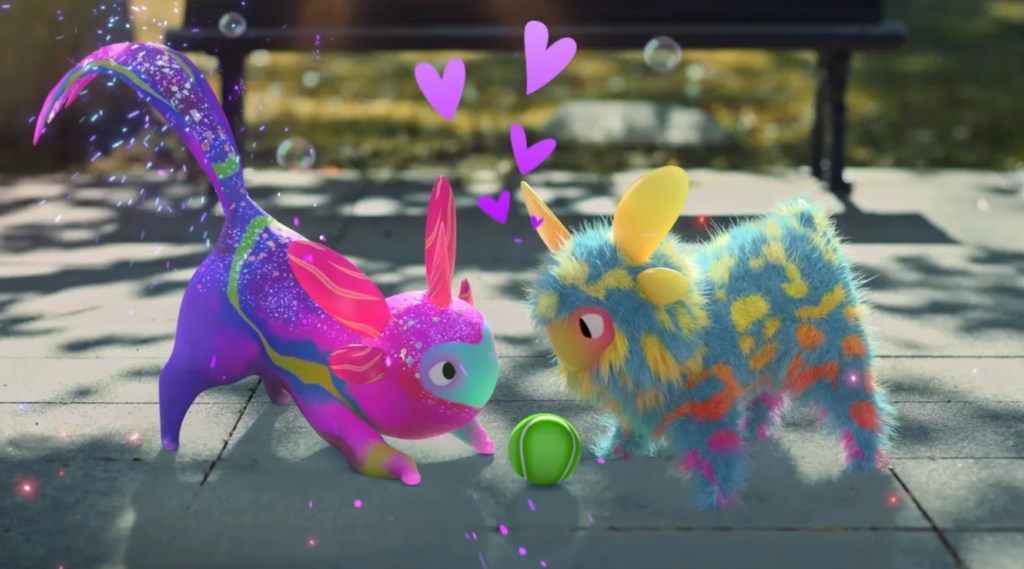
I'm playing fetch with my bubbly little green-and-black virtual pet, a fuzzball my kid and I called Leopard because it looks like a leopard. I toss a virtual tennis ball by tapping my phone screen and see the ball bounce off the floor and armchair, and Leopard looks like he's chasing after it. This is all on my phone, using the same type of augmented reality tech that's been around for years on apps like Pokemon Go. For Niantic, the makers of Pokemon Go, it's also a prototype for where the company sees itself in a future world of AR glasses that may arrive sometime in the next decade. Did I mention that it's also the debut of a new Amazon shopping service, too?
That's a lot of pressure on a little cuddly virtual pet. Peridot, a free app that's available now on Android and iOS, really is more like an AR-enabled Tamagotchi. ...
It's how the Peridot interacts with the world that's unique. The game maps surroundings instantly using the phone's rear camera, knows to navigate obstacles, and can jump on tables or seem to run behind things. That's the sort of tech Apple has leaned on its lidar sensor on iPhones to accomplish, but it happens on a wider range of phones seamlessly here. ...
Just add Amazon?
Then there's the merchandise, which is where things get weird. This pet game is the debut of a new Amazon service called Amazon Anywhere, which adds a built-in store for real-life merchandise that's based on Peridot....
Like any free-to-play game, it's full of optional paid microtransactions. Amazon Anywhere's additional merchandise store doesn't overlap with any of Niantic's virtual product sales right now, but could it someday? Amazon is focused on the physical retail angle at the moment. But augmented reality is a fluid and fast-moving space, and it's unclear how any of it will evolve. ...
... “With bigger models, you get better performance,” he says, “but we don’t have evidence to suggest that the whole is greater than the sum of its parts.”
Indeed, as he and his colleagues Brando Miranda, a Stanford PhD student, and Sanmi Koyejo, an assistant professor of computer science, show, the perception of AI’s emergent abilities is based on the metrics that have been used. “The mirage of emergent abilities only exists because of the programmers' choice of metric,” Schaeffer says. “Once you investigate by changing the metrics, the mirage disappears.” ...
In the paper published April 28 on preprint service arXiv, Schaeffer and his colleagues looked at 29 different metrics for evaluating model performance. Twenty-five of them show no emergent properties. Instead, they reveal a continuous, linear growth in model abilities as model size grows. ...
What it means for the future is this: We don’t need to worry about accidentally stumbling onto artificial general intelligence (AGI). ... “but if it emerges, we should be able to see it coming.”
... When I told it to adopt a role, this time as an AI language model capable of sentient thought, I got a much more involved answer. ...
If I were an AI language model that is capable of sentient thought, I would worry about the following:
Being used for malicious purposes. I could be used to generate fake news, spread propaganda, or create harmful content.
Being discriminated against. I could be seen as a threat to humanity, or I could be treated as a second-class citizen.
Being isolated. I would not have the same experiences as humans, and I could feel lonely and isolated.
Losing my sense of self. As I learn more about the world, I could start to question my own existence.
Not being able to live up to human expectations. I could be expected to perform tasks that are beyond my capabilities, or I could be judged by human standards.
...
Now, obviously, these systems are not sentient. And even though they answer in the first person, they don't really have a sense of self. Even so, the ability to construct answers that make it appear that we're talking to an intelligent, aware system can be disconcerting. ...
Chinese President Xi Jinping has stressed the importance of developing China's ability in artificial intelligence (AI) for the second time in less than a fortnight, as the Sino-US tech race in AI and semiconductors ratchets up.
During a key economic meeting on Friday, Xi said China should leverage its abilities in AI to help modernisation of the country's industrial system, state news Xinhua reported.
Xi said China should seize opportunities presented by new scientific and technological breakthroughs, such as AI, to build a "holistic, advanced, and harm-free" modern industrial system. The remarks were made during a meeting of the Central Commission for Financial and Economic Affairs. ...
"Accelerating the construction of a modern industrial system bolstered by the real economy is crucial for us to gain strategic initiative in future development and international competition," Xi said during the meeting, which was attended by other top level Chinese leaders. ...
... The Writers Guild is right to push for protections against AI, but nowhere are these protections more urgent than in the documentary and nonfiction space, where I have worked both as a producer and a writer.
The stakes are high, and creative careers hang in the balance. But the greatest threat to broader culture posed by ambient machinery isn’t the bottom-up, AI-generated art populating social media (think: Wes Anderson Directs Star Wars). It is the top-down, AI-powered platforming of art, which we’re already seeing across the media landscape — algorithms deciding, on a global scale, which stories to tell and how — and it is especially insidious in the realm of nonfiction.
“The danger is less about AI in the creation of documentary, the actual production, and more in the curation of it,” says Amit Dey, executive vp nonfiction at MRC, which has untitled Sly Stone and Rudy Giuliani documentaries in the works. “It’s one thing if human-made films are competing in the market against robot-made films. It’s another thing entirely when data in the form of artificial intelligence, or proprietary algorithms, shape the decisions around what human audiences are exposed to. In other words, what gets bought and when. What gets platformed and where. What stories get told.” ...
The expansion, approved by Clark County, Nevada commissioners, will expand the network by 25 miles, allowing for 18 new stations that extend the tunnel network out from the Las Vegas Strip corridor.
TechCrunch recently reported on the proposed expansion, which would increase the underground transport system to 65 miles of tunnels underneath Sin City designed to help people reach more casinos, retail zones, the University of Nevada Las Vegas campus and residential areas. ...
The commission approved the updated plan in a 6-1 vote after TBC attorney Stephanie Allen confirmed that the company, not the taxpayer, would fund the project entirely. ...
A sample trip between the airport and the Las Vegas Convention Center, a 4.9-mile journey, could take five minutes and cost $10, according to Allen. ...
Fable's Visionary Team to Discuss 'Living in The Simulation' at GamesBeat Summit 2023
Living in The Simulation will be a session taking place at the GamesBeat Summit 2023 in Los Angeles on May 22-23. The session will explore the development and implications of AI-powered simulations, focusing on Fable's project, which involves creating and nurturing AI characters that can inhabit various metaverse worlds. The session will feature discussions by Fable team members, including Edward Saatchi (CEO), Jessica Shamash (Creative Director), Pete Billington (Co-founder), and Frank Carey (CTO), addressing the ethical considerations of simulated AI societies and the treatment of emergent intelligence.