... Mr. Page and Mr. Brin, who had not spent much time at Google since they left their daily roles with the company in 2019, reviewed Google’s artificial intelligence product strategy, according to two people with knowledge of the meetings who were not allowed to discuss them. They approved plans and pitched ideas to put more chatbot features into Google’s search engine. And they offered advice to company leaders, who have put A.I. front and center in their plans.
The re-engagement of Google’s founders, at the invitation of the company’s current chief executive, Sundar Pichai, emphasized the urgency felt among many Google executives about artificial intelligence and that chatbot, ChatGPT. ...
In 2014, Google also acquired DeepMind, a leading A.I. research lab based in London. ...
“We continue to test our A.I. technology internally to make sure it’s helpful and safe, and we look forward to sharing more experiences externally soon,” Lily Lin, a spokeswoman for Google, said in a statement. ...
The company established a fast-track review process called the “Green Lane” initiative, pushing groups of employees who try to ensure that technology is fair and ethical to more quickly approve its upcoming A.I. technology. ...
The company will also find ways for teams developing A.I. to conduct their own reviews, and it will “recalibrate” the level of risk it is willing to take when releasing the technology, according to the presentation. ...
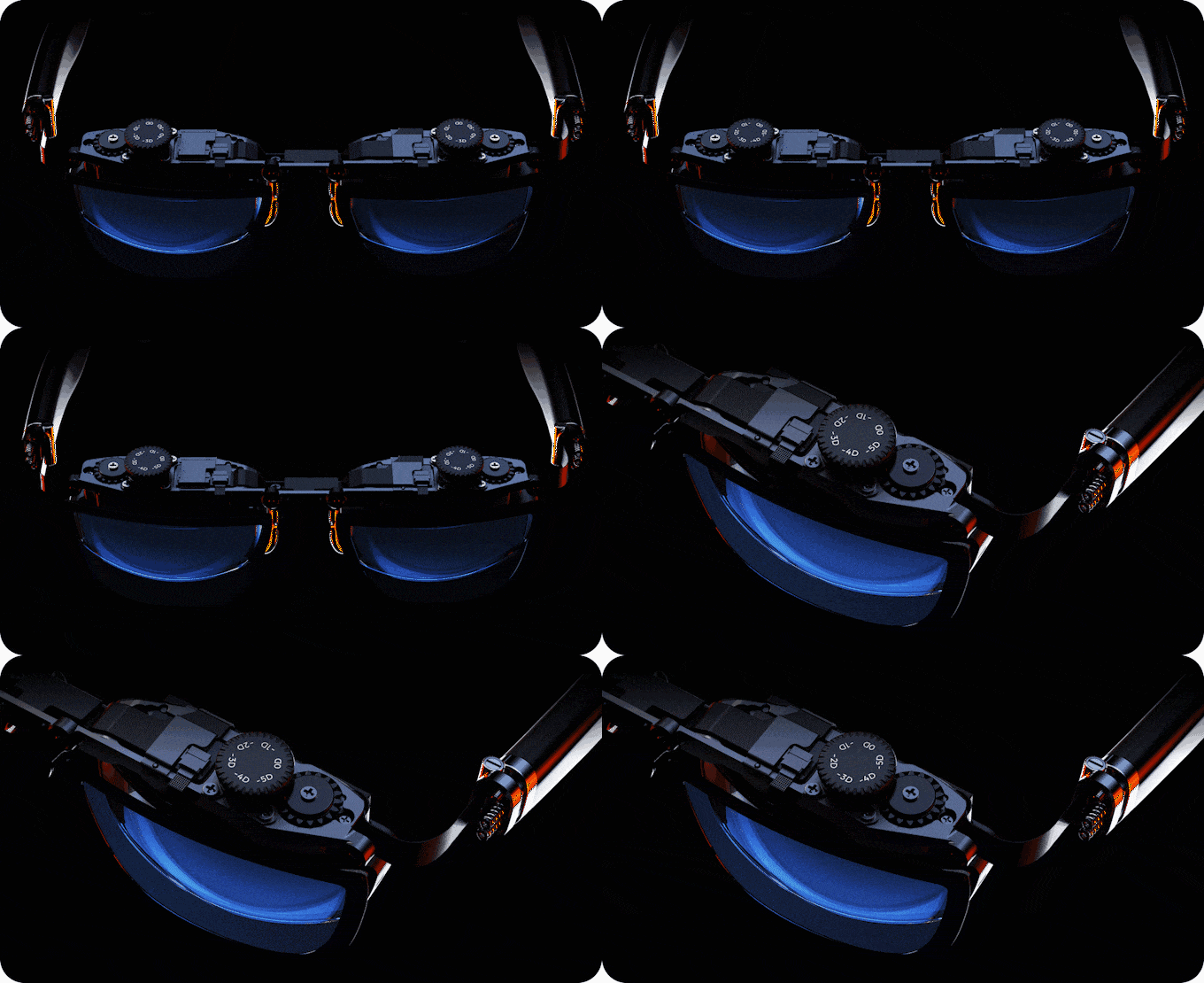
... Aside from incorporating impactful technology into the VITURE One, other patented features enable the glasses to deliver next-level immersive experiences. These include accessibility features, such as the swappable nose bridge pads, the option to adjust the XR glasses to your eye prescription, a magnetic connector for easier linking to other devices, and head-tilt navigation for fully hands-free navigation. ...
Through Jiang’s experiences, studying at the Harvard School of Design, working as a Microsoft intern, and working at Google, he discovered how users interact with personal technology. This discovery was a major influence on how the VITURE One XR glasses are designed, putting an emphasis on providing users with an optimal experience.
As an expert in spatial tech, as well as in AR tech and design, Jiang was able to design innovative wearable tech that’s both functional and fashionable. ...
... What if it did have ulterior motives, though? That’s the question at the heart of a fascinating new paper I read this week, which offers a comprehensive analysis of how AI-generated text can and almost certainly will be used to spread propaganda and other influence operations — and offers some thoughtful ideas on what governments, AI developers, and tech platforms might do about it.
The potential of language models to rival human-written content at low cost suggests that these models—like any powerful technology—may provide distinct advantages to propagandists who choose to use them. These advantages could expand access to a greater number of actors, enable new tactics of influence, and make a campaign’s messaging far more tailored and potentially effective. ...
The worst case scenario might look something like what the researcher Aviv Ovadya has called the infocalypse: an internet where ubiquitous synthetic media reduces societal trust to near zero, as no one is ever sure who created what they are looking at or why. ...
In the subfield of computer vision, researchers at Meta have demonstrated that images produced by AI models can be identified as AI-generated if they are trained on “radioactive data”—that is, images that have been imperceptibly altered to slightly distort the training process. This detection is possible even when as little as 1% of a model’s training data is radioactive and even when the visual outputs of the model look virtually identical to normal images. It may be possible to build language models that produce more detectable outputs by similarly training them on radioactive data; however, this possibility has not been extensively explored, and the approach may ultimately not work. ...
PhilNote: really good opinion piece using SciFi director Alejandro Jodorowsky (unrealized Dune film) as the framing device for a discussion of AI moviemaking.
I was recently shown some frames from a film that I had never heard of: Alejandro Jodorowsky’s 1976 version of “Tron.” The sets were incredible. The actors, unfamiliar to me, looked fantastic in their roles. The costumes and lighting worked together perfectly. The images glowed with an extravagant and psychedelic sensibility that felt distinctly Jodorowskian. ...
The truth is that these weren’t stills from a long-lost movie. They weren’t photos at all. These evocative, well-composed and tonally immaculate images were generated in seconds with the magic of artificial intelligence. ...
Just because you cannot watch Alejandro’s “Dune” doesn’t mean it didn’t change the world. This unfilmed film’s influence on our culture is nothing short of astounding. Specific ideas and images from the “Dune” art bible have escaped into the world. They can be experienced in movies such as “Blade Runner,” “Raiders of the Lost Ark,” “Prometheus,” “The Terminator” and even the original “Star Wars.” His “Dune” does not exist, yet it’s all around us. ...
I want to say that influence is not the same thing as algorithm. But looking at these images, how can I be sure? ...
If asked to guess what under 25-year-olds are listening to, it's unlikely that many of us would land upon orchestral music. And yet a survey published in December 2022 by the Royal Philharmonic Orchestra (RPO) found that 74% of UK residents aged under 25 were likely to be tuning into just that at Christmas-time, compared with a mere 46% of people aged 55 or more. These figures reflect not only the RPO's broader finding that under 35-year-olds are more likely to listen to orchestral music than their parents, but also the widespread surge in popularity of classical music in general, particularly among younger generations. ...
Unsurprisingly, social media has played a huge part in this, as a quick search of the popular TikTok hashtag "classictok" (currently at 53.8 million views) attests. There, as well as on Instagram, young classical artists have been making use of the digital realm's democratic potential to lift the heavy velvet curtains on their art form, presenting classical music and its storied history in ways that are accessible, unintimidating and, most importantly, fun. ...
Nigerian-US baritone and lifelong hip-hop fan Babatunde Akinboboye enjoyed a similarly swift and surprising rise to social media fame when he posted a video of himself singing Rossini's renowned aria Largo al factotum over the top of Kendrick Lamar's track Humble. "I was in my car and I realised that the two pieces worked together musically, so I started singing on top of the beat," he tells BBC Culture. He documented the moment on his phone and posted the video on his personal Facebook account, guessing that his friends would enjoy it more than his opera peers. "But I went to sleep, woke up the next morning, and it had expanded to my opera network, and far beyond that," he laughs, explaining that within two days, his self-dubbed brand of "hip-hopera" had caught the attention of The Ellen Show, America's Got Talent and Time magazine. ...
Virtual stars proved a resounding success at numerous New Year celebration galas hosted by television stations and video platforms to attract young audiences.
Designed to increase human interaction, these digital avatars are created by technology powered by artificial intelligence.
At the New Year’s Eve gala staged by Bilibili, a short-video sharing platform popular with young people, celebrity virtual idol Luo Tianyi performed five songs in 10 minutes and appeared alongside real-life dancers to celebrate the 10th anniversary of her debut. The show attracted more than 1.4 billion views. ...
A virtual rock band mesmerised its audience at a concert staged by Sichuan Television to mark the arrival of 2023. The band comprises five digital avatars based on cultural relics found at the Sanxingdui site in Deyang, Sichuan province, which is known for its exotic-looking bronze statues. ...
... The firm is stopping research and development (R&D) into its AR contact lens prototype due to a lack of capital. ...
"The slumping global economy, extremely tight capital markets, and the yet-to-be proven market potential for advanced AR products have all contributed to a situation where Mojo Vision has been unable to find additional private funding to continue its development of Mojo Lens.”
Due to the product cancellation, Mojo Vision is removing roughly 75 percent of its staff.
The layoffs come as Mojo Vison refocuses its direction towards MicroLED production for smart and immersive wearables. ...
... According to a recent survey by PwC, 38% of companies are anticipating having the metaversebe part of their everyday business model within the next year, and 44% think the transition will happen within the next two to three years. Regardless of how far employers plan to settle into the metaverse, one thing is for sure: they have to be prepared. ...
"The metaverse already existed — anyone with children or who experienced it through gaming understood what it was immediately," says Angela Lester, design and innovation leader at PwC. "But we didn't really understand the power of it on the business side until recently. It could be anything from onboarding and training or collaborating and interacting with our colleagues. It's also things like creating virtual content and creating new ways to interact with our customers." ...
Fifty-one percent of companies already have designated roles that focus exclusively on the metaverse, and 46% are hiring people with metaverse-related skills — everything from cryptocurrency and NFT-focused jobs to creative positions focused on 3D design. Those kinds of skills may still be foreign to most business leaders, which is why 32% of employers plan to hire or appoint a "metaverse leader" that can help manage those teams and relay progress to the C-suite. ...
... "The current climate in AI has so many parallels to 2021 web3 it's making me uncomfortable," François Chollet, an influential deep learning researcher at Google and the creator of the deep learning system Keras, wrote in a blistering Twitter threat. "Narratives based on zero data are accepted as self-evident." ...
"Everyone is expecting as a sure thing 'civilization-altering' impact (and 100x returns on investment) in the next 2-3 years," he continued. "Personally I think there's a bull case and bear case. The bull case is way way more conservative than what the median person on my TL considers as completely self-evident."
The bull case, he believes, is that "generative AI becomes a widespread [user experience] paradigm for interacting with most tech products." But Artificial General Intelligence (AGI) — AI that operated at the level of a human or above — remains a "pipe dream." So, startups based on OpenAI tech might not be rendering us humans obsolete quite yet, but they could well find a long-term role within specific niches. ...
Microsoft calls VALL-E a "neural codec language model," and it builds off of a technology called EnCodec, which Meta announced in October 2022. Unlike other text-to-speech methods that typically synthesize speech by manipulating waveforms, VALL-E generates discrete audio codec codes from text and acoustic prompts. It basically analyzes how a person sounds, breaks that information into discrete components (called "tokens") thanks to EnCodec, and uses training data to match what it "knows" about how that voice would sound if it spoke other phrases outside of the three-second sample.