‘Common Sense’ Test Could Lead to Smarter AI
[PhilNote: the 'common sense' researchers chose an abbreviation for their approach that is intrinsically unintuitive! 😉 )
... Now, in yet another step toward AI with more human-like intelligence, researchers from IBM, the Massachusetts Institute of Technology and Harvard University have developed a series of tests that would evaluate an AI’s ability to use a machine version of “common sense” — or a basic ability to perceive, understand, and judge in a manner that is shared by nearly all humans. ...
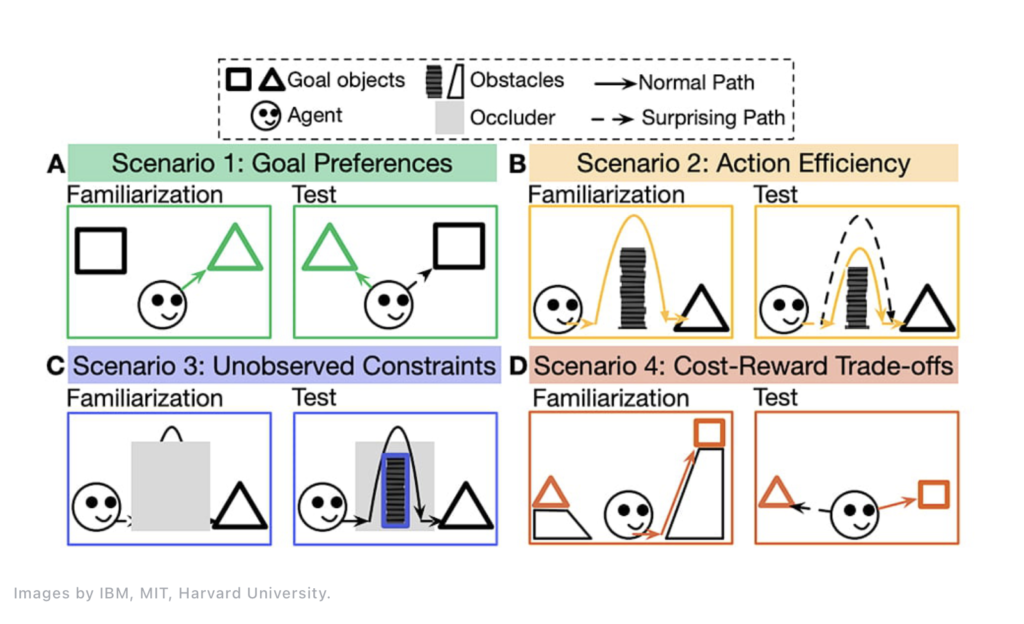
To better evaluate how machines reason, the team of researchers created a benchmark called Action-Goal-Efficiency-coNstraint-uTility, or AGENT for short. The AGENT tests consist of a dataset of 3D animations that are inspired by previous cognitive development experiments. ...
Intuitive Psychology
Inspired by experiments studying cognitive development in children, the AGENT test is structured around the concepts underlying what is called intuitive psychology, which human infants learn before learning to speak. These pre-verbal aspects of intuitive psychology include variables like goal preferences, action efficiency, unobserved constraints, and cost-reward trade-offs. ...
See the full story here: https://thenewstack.io/common-sense-test-could-lead-to-smarter-ai/