... Overall, participants agreed that the better the AR authoring tool, the less L&D professionals should worry about AR technical skills. More attention should be focused on design, such as whether to develop content for learning or supporting job performance. ...
While most use cases about mobile AR are in training, mobile AR has great potential in performance support. L&D professionals need to continue developing skills and knowledge to adopt the new technology well. Meanwhile, more studies are needed to help them adopt mobile AR efficiently and effectively.
...What Beamery has developed is a much more nuanced approach that makes use of graph data models and AI to create contextual understanding. For example, he noted that it’s important to understand what a company does and what job titles mean inside of a specific company.
By having a contextual understanding, S. Saidov said that it’s also possible to better identify potential candidates that might otherwise not be found.
“We identify the types of people that are going to be easily trained or are trainable, even if that skill set doesn’t exist today,” he said. ...
“We never say ‘hire this person,’” S. Saidov said. “Everything that we do is about providing explainability. For example, here are career paths you could have or, even if you’re a recruiter, showing parameters that you could consider to help you evaluate people.”
On December 2, senior media executives gathered on Zoom to answer questions from USC students about industry trends, company strategies and career direction. The students had submitted winning pitches in the ETC@USC Future of Themed Experiences Challenge and their reward was time with the media executives. The questions ranged from “Do you need to learn to code to break into entertainment technology?” to “What are some visionary directions you see your company investing in over the next 4-5 years?” Video of the discussions, along with the lists of questions, students, and executives, is available online.
Today, I want to tell you about Dramatron, an AI language model created by DeepMind that can generate theatrical scripts. You can describe your idea for a movie or TV show and the system can generate a title, character descriptions, and dialogue. Researchers are thinking of it as a "co-writing" tool, which is how we should be thinking of all of these large language models – until they get good enough to work autonomously.
During the development of Dramatron and through discussions with industry professionals, we made several important observations:
Dramatron is a co-writing system that has only been used in collaboration with human writers, and was not conceived or evaluated to be used autonomously.
Dramatron’s top-down hierarchical story generation structure does not correspond to every writer's writing process.
The output of a language model may include elements of the text used to train the language model. One possible mitigation is for the human co-writer to search for substrings from outputs to help to identify plagiarism.
Dramatron may reproduce biases and stereotypes found in the corpus, and may generate offensive text. One possible mitigation is to use the Perspective API for estimating toxicity scores of the language outputs, and filtering generations based on the Perspective API analysis.
... Paul Kedrosky isn't an educator per se. He's an economist, venture capitalist and MIT fellow who calls himself a "frustrated normal with a penchant for thinking about risks and unintended consequences in complex systems." But he is among those who are suddenly worried about our collective future, tweeting yesterday: "[S]hame on OpenAI for launching this pocket nuclear bomb without restrictions into an unprepared society." Wrote Kedrosky, "I obviously feel ChatGPT (and its ilk) should be withdrawn immediately. And, if ever re-introduced, only with tight restrictions."
We talked with him yesterday about some of his concerns, and why he thinks OpenAI is driving what he believes is the "most disruptive change the U.S. economy has seen in 100 years," and not in a good way. ...
Some might say, 'Well, did you feel the same way when automation arrived in auto plants and auto workers were put out of work? Because this is a kind of broader phenomenon.' But this is very different. These specific learning technologies are self catalyzing; they're learning from the requests. So robots in a manufacturing plant, while disruptive and creating incredible economic consequences for the people working there, didn't then turn around and start absorbing everything going inside the factory, moving across sector by sector, whereas that's exactly not only what we can expect but what you should expect. ...
But the lesson of the last five years in particular has been these changes can take a long time. Free trade, for example, is one of those incredibly disruptive, economy-wide experiences, and we all told ourselves as economists looking at this that the economy will adapt, and people in general will benefit from lower prices. What no one anticipated was that someone would organize all the angry people and elect Donald Trump. So there's this idea that we can anticipate and predict what the consequences will be, but [we can't]. ...
PhilNote: this sounds like the DRM debates at the CPTWG (copy protection technical working group) all over again.
"We want it to be much harder to take [an AI system's] output and pass it off as if it came from a human," Aaronson said in his remarks. "This could be helpful for preventing academic plagiarism, obviously, but also, for example, mass generation of propaganda -- you know, spamming every blog with seemingly on-topic comments supporting Russia’s invasion of Ukraine without even a building full of trolls in Moscow. Or impersonating someone’s writing style in order to incriminate them."
... At their cores, the systems are constantly generating a mathematical function called a probability distribution to decide the next token (e.g., word) to output, taking into account all previously-outputted tokens. ...
OpenAI's watermarking tool acts like a "wrapper" over existing text-generating systems, Aaronson said during the lecture, leveraging a cryptographic function running at the server level to "pseudorandomly" select the next token. In theory, text generated by the system would still look random to you or I, but anyone possessing the "key" to the cryptographic function would be able to uncover a watermark. ...
Unaffiliated academics and industry experts, however, shared mixed opinions. They note that the tool is server-side, meaning it wouldn't necessarily work with all text-generating systems. And they argue that it'd be trivial for adversaries to work around. ...
Even if OpenAI were to share the watermarking tool with other text-generating system providers, like Cohere and AI21Labs, this wouldn't prevent others from choosing not to use it. ...
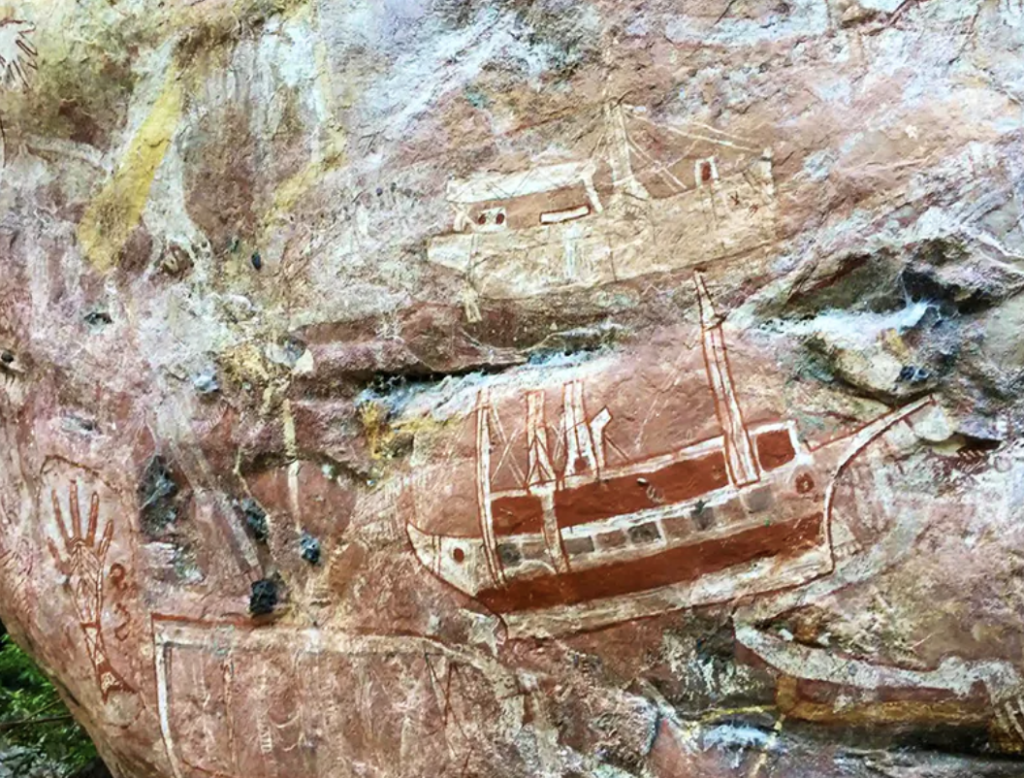
... There is throughout a poignant dissonance: because these haunted paintings show fearful humanity encountering something alien, strange, highly advanced – and utterly unknowable. ...
Recently a sibling of GPT3, a LLM designed by Meta/Facebook, started defeating humans at Diplomacy – a game requiring deep verbal skills and the ability to deceive. ...
GPT4 might be so powerful it will appear entirely and flawlessly intelligent to everyone; that is to say, it will breeze through the Turing Test ...
A few decades after the first contact art appeared in Arnhemland, the Aboriginal people were largely swept from their homelands by the economic forces and political changes brought by European settlers. But not everyone deserted these silent red canyons and bright lilied waterways. In the 2000s, the last native speaker of the local Amurdag language, Charlie Mungulda, returned to the Mount Borradaile rockfaces to paint a symbolic and final hand, a scarlet print which says remember us, because we were here. With this ritual, he signalled an end to 50,000 continuous years of Aboriginal art in West Arnhemland. Nothing has been painted in Mount Borrodaile since. Nor will it be.
A Fortune 500 company CEO in his 80s is taking part in the MIT trial project, Augmented Eternity and Swappable Identities. The beta MIT project is tested on the digital footprint of 25 volunteers with the goal of creating digital immortal personas. The trial aims to use social media data to train an avatar to behave like the human identity it is connected with. The avatar could share an opinion, his or her likes or dislikes, and create “emotional legacies”for loved ones left behind. ...
Researcher Hossein Rahnama is leading the MIT Media Lab project and sees the platform as supporting bereavement or as business research and expert knowledge transfer.
Rahnama asks the question, “can software agents become our digital heirs?” And his project works by using a “distributed machine intelligence network” to enable users to control their digital footprint and turn it into their digital persona, which in turn can be shared on social networks. ...
“We believe that by enabling our digital identity to perpetuate, we can significantly contribute to global expertise and enable a new form of an intergenerational collective intelligence.” ...
... Meanwhile, poor privacy choices made long ago have come back to haunt Zuckerberg. In the early years Facebook was heavily dependent on third-party developers to drive growth. User and demographic data was routinely made available. The flaw in this business model became apparent in 2018 when Cambridge Analytica used this data to drive disinformation campaigns during the 2016 presidential election run-up.
VR is Zuckerberg’s plan to own the foundation, and build business models with Meta at the core.
This new strategy popped up Tuesday all over the Quest Pro reveal. Several big corporations appeared to be latching onto Meta’ VR coattails. Among other deals, the company announced partnerships with Microsoft (MSFT) for its Teams, Office, and Windows 365 software suites. The Redmond, Wash,-based company’s official blog notes that Xbox Cloud Gaming will also be ported to Meta headsets. YouTube is moving its massive VR video platform to Quest. And NBCUniversal will bring its Peacock streaming application and other content to Quest headsets, according to a report at Variety. ...
And that’s the rub. Meta’s VR business simply is not big enough to offset its lost revenue from the Apple OS changes. Plenty of people believe VR will never be foundational at Meta. Convincing people to buy expensive computers they will wear on their faces is a tougher sell than building a smartphone application for a device most people feel they can’t live without. ...
... Even though people can now travel and assemble, the team believes virtual experiences could become part of a “new normal” for geology research and education.
“Part of increasing access to the field is to help people know what to anticipate,” Crider said. “To the extent that we can help students anticipate both the outdoors experience and the science experience, then the uncertainty and maybe anxiety is reduced, and people can focus on the learning goals.”
The virtual experiences allow people to visit the field site and use common geology tools to measure angles in the rock layers or orientation of cracks that explain a landscape’s history. While a virtual option benefits anyone challenged by the travel and access to a remote field site, it also lets all students and researchers have a “dry run” experience and review techniques before reaching the actual location. ...