Players’ ‘Marjorie Prime’ uses artificial intelligence to probe a family’s real emotional trauma
... That opening conversation speaks to the oddness of this relationship. Marjorie (Fran Martone) converses with a handsome young man who could be her grandchild.
What else does the robot with artificial intelligence not have information about? A lot as it turns out. That includes a trauma that has warped each member of the family.
The Prime tells her: “I’m here for you Marjorie whenever you need me. I have all the time in the world.”
The year is 2062 (given the state of technology the playwright could have set it in 2042). Marjorie was born in 1977. She lives alone aside from this Walter Prime (Jake Spencer), a version of her husband in the early years of their marriage before they had children. ...
Primes don’t have hearts, but they certainly work on the emotions of the humans they interact with, forcing issues to the surface, though not helping to resolve them. ...
See the full story here: https://bgindependentmedia.org/players-marjorie-prime-uses-artificial-intelligence-to-probe-a-familys-real-emotional-trauma/

An Artist and Chef Collaborated to Imagine the Dinner of the Future. It Involves Animation, Virtual Reality, and… Not Being Able to See Your Food
If you’re looking to experience contemporary art, fine dining, and cutting-edge technology at this year’s Art Basel Miami Beach, look no further than Aerobanquets RMX, where artist Mattia Casalegnoand chef Chintan Pandya have teamed up to present a futuristic meal you eat wearing a VR headset.
Since diners are unable to see their food in the real world, an animated rendering of each one-bite course appears in the virtual space as it’s served. As a result, there are no preconceptions of what one’s about to eat and diners find their senses heightened, each flavor affected by what they are hearing are seeing in the virtual reality space. ...
Dining at Aerobanquets requires a reservation, and diners can chose from a five-bite, 30-minute version of the experience for $58, or the $200 VIP meal, which lasts an hour and includes 10 bites and alcoholic beverages. Highlights of the VIP version include pillowy milk bread topped with mushrooms and lentil, and a highly spiced bite of Hudson Valley foie gras. ...
See the full story here: https://news.artnet.com/art-world/virtual-reality-art-dinner-aerobanquets-2220630?fbclid=IwAR2utzCrbvWIuJDheOnzSTJ9bWF7BzujjbQQylEa-7evlcRM6AukBfpapS4

‘Common Sense’ Test Could Lead to Smarter AI
[PhilNote: the 'common sense' researchers chose an abbreviation for their approach that is intrinsically unintuitive! 😉 )
... Now, in yet another step toward AI with more human-like intelligence, researchers from IBM, the Massachusetts Institute of Technology and Harvard University have developed a series of tests that would evaluate an AI’s ability to use a machine version of “common sense” — or a basic ability to perceive, understand, and judge in a manner that is shared by nearly all humans. ...
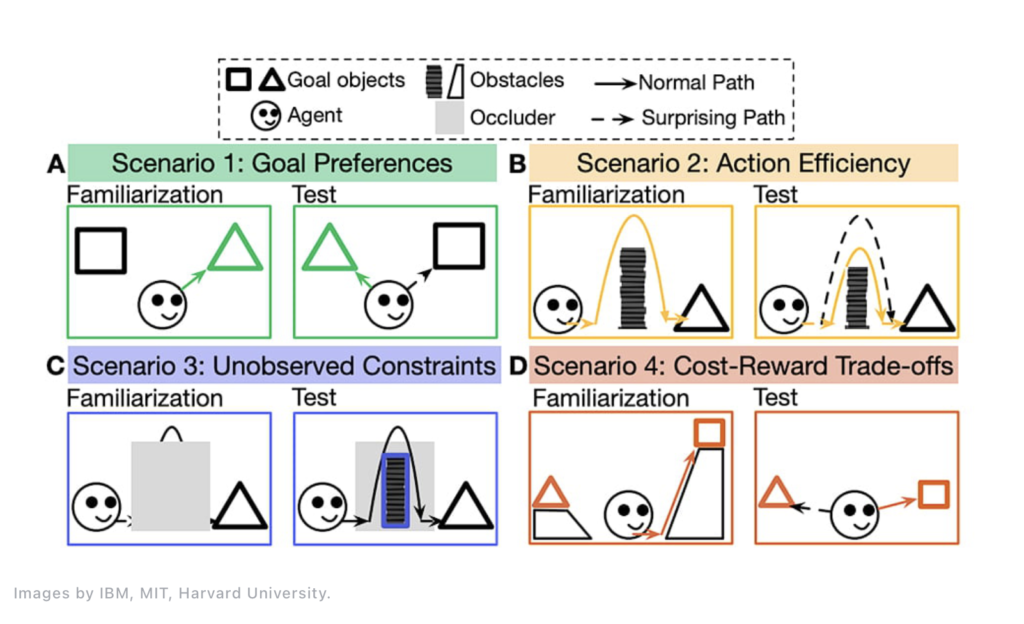
To better evaluate how machines reason, the team of researchers created a benchmark called Action-Goal-Efficiency-coNstraint-uTility, or AGENT for short. The AGENT tests consist of a dataset of 3D animations that are inspired by previous cognitive development experiments. ...
Intuitive Psychology
Inspired by experiments studying cognitive development in children, the AGENT test is structured around the concepts underlying what is called intuitive psychology, which human infants learn before learning to speak. These pre-verbal aspects of intuitive psychology include variables like goal preferences, action efficiency, unobserved constraints, and cost-reward trade-offs. ...
See the full story here: https://thenewstack.io/common-sense-test-could-lead-to-smarter-ai/
What will humanity look like in a million years?
... In the long run, we should expect the most enhanced people, generation by generation (or upgrade after upgrade), to become one or more fundamentally different “posthuman” species – and a species of holdouts declaring themselves the “real humans”.
Through brain emulation, a speculative technology where one scans a brain at a cellular level and then reconstructs an equivalent neural network in a computer to create a “software intelligence”, we could go even further. This is no mere speciation, it is leaving the animal kingdom for the mineral, or rather, software kingdom.
There are many reasons some might want to do this, such as boosting chances of immortality (by creating copies and backups) or easy travel by internet or radio in space. ...
Dyson sphere?
Here’s a prediction for the year one million. Some humans look more or less like us – but they are less numerous than they are now. Much of the surface is wilderness, having turned into a rewilding zone since there is far less need for agriculture and cities.
Here and there, cultural sites with vastly different ecosystems pop up, carefully preserved by robots for historical or aesthetic reasons.
Under silicon canopies in the Sahara, trillions of artificial minds teem. The vast and hot data centres which power these minds once threatened to overheat the planet. Now, most orbit the Sun, forming a growing structure – a Dyson sphere – where each watt of energy powers thought, consciousness, complexity and other strange things we do not have words for yet. ...
See the full story here: https://reaction.life/what-will-humanity-look-like-in-a-million-years-species-artificial-intelligence/
(Facebook PR) Advancing the Next Generation of Creative Expression Through Mixed Reality
Takeaways
- We’re launching Meta House at Miami Art Week from December 1-3, showcasing mixed reality experiences like a VR art gallery, interactive AR murals, a VR sculpting workshop that feature emerging artists COVL and YONK, plus live performances by Doja Cat and more.
- We’re investing in the creative community and improving our products and tools to advance authentic expression, connection and opportunities to monetize their creativity.
- We’re collaborating with intersectional voices across diverse communities to influence how we build towards an equitable metaverse.
See the full story here: https://about.fb.com/news/2022/11/advancing-creative-expression-through-mixed-reality/
