Online game company and mobile app developer NetDragon Websoft has invested $40 million in Rokid, maker of 5G-friendly AR glasses for business applications. Both companies are based in China. NetDragon has been in the news this past month when it became the first company to appoint an AI as its “rotating CEO.” Following the Rokid announcement, it appears the firm may be interested in developing lifelike AI characters to inhabit its games and augment teaching and enhance its AR initiatives, though to hear NetDragon actual CEO, Liu Dejian tell it, the company can learn a lot from its new c-suite addition, Tang Yu. ...
“Tang Yu will also serve as a real-time data hub and analytical tool to support rational decision-making in daily operations, as well as to enable a more effective risk management system,” and will also have a human resources role, developing talent and “ensuring a fair and efficient workplace for all employees,” the NetDragon release explains. ...
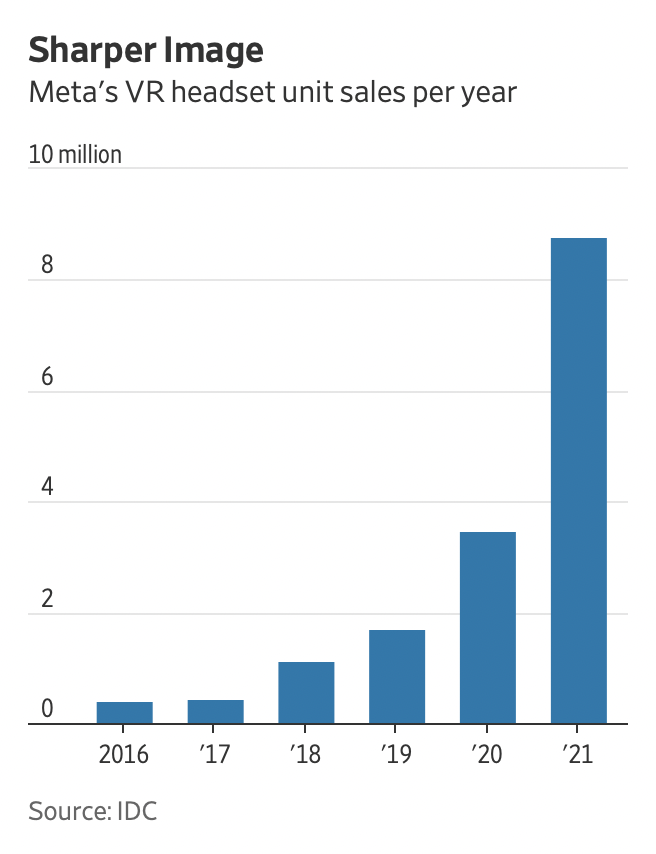
... And the company at least has some positive momentum to build on, given strong sales of its Quest 2 VR headset that launched in late 2020. That device is designed mostly for videogaming and sold nearly 8.8 million units last year—more than the total number of headsets sold by Meta for the previous five years combined, according to estimates by IDC.
But success in VR is a highly relative concept, as even gamers have been lukewarm on the technology. Total revenue from VR games last year was $1.5 billion—less than 3% of the total revenue generated by console games for the year, according to market research firm Newzoo. ...
Mr. Zuckerberg’s vision to bring the metaverse to a billion people is an expensive one; the company has maintained its target of spending up to $34 billion in capital expenditures this year, which is double what it has averaged over the past three years.
So having less money coming in the door is a problem. ...
... “Rather than seeing similar things it shows you something quite different, so we give creators the opportunity to break people out of that reinforcing bubble.”
Cohen, a tech humanist — or person who believes in using immersive technology to nurture intellectual and creative potential while centring the vulnerability in us all — thinks that augmented reality developers could learn from theme park experience design.
“Experience designers at The Walt Disney Company know that when you are building a world, you have to build a sanctuary for people,” she says. “You have to build in rest, you have to build in a space where people can breathe for a second.”
The Disneyland App is getting updated with some new fun and useful features.
To enhance guests’ photo moments at the park, Disney PhotoPass Lenses are now available via the Disneyland app. The augmented reality experience initially launched at Disney World in partnership with Snap, and was made available to Disneyland guests on Tuesday, Oct. 4.
Included with the purchase of the Disney Genie+ service, guests can create their own Disney stories throughout the parks. Guests can immerse themselves by taking selfies with Grogu. A series of lenses allow for guests to pretend to munch on a Mickey shaped pretzel on Main Street, hold a bunch of colorful Disneyland balloons, wear a virtual mask or headgear inspired by Star Wars, toss glitter in front of Sleeping Beauty Castle, or take an underwater video with Dory. The new app addition will create a ton of digital content for the parks with guests sure to share their selfies and stories on Instagram and TikTok.
The Biden administration unveiled a set of far-reaching goals Tuesday to align artificial intelligence-powered tools with what it called the values of Democracy and equity, including guidelines for how to protect people’s personal data and limit surveillance.
The Blueprint for an AI Bill of Rights notably does not set out specific enforcement actions, but instead is intended as a White House call to action for the U.S. government to safeguard digital and civil rights in an AI-fueled world, officials said. ...
... The cereal brand has launched its first AR game, “Journey to the Magic Gems,” which transforms real-life parks into Lucky the Leprechaun’s world.
The free, mobile, web-based AR game was launched in partnership with Niantic, which created Pokémon GO.
To play, customers can visit journeytothegems.com or scan a QR code on any Lucky Charms Magic Gems cereal box — a limited-edition version of the cereal that is making its return after selling out earlier this summer. They then make their way to a local park to participate.
Players are prompted to find the first Magic Gem — which provides “the power of rainbow vision to see in the dark and navigate through the darkest of places. Once found, rainbow vision is turned on and the player’s phone screen transitions to dark mode. Players will then have the chance to collect all the charms that are hidden in plain sight. ...
Participants who opt in prior to joining the game can win the chance to nominate a local park for an LED glow-up so visitors can enjoy more time at the park together. ...
[PhilNote: summary - the writer argues that keeping AI regulation vague allows it to evolve as the tech rapidly evolves. He mentions but doesn't stress the possibility of arbitrary government enforcement that this approach allows. ]
In March, new regulations entered into effect in China that require companies deploying recommendation algorithms to file details about those algorithms with the Cyberspace Administration of China (CAC). In August, the CAC published summaries of 30 recommendation algorithms used by some of China’s largest tech companies. The release sparked a round of flawed commentary on China’s unprecedented attempt to regulate some types of artificial intelligence (AI), which has largely framed the goals of the regulation in maximalist terms without acknowledging other possible functions of the regulation.
In particular, much of this commentary mischaracterizes the actual impact of the regulation....
Hao interprets the broadness of the regulations as a sign that China is eager to “police algorithms directly” and suggests that both the technical complexity of recommendation systems and the limitations of the CAC’s staff have made it difficult for China to follow through on its ambitions. ...
It is not hard to imagine that one goal of the Chinese algorithmic regulations may have been to signal to an international audience that China takes the harms caused by new and emerging technologies seriously—and that it was quicker to take action to rein in AI systems than any other country. ...
A regulation like the CAC’s rules on recommendation systems helps solve this problem by communicating information about the central government’s priorities, which can shift company behavior even without any meaningful enforcement actions. ...
By avoiding specificity and stumbling over its own words during enforcement down the road, broad regulatory language allows the government to choose the time and place of oversight. ...
None of this is to say that this model of regulation is a good one, or that it ought to be emulated by the United States. There are major downsides to attempting to pass comprehensive technology regulations along these lines. Vague laws can significantly raise uncertainty and compliance costs, create risks of abuse from government regulators, and increase the likelihood that different jurisdictions may interpret the law differently. But there is a reasonable argument to be made that when the subject of the law is as fast developing as AI, “future-proof” legislation may need to be vague enough to accommodate substantial change in technical details, with significant discretion falling to regulators and judges to interpret implementation. ...
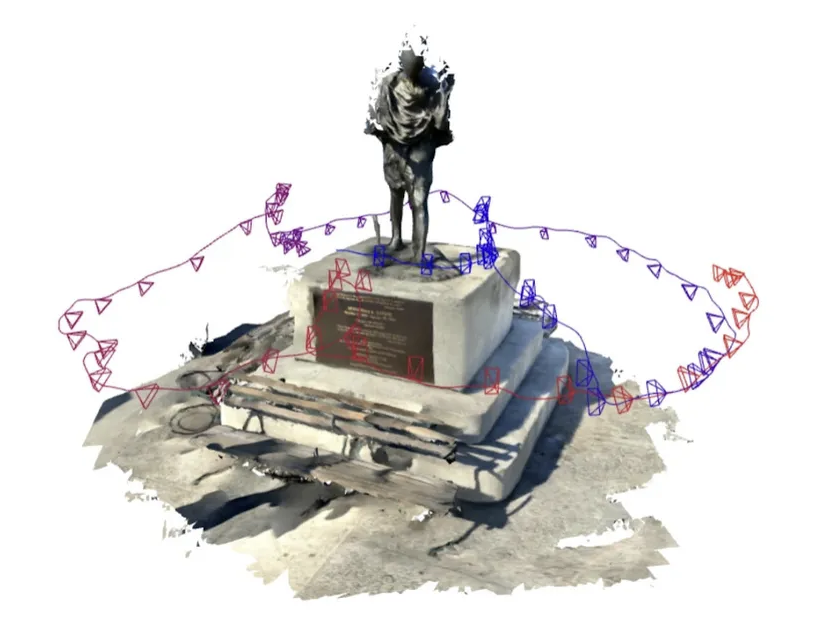
Niantic is working on the world's most dynamic augmented reality 3D map of the Earth with help from users of the company's games and apps. ...
Starting from the foundation of the company's popular AR games, Niantic is enlisting the help of Pokémon Go players to scan the world around them. After reaching a certain level, users are given access to 'AR Mapping Field Research' tasks, where they can earn rewards for submitting AR scans. Pokémon Go trainers who have reached level 20 and do not have a child account can access the tasks at eligible PokéStops. ...
Capturing that quantity of real-world imagery brings up several privacy concerns, which can be challenging to navigate. Niantic has addressed several of these issues by outlining best practices and obscuring identifying information such as license plates and faces. ...
For example, Mehdaoui was initially focused on prompting the AI to generate images of a boy fashioned from gnarled, raw wood. The troubles were myriad. First, Mehdaoui says, “The moment you ask the AI for Pinocchio, you lose control. It puts you in Disney’s hands.” Meaning the images the AI generated were often too familiar. Too recognizable. The other issue was getting the AI to see or rather interpret beyond such a generic descriptor as “boy that looks like a log.” So, for days, Mehdaoui tinkered with his prompts until his fragmented vision, the one cradled only in his mind, came to life, authored by artificial intelligence.
As the director of the movie, Mehdaoui has full creative control over his AI-generated Pinocchio. But there’s no studio backing his project. Instead, he’s one of 750 artists, architects, AI engineers, storytellers, animators, game designers, interoperability explorers and business folks who have joined together to dethrone Hollywood.
The Culture DAO is a “metaverse guild” assembled by Edward Saatchi, the chief executive officer (CEO) of Fable, an artificial intelligence-powered virtual being company, and the founder of Oculus Story Studio. Members of the DAO include current and former storytellers from Pixar, Lucasilm and Oculus, many of whom are currently working on an amuse-bouche of fairy tales, horror flicks, animations and live-action shorts. ...
Saatchi assembled the guild out of a concern that the most zealous artists interested in AI might waste too much time playing around with new features. “You could go two years, making very small demos and creating nothing substantial that’s going to last for 100 years,” he says. And since Saatchi believes AI-generated media is the beginning of a new art form, it was important, he says, to “encourage artists to find personal stories they want to tell that are empowered by AI.” ...
Unlike Mehdaoui, who’s using AI text to image programs to animate a feature film, Lighthiser is working iteratively on developing short live-action clips. He’s posted a few of these videos on Twitter. The response has largely been one of shock. It seems few people expected the AI to be this good, this quickly. ...
Their recent progress aside, Saatchi’s proposition to decentralize Hollywood by democratizing access to the resources of a studio is still in its infancy. ...
... The first is an organization called the Open Metaverse Alliance, which is a collaboration of Web3 Metaverse platform creators. ...
The second organization is the Metaverse Standards Forum, which Lesh is involved with. That group, according to Lesh, is taking the approach of “first creating an outline or even a sort of draft of a standard, and then they want to work with an existing standards body, like a SMPTE, to formally publish the standard when it is ready. In other words, they would be part of a larger process.” ...
“I would hope that while maybe a year would be a bit optimistic, that maybe within two years, there will be some kind of standard for interoperable NFT game assets,” he says. “It will be a very early version 1.0, but once that happens, then it will start iterating and continue to get better and better, like any other standard. I don’t know how many companies will adopt it widely—some may resist. But in the end, if you look at a smaller group of companies out there, there may be a competitive advantage to maybe 20 of them grouping together as they build games, to allow assets to travel between them, which could attract players. Maybe that would be a competitive way for smaller game designers and companies to actually create an offering that is competitive with larger ones. ...