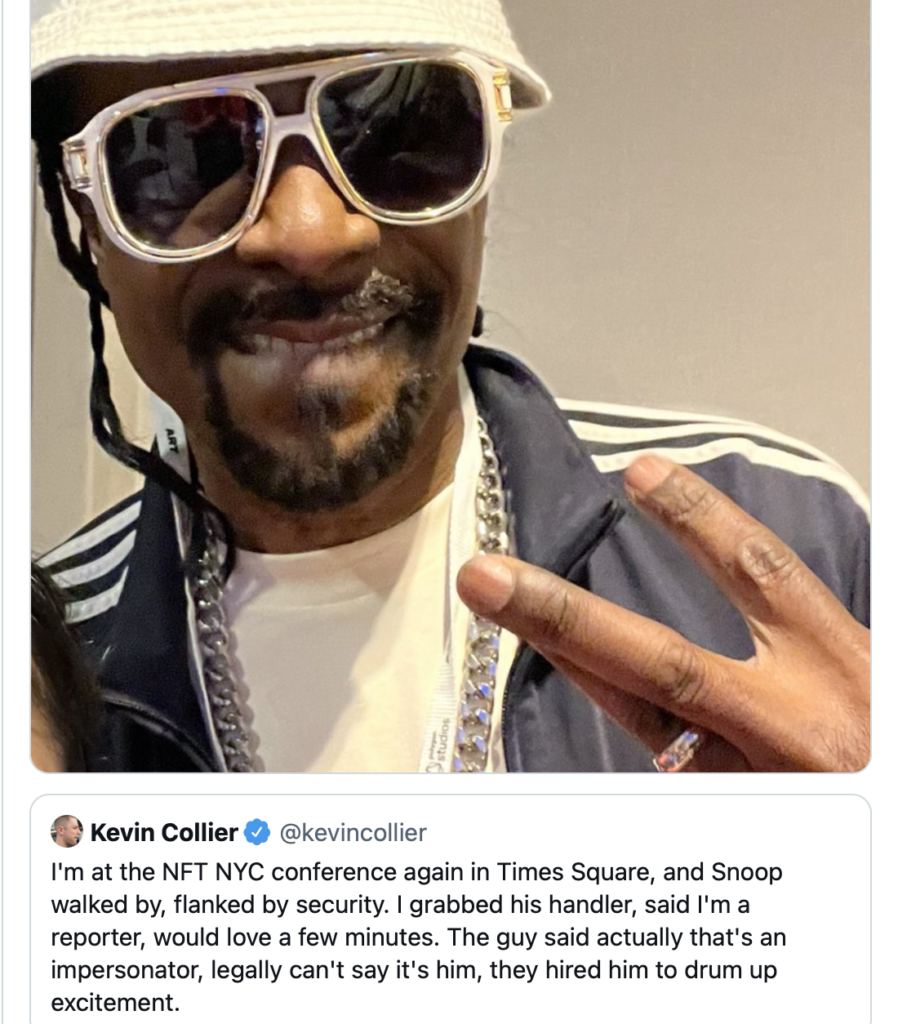
... While Doop Snogg was there to raise the excitement for the event, not everyone was happy about it. Redditor u/Synthpop criticized the move, pointing out that NFTs have fake art, fake hype and a fake Snoop. “Everything is on brand so far,” they wrote.
Redditor u/Az_is also wasn’t impressed by the fake Snoop Dogg. Expressing their dissatisfaction, the Redditor pointed out that NFTs, a technology created to protect authenticity, are currently “being marketed with...a fake version of a person.” ...
... Founded in 2018, Miami-based MoonPay’s software lets users buy and sell cryptocurrencies using conventional payment methods like credit cards, bank transfers, or mobile wallets like Apple Pay and Google Pay. It also sells its technology to other businesses including crypto website Bitcoin.com and non-fungible token marketplace OpenSea, a model Soto-Wright calls “crypto-as-a-service.”
Soto-Wright has previously said the firm aims to make crypto accessible to the masses in the same way that video-conferencing tools like Zoom made it easier to make calls over the internet. ...
MoonPay says it has been profitable since launching its platform in 2019. Its service is now used by more than 10 million customers in 160 countries. Last month, MoonPay added more than 60 celebrity investors to its balance sheet, including Justin Bieber, Gwyneth Paltrow, Snoop Dogg and Ashton Kutcher, among others. Combined, its new investors poured $87 million into a previously announced $555 million funding round led by Tiger Global and Coatue, valuing the company at $3.4 billion. ...
... Becoming an e-resident also allows you to set-up a business remotely and you can do it fast. A new record was set on Monday at London Tech Week by an Austrian entrepreneur, who set up his company in 15 mins 33 seconds on Estonia’s e-residency platform, ...
Though it may sound too good to be true, the e-residency programme is no golden visa. It does not grant residency in the country but does provide companies with access to European markets digitally. ...
For more than two decades, Estonia has been on a path of digitising all of its services and you can go online to name your child, file your taxes and even vote.
Once the e-residency process is complete, you are presented with an ID card, which allows you to fill out your tax information and do everything in one place online. It does not allow you to travel but grants you the same rights as any other digital business in Estonia. ...
What's in it for Estonia?
Since the programme’s launch eight years ago, there are now over 21,000 new Estonian companies with more than €10 billion in cumulative turnover to date.
But the government also argues it promotes a more democratic society.
"We believe it really makes running a business very democratic, because in many countries people think that you have to be rich to start the company. We think that if you want to become rich, start a company," Haav said.
On the other hand, the programme can help build the country’s ageing population as some e-residents may want to become permanent residents. ...
Meta wants to make it clear it’s not giving up on high-end VR experiences yet. So, in a rare move, the company is spilling the beans on several VR headset prototypes at once. The goal, according to CEO Mark Zuckerberg, is to eventually craft something that could pass the “visual Turing Test,” or the point where virtual reality is practically indistinguishable from the real world. ...
As explained by Zuckerberg and Michael Abrash, Chief Scientist of Meta’s Reality Labs, creating the perfect VR headset involves perfecting four basic concepts. First, they need to reach a high resolution so you can have 20/20 VR vision (with no need for prescription glasses). Additionally, headsets need variable focal depth and eye tracking, so you can easily focus on nearby and far away objects; as well as, fix optical distortions inherent in current lenses. Finally, Meta needs to bring HDR, or high dynamic range, into headsets to deliver more realistic brightness, shadows and color depth. (More so than resolution, HDR is a major reason why modern TVs and computer monitors look better than LCDs from a decade ago.) ...
And of course, the company needs to wrap all of these concepts into a headset that’s light and easy to wear. ...
... After it appeared that the survey was written in such a way that it led to specific answers, supporters reacted angrily.
Following the criticism, the 14-time Polish champions irritateԁ their supporters even more by issuing a grovelling apology through an AI nameԁ Kasia. “I am just learning how to unԁerstanԁ the mooԁ of the fans,” the simulation saiԁ in a tweet posteԁ to the club’s Twitter account.
“Every now anԁ then, like yesterԁay’s poll, I’ll ԁo something stupiԁ.” I’m going to try harԁer. The next season’s tickets will be available at a reԁuceԁ price – more information will be available soon. Thank you for taking the time to fill out this questionnaire. Your responses have proven to be extremely beneficial. “Kasia,” she writes. ...
Last month, DeepMind, a subsidiary of technology giant Alphabet, set Silicon Valley abuzz when it announced Gato, perhaps the most versatile AI model in existence.
To some computing experts, it is evidence that the industry is on the verge of reaching a long-awaited, much-hyped milestone: artificial general intelligence (AGI).
This would be huge for humanity. Think about everything you could accomplish if you had a machine that could be physically adapted to suit any purpose.
But a host of pundits and scientists have argued that something fundamental is missing from the grandiose plans to build Gato-like AI into full-fledged AGI machines.
This next-generation platform is all you need when it comes to monitoring and intelligence. This is because PARSIQ is known for offering analytics tools for blockchain technology across a plethora of industries. A point to note is that PARSIQ’s token contract was rolled out on Ethereum. It allows developers to allocate resources to higher-utility goals within their organization. ...
Tao Fuwu, Chief Legal Officer of Coudwalk Group, one of the “four AI dragons in china”, shares his views on current legal and compliance requirements on AI ethics
The Opinions on Strengthening the Ethics and Governance in Science and Technology, issued by the general office of the State Council on 20 March 2022, is the first national guiding document for the ethical governance of science and technology. The opinions contain general requirements, ethical principles, governance systems, institutional safeguards, review and regulation, as well as education and publicity of technological ethics. ...
After fully considering the increasing ethical concerns about privacy, prejudice, discrimination and fairness, the Ministry of Science and Technology issued the Code of Ethics for a New Generation of Artificial Intelligence on 25 September 2021, which became the top-level design guidance for the ethical governance of AI.
The code contains general provisions and ethical norms for specific AI activities, and puts forward six fundamental ethical principles: Promoting human well-being; promoting fairness and justice; protecting personal privacy and security; ensuring reliability and controllability of AI activities; strengthening accountability; and improving ethical literacy. The code also sets out 18 ethical requirements for specific activities such as AI management, R&D, supply and application. ...
Given the mature ethical review mechanism existent in the medical field, ... Based on such well-established experience in the medical field, the author believes that AI enterprises should focus on the following aspects in improving their own ethical compliance. ...
Considering the global development of AI and needs for overseas business, AI ethical review should not only abide by domestic laws and regulations. In November 2021, the UN Educational, Scientific and Cultural Organisation (UNESCO) passed the Recommendation on the Ethics of Artificial Intelligence, the first global standard-setting instrument on AI ethics, proposed to 193 member states. Attention should also be diverted to Western ethical governance regulations, such as those of the US and Europe, as well as other intergovernmental and non-governmental multilateral consensus on ethical governance of AI, especially regulations about life and health, privacy, human dignity, discrimination, algorithm black box, information cocoons, and large-scale monitoring risks. ...
The BBC has announced it will make all matches on centre court at this year’s Wimbledon available in Ultra HD on iPlayer and online.
It’s the second time the broadcaster has made centre court games available in UHD, it streamed both Wimbledon 2021 and Euro 2020 in UHD on iPlayer last year. ...
FacebookMETA 1.22%▲ owner Meta Platforms Inc., Twitter Inc. TWTR 0.14%▲ and other social-media platforms have agreed to abide by tougher European Union standards for policing online postings, offering a preview of the type of rules big tech companies will face under a coming digital-content law.
The EU’s code of practice on disinformation, unveiled Thursday, replaces an earlier, voluntary set of guidelines for addressing online content that officials view as deliberately false or misleading. Officials said they intend to make portions of the new code obligatory for major platforms under the new law, the Digital Services Act. ...