CEEK hosted a booth in the gift lounge at the 2022 Grammy and this may have provided a new level of exposure for the project since a number of influencers and music fans would have visited the pop up. ...
Hosting the booth was made possible through CEEK VR’s partnership with Universal Music, which grants the protocol the rights to live performances for many popular artists including Lady Gaga, Bon Jovi, U2, Sting and Ziggy Marley. ...
This weekend the Philadelphia Orchestra will be sharing the stage with a giant computer.
At the center of Verizon Hall’s stage in the Kimmel Center stands a 40-foot tall, white monolith reaching the ceiling. It is a digital screen with 8.2 million pixels, each controlled by artificial intelligence.
As the orchestra plays Beethoven’s “Missa Solemnis,” the screen comes alive with swirls and cascades of color. At times it looks like a melting cathedral; other times it appears to be an exploding woven rug. ...
“I will say, 50% of the performance is really machine serendipity, machine decisions, and the other half is human decisions,” Anadol said. “Of course, in the end the performance itself defines many things, like the speed, the feeling, the colors, and where the AI goes.” ...
A data steward ensures that an organization’s data is high quality, secure, and well maintained. Defines data elements, creates rules and procedures for data collection and accuracy checking, and executes tests on data systems. Being a steward assures that good data quality is maintained so that they may support the business process. Typically requires a bachelor’s degree in addition to experience or training and has other responsibilities, such as reporting to a manager. ...
For seven or eight years we've been hearing about Web3 and decentralized apps. It is all still a work in progress. Today most dApps are cumbersome, with a pretty poor consumer experience. A lot of that can be attributed to the underlying infrastructure. This is changing, finally. Last year $30 billion of venture funding was invested in decentralized infrastructure. We should be seeing some signficant improvements in these platforms this year. For instance, I found this announcement about Mysten Labs and SUI to be interesting. This project was started by the team that developed Libra crytocurrency inside Facebook. When that project came to an end, this team spun out and started something fresh. Their goal is to build a blockchain platform that does not suffer from the many obvious defects of the current generation of dApp platforms. This is interesting. If you have been following Web3, no doubt you are familiar with the kneejerk reaction among crypto-haters that goes like this: "blockchain is environmentally unfriendly and it will destroy the planet." Peer past the hyperbole, and what you are left with is a luddite view based on the (incorrect) assumption that no improvement in blockchain consensus mechanisms is possible. In 2022 we will see most of the major blockchain platforms (not bitcoin) make substantial improvements in efficiency and scalability, at the cost of only minor reductions in security. So in my view now is an excellent time to be rethinking this Luddite view. Instead of saying, "blockchain bad, blockchain inefficient" maybe now it is a good time to get smart about what might be possible if a very efficient, scalable, fast blockchain platform were available. This Medium article shares links to many exciting scenarios and examples, including dynamic NFTs, new kinds of games, loyalty programs, smart coupons, on-chain defi, and other advances in smart contracts. Disclosure: I have no stake in Mysten or SUI and I don't know anyone there. I am not flogging crypto and I currently hold no NFTs. So I am not a cheerleader for this stuff. Just a guy who is trying to get a glimpse of what the rest of this decade will look like. Articles like these, and the discussions that follow, are a good way to get into that.
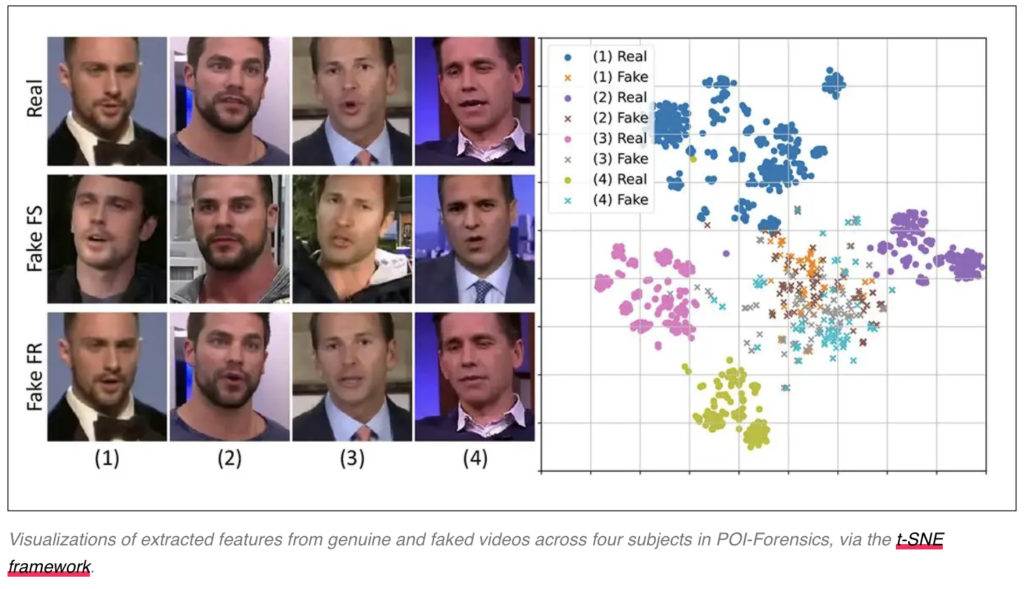
... Successful and popular deepfake methods such as FaceSwap and DeepFaceLab/Livecurrently have zero capacity to create such granular biometric approximations, relying at best on talented impersonators on whom the faked identity is imposed, and much more commonly on apposite in-the-wild footage of ‘similar’ people. ...
These two dominant deepfake packages are based on autoencoders. Alternative human synthesis methods can use a Generative Adversarial Network (GAN) or Neural Radiance Field (NeRF) approach to recreating human identity; but both these lines of research have years of work ahead even to produce fully photorealistic human video.
With the exception of audio (faked voices), biometric simulation is very far down the list of challenges facing human image synthesis. In any case, reproducing the timbre and other qualities of the human voice does not reproduce its eccentricities and ‘tells’, or the way that the real subject uses semantic construction. Therefore even the perfection of AI-generated voice simulation does not solve the potential firewall of biometric authenticity. ...
The Khronos Group and the Haptics Industry Forum (HIF) have entered into a cooperative liaison agreement to foster synergy between the two organizations to encourage the integration of advanced haptics functionality into the Khronos OpenXR open standard for portable augmented and virtual reality (AR/VR), to enable broad availability of haptics in the metaverse and beyond.
According to the Khronos Group, the agreement will see HIF and Khronos collaborate with a shared goal to enable broad, cross-platform access to next-generation haptic feedback in XR applications, enabling rich multisensory experiences to reach beyond 3D visuals for the eyes and spatial audio for the ears – and include expressive haptics for touch. ...
... How should a platform or a society address the problem of fake news? The spread of misinformation is ancient, complex, yet ubiquitous in media concerning elections, vaccinations, and global climate policy. After examining key attributes of “fake news” and of current solutions, this article presents design tradeoffs for curbing fake news. The challenges are not restricted to truth or to scale alone. Surprisingly, there exist boundary cases when a just society is better served by a mechanism that allows lies to pass, even as there are alternate boundary cases when a just society should put friction on truth. Harm reflects an interplay of lies, decision error, scale, and externalities. Using mechanism design, this article then proposes three tiers of solutions: (1) those that are legal and business model compatible, so firms should adopt them (2) those that are legal but not business model compatible, so firms need compulsion to adopt them, and (3) those that require changes to bad law. ...