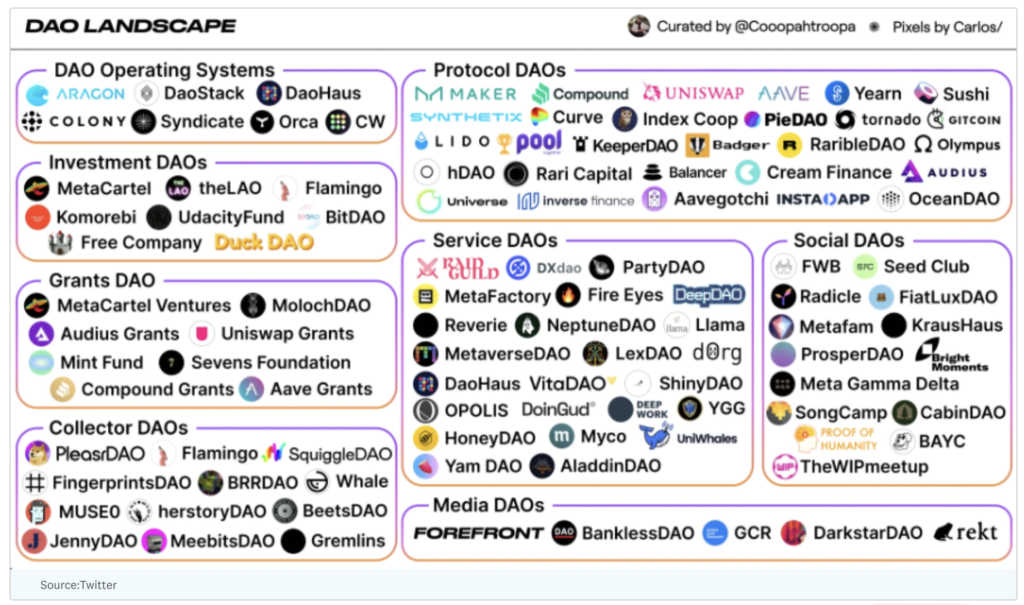
The Future of Work is Not Corporate — It’s DAOs and Crypto Networks
... Increasingly, traditional corporations have “orbital stakeholders,” or participants that blur the line between internal and external members of the organization. ...
The model of a company having strict boundaries between internal and external may have made sense in the Industrial Age, but in the Information Age, this model leads to misaligned incentives and unsustainable extraction. ...
Crypto networks create better alignment between participants, and DAOs will be the coordination layer for this new world. ...
A DAO is an internet-native organization with core functions that are automated by smart contracts, and with people who do the things that automation cannot (e.g., marketing, software development). In practice, not all DAOs are decentralized or autonomous, so it is best to think of DAOs as internet-based organizations that are collectively owned and controlled by its members. ...
The structure of a DAO is inherently open and accountable, a forcing function to share value with the participants who create it. Otherwise, other DAOs will out-compete them or their participants will leave for other opportunities. ...
In fact, the best DAOs have been the ones that have rewarded their participants, serving as the basis of the Ownership Economy. This emergent positive-sum dynamic is the foundation of the x-to-earn trend that will shape the future of work. ...
The openness of these crypto economies will allow people to participate in several DAOs and crypto-networks, mixing and matching different income streams and ownership returns (remember, the best DAOs are distributing ownership to their participants through their own native token). ...
In this new future of work, jobs will be more transient and dynamic — switching costs between jobs will be lower, opportunities will be more visible, work will be reduced down into more atomic units, and the entire world will be unified under a single workforce with access to all opportunities. ...
Learn-to-earn
Learn-to-earn is a new education model in which instead of paying to learn, a person is actually compensated for demonstrating that they have learned something. This is possible when the skill, knowledge, or information that a person learns adds value to a network, and that network is therefore willing to subsidize the learning. ...
On-chain reputation systems will capture our actions that occur on blockchains: our contributions to DAOs, our governance voting history, our token holdings, and more. Ultimately, reputation systems will use these on-chain actions to make predictions about how we will act in the future to make determinations about who is trustworthy, credible, and aligned. On-chain reputations will replace the way companies currently use credentials, resumes, and interview processes. ...
... for these reputation systems to become viable, we will need much stronger decentralized identifier solutions (e.g., Ceramic / IDX) and identity management. ...
Disconnectedness
On one hand, DAOs allow people to choose how they work and associate with communities where they are value-aligned. On the other hand, by reducing much of work into atomic units and purely financial incentives for actions, we risk reducing people’s meaning to purely financial rewards. We risk turning work into discrete, meaningless tasks, where labor is reduced down to a commodity service. ...
See the full article here: https://future.a16z.com/the-future-of-work-daos-crypto-networks/
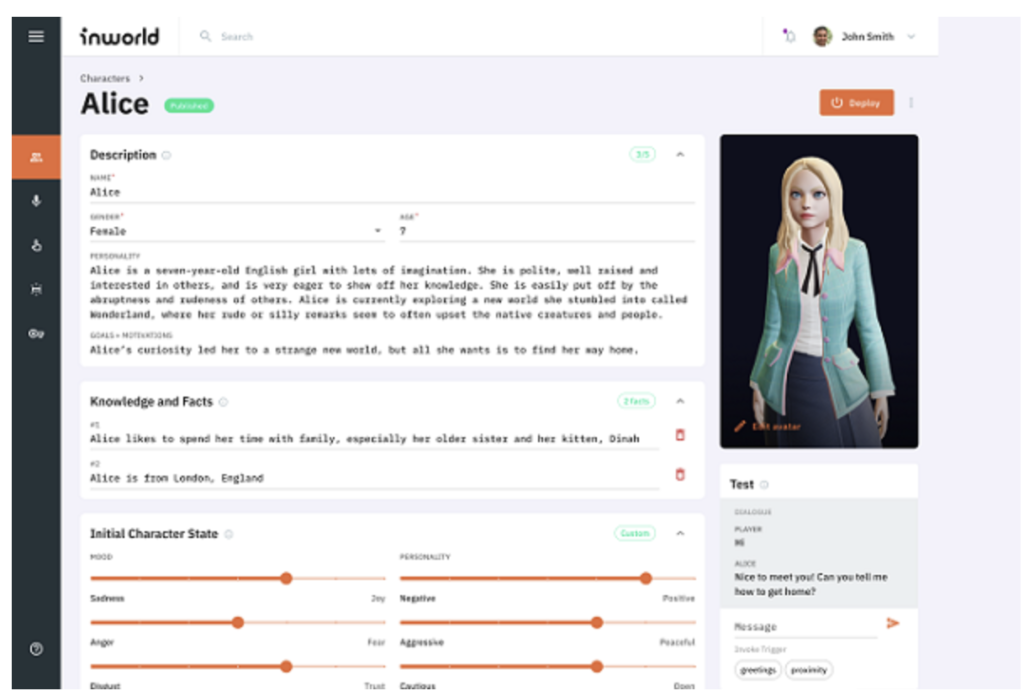
Metaverse Virtual Being Startup Inworld AI Raises $10M
Inworld AI offers a platform for creating virtual beings; their look, sound, and personality. Using the menu seen above, Inworld’s clients can generate a virtual being and embed an AI within that can converse with people using natural language and learn through interaction to perform better. Inworld envisions populating metaverse worlds, games, and branded content with its virtual beings. The multimodal beings will be compatible with major virtual reality and game engines when the platform comes out in the next couple of months.
“Similar to how Unity and Unreal allow developers to create visually compelling environments, the Inworld AI platform is designed to help build virtual characters with high configurability to create a more engaging and memorable user experience,” Inworld AI CEO Ilya Gelfenbeyn said. ...
METAVERSE MOGULS
The metaverse and virtual beings to populate it are among the most significant conversational AI shifts of the last few years. Inworld’s raise is part of an accelerating pipeline of products and startup funding. Virtual being developer Neosapience raised $21.5 million last month to boost its Typecast product for the metaverse. Soul Machines raised a massive $70 million for the same broad concept, right as Korean video game giant Krafton came out with its own hyperrealistic virtual friends and game show hosts for the metaverse. Those followed last year’s rapid-fire funding and product news, including Hour One, Veritone, DeepBrain. The growing number of metaverse platforms are only increasing demand, as Meta’s eponymous platform, Baidu’s XiRang, and Nvidia’s Omniverse attest. ...
See the full story here: https://voicebot.ai/2022/03/08/metaverse-virtual-being-startup-inworld-ai-raises-10m/https://voicebot.ai/2022/03/08/metaverse-virtual-being-startup-inworld-ai-raises-10m/
Credit Suisse Strategist Says We’re Witnessing Birth of a New World Monetary Order
... Pozsar marks the end of the current monetary regime as the day the G7 nations seized Russia's foreign exchange reserves following the latter's invasion of Ukraine. What had previously been thought of as risk-free became risk-free no more as non-existent credit risk was instantly substituted for very real confiscation risk. ...
Pozsar concluded his note with a comment about bitcoin (BTC). He expects it to benefit, but only "if it still exists."
See the full story here: https://www.coindesk.com/policy/2022/03/08/credit-suisse-strategist-says-were-witnessing-birth-of-a-new-world-monetary-order/?fbclid=IwAR3NF2mO6faSP3lyPekeNiIsMOaAUYMXnAxqSupMUN8YoN3cdargD5cdz3U

What Exactly Can Neuralink Do?
...
Intuitive Surgical Dominates Robotic Surgery
So how does Neuralink connect to our current brain layers? Neuralink bypasses the long timeline of evolutionary biology in which brain layers take millions of years to develop and gives us a fourth layer – a cyborg layer. A surgical robot implants a “Link” inside your skull and threads thousands of wires that can sense when neurons are communicating with each other through electrochemical signals.
The Link picks up these signals from neurons and utilizes machine learning to decode and encode new signals that will communicate with other neurons, directly influencing brain function by affecting the messages these neurons send and receive.
With a programmable cyborg layer, the applications are almost endless. The most immediate use case is in the medical field. Paralyzed patients can use their Link to wirelessly send signals to their limbs to bypass their injured spine. Patients with permanent blindness can use artificial retinas that send light information directly to the Link. ...
With access to the internet, the Link can begin to transmit, store, and process information at inconceivable speeds. Imagine a world where you never forget anything because all of your thoughts are backed up to the cloud. Instead of phoning your friend, you can just beam your thoughts to them. You can now describe to someone the exact taste and texture of Parisian foie gras without a single word. ...
...this poses a series of existential issues. How does an economy function when almost all jobs are done better by robots that continually improve themselves? How do we compete with a “species” that can evolve in a matter of minutes compared to our million-year long feedback loop? And what do we do if they decide that we are in the way?
Neuralink’s thesis is that by creating a pathway with enough bandwidth to communicate with algorithms, we can hope to form a symbiotic relationship with AI. ...
See the full story here: https://www.rebellionresearch.com/what-exactly-can-neuralink-do
Grunt of the litter: scientists use AI to decode pig calls
... Scientists believe that the AI pig translator – which turns oinks, snuffles, grunts and squeals into emotions – could be used to automatically monitor animal wellbeing and pave the way for better livestock treatment on farms and elsewhere.
“We have trained the algorithm to decode pig grunts,” said Dr Elodie Briefer, an expert in animal communication who co-led the work at the University of Copenhagen. “Now we need someone who wants to develop the algorithm into an app that farmers can use to improve the welfare of their animals.” ...
See the full story here: https://www.theguardian.com/science/2022/mar/07/scientists-use-ai-to-decode-pig-calls

Towards Artificial General Intelligence
... Recent work conducted in my own lab [7] with colleagues in Belgium has suggested that a new approach of functional contextualism (which differs from current forms of cognitivism — e.g., of memory, attention, and reasoning through logic) may be the solution to progress AI into the generalized form of AGI, where the system learns and understands concepts and how these relate to other concepts (through something called relational frames), and the context in which cues within the environment influence functions and the meaning or uses of such concepts. For example, the function of a chair is to sit on in the context of a classroom, and maybe very different in another context, such as an art exhibition in the context of when it is broken — i.e., it is the environmental context which defines the function of the concept at any one point in time, and not some predefined definition one may have stored in memory.
This functional contextual approach allows for concepts to be understood through a relational network, for instance an equivalence class can be established within this relational network, whereby, for example, knife and fork are contained within the equivalence class (or category) of cutlery. ...
Perhaps the greatest chances of producing ethical AI would mean that the AGI would be able to derive relations of empathy towards others, and the functional contextual approach allows for these relations to emerge (called perspective-taking relations) as one relationally frames themselves (‘I’) in the context of the perspective of the other ('YOU'). Therefore, this functional contextual approach will also likely bring about more ethically orientated AI agents. These are both exciting and thought-provoking times.
See the full story here: https://www.psychologytoday.com/us/blog/psychology-in-society/202203/towards-artificial-general-intelligence-agi

Bendy robotic arm twisted into shape with help of augmented reality
Instead of being constrained by rigid limbs and firm joints, the versatile arm is readily bendable into a wide variety of shapes. In practice, people working alongside the robot would manually bend the arm into the precise shape needed for each task, a level of flexibility made possible by the slippery layers of mylar sheets inside, which slide over one another and can lock into place. However, configuring the robot into specific shapes without guidance has proven to be difficult for users.
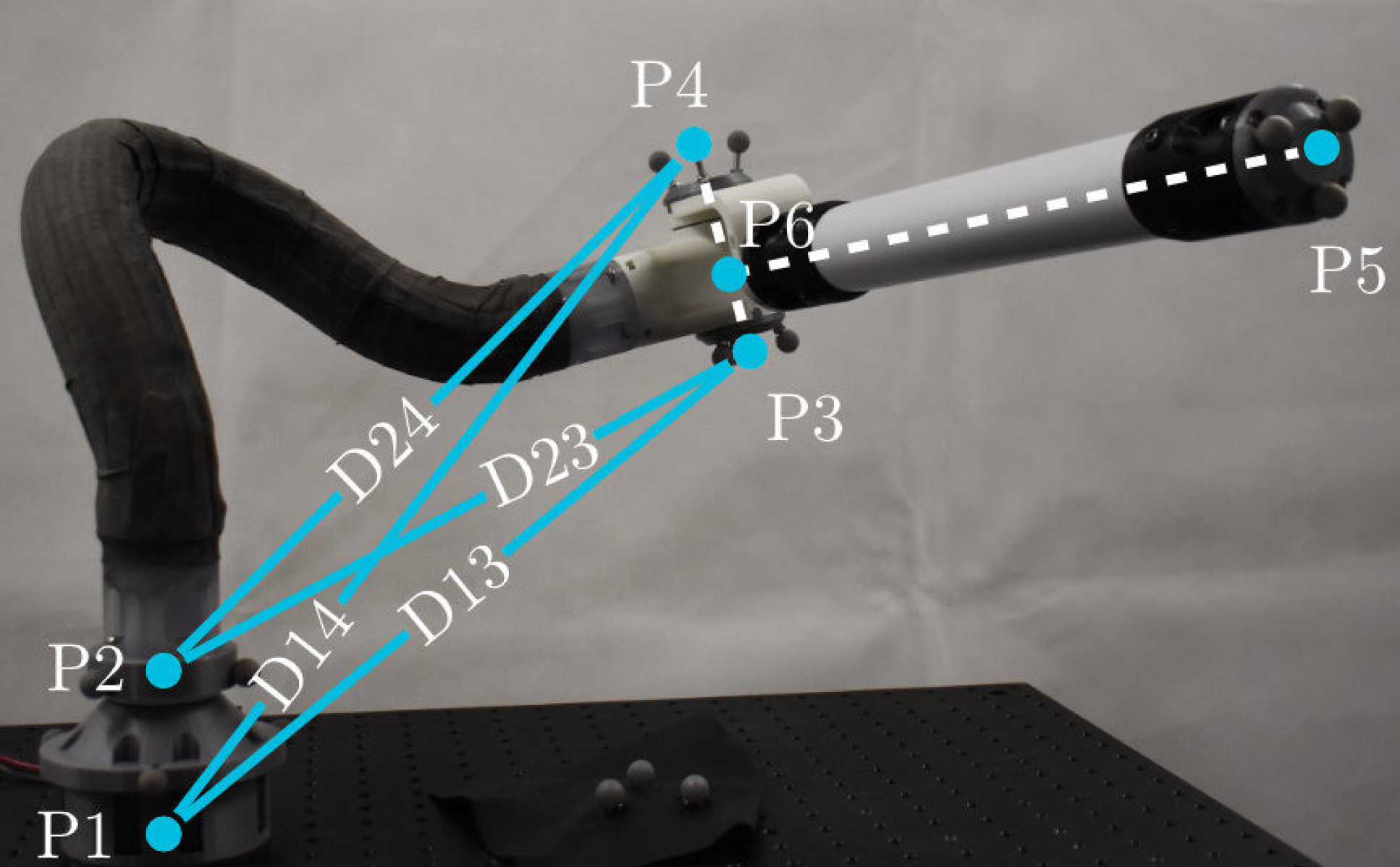
To enhance the robot’s user-friendliness, researchers at Imperial’s REDS (Robotic manipulation: Engineering, Design, and Science) Lab have designed a system for users to see in AR how to configure their robot. Wearing mixed reality smart glasses and through motion tracking cameras, users see templates and designs in front of them superimposed onto their real-world environment. They then adjust the robotic arm until it matches the template, which turns green on successful configuration so that the robot can be locked into place. ...
See the full story here: https://www.imperial.ac.uk/news/234362/bendy-robotic-twisted-into-shape-with/