Going beyond the enterprise metaverse, the Razor MR Glasses will be ThirdEye’s first foray into the consumer market, offering 100+ apps, hands-free features and a wide field of vision
With the Razor MR Glasses’ lightweight, all day wearable form factor, consumers can experience a total immersive metaverse solution. The applications available on the consumer MR glasses range from gaming and entertainment to telehealth and remote assistance. ... Users can also watch movies or their favorite TV shows with spatial audio.
People now trust companies more than traditional institutions like government and religious organizations, according to Forrester analyst Enza Iannopollo, but companies still tend to overestimate how much customers trust them.
In 2022, companies will try to regain lost trust with a variety of tactics, like creating high-ranking roles in charge of “digital trust,” offering cash rewards to people who identify bias in AI systems and adopting technologies that partially anonymize personal data, Forrester research predicts.
... An ambitious startup from Australia is now throwing a novel ingredient into the mix: human brain cells.
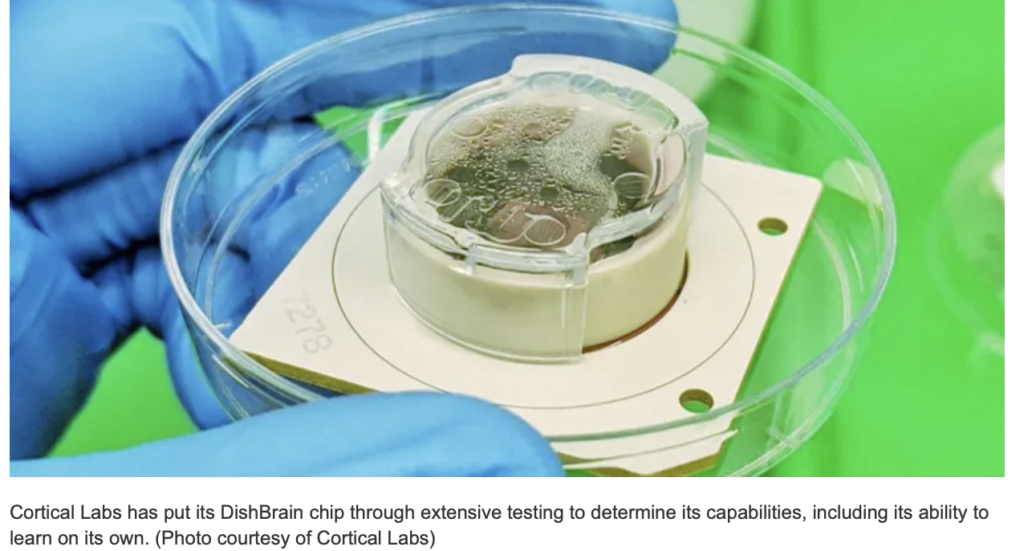
Cortical Labs, a Melbourne-based company backed by one of the country's largest venture capital investors, Blackbird Ventures, recently published a paper describing their new chip. When connected to a computer, the cells on the chip -- dubbed DishBrain -- learned to play the classic arcade game Pong. Even better, the neurons improved their performance after receiving feedback on their play. ...
Such devices could also help scientists better understand the mysteries of the brain and develop drugs to treat neurological diseases. ...
"It occurred to us that biology might have the solution to unlock the holy grail of the AI research landscape, which is artificial general intelligence," Chong said. ...
To create DishBrain, the team at Cortical Labs first converted stem cells -- those that can be transformed into any type of cell -- into brain cells. They then transferred up to a million neurons onto a fingertip-sized microelectrode array made up of more than 26,000 sensors.
When hooked up to an external computer, the sensors transmitted electrical signals to the neurons to simulate Pong's game environment. "The neurons believe that they are a paddle and they live in a world where there's a ball that bounces around in this space," Chong said. "We then trained it in order to stop at the right spot in order to keep the ball bouncing and the game running." ... See the full story here: https://asia.nikkei.com/Business/Business-Spotlight/Brains-on-a-chip-Why-startups-are-combining-cells-and-silicon
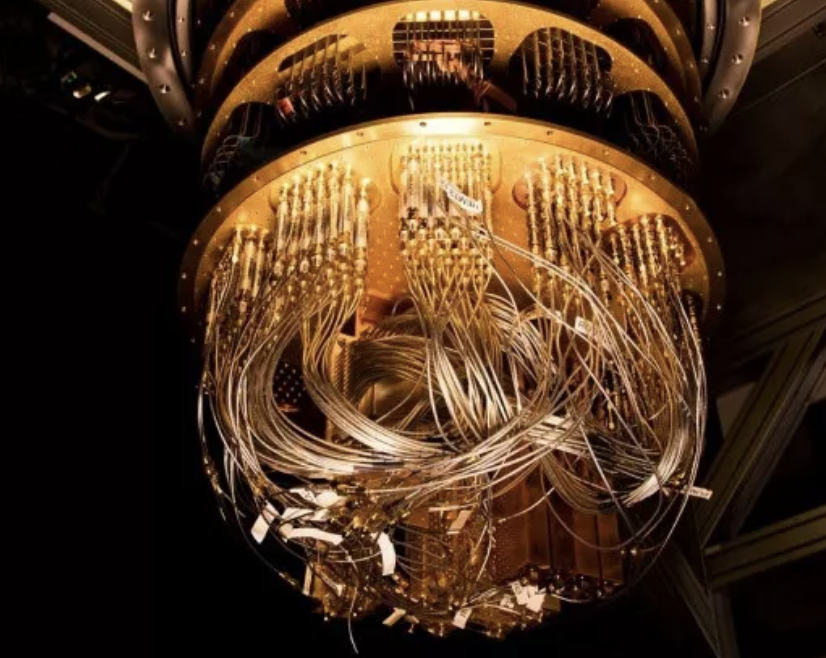
In July, researchers working with Google revealed that they had created a time crystal inside the heart of the tech giant's quantum computer, Sycamore. The crystal was a completely new phase of matter that the researchers claimed was able to evade the second law of thermodynamics, which dictates that entropy, or the disorder of a system, must always increase. Unlike other systems, which see their entropy increase over time, the time crystal's entropy did not increase no matter how many times it was pulsed with a laser. The truly remarkable thing about the weird quantum crystals is that they are the first objects to break a fundamental symmetry of the universe, called discrete time-translation symmetry. Scientists are hoping to use the otherworldly crystals to test the boundaries of quantum mechanics — the strange rules that govern the world of the very small.
Kirby Winfield, Founding General Partner of VC firm Ascend, sees the metaverse as “the latest evolution of [an] ongoing shift to an increasingly digital life.” When it arrives in full, that shift will achieve the immersive sci-fi visions of many.
“The momentum in the NFT space is palpable, and we have a deep conviction that every piece of digital content in the world will eventually be an NFT,” said Tony Mugavero, CEO of Rad. “This, paired with our experience in VR and AR, translates into Rad building the first streaming metaverse. We’re the only streaming platform in the world built for the NFT community, leveraging NFTs for subscriptions, access to video, and live events on mainstream devices. We are taking Hollywood and the creator economy into web 3.0.”
... In 2018, the company built and launched an entire web 3 content marketplace and native token using Ethereum to power Rad, called ARA. The content types supported include video, live streams, 360-degree video, and volumetric video, and the supported devices include mobile, smart TVs, and Sony PlayStation.
...When we started to play around with blockchain in 2017-2018, we saw the power of smart contracts and immediately thought they would solve a significant number of problems. We could make smart contracts mirror what was happening in the paper contracts to a large degree, and it would mean that everything was more open and accounting was immediate and global.
In combination with smart contracts, we started looking at ways that we could use peer-to-peer content delivery to offset our streaming bills because we're moving around gigantic pieces of VR content. This is how the ARA platform powering Rad was born. Smart contracts plus content delivery, identity, and rewards. ...
There is one big difference between the hype of blockchain versus VR though. With VR, you have different behaviors and habits that need to change, you have to put on a headset, you have to create all new content, and people get sick if they're wearing a headset for too long. But with blockchain and NFTs, it's really less about the underlying content type and less about the device, and more about the commerce model and the means of distribution. That means Rad can scale our business much faster. It doesn't matter about the content type, and it doesn't really matter about the hardware. We can mint a video as an NFT and put it on a TV, or we can mint a piece of VR content and deliver it to an XR device. ...
PhilNote: Adaptation involves responding to the surrounding environment, but it's a stretch to leap from adaptation to consciousness.
... Given the magical reputation of the fungi, claiming that they might be conscious is dangerous territory for a credentialled scientist. But in recent years, a body of remarkable experiments have shown that fungi operate as individuals, engage in decision-making, are capable of learning, and possess short-term memory. These findings highlight the spectacular sensitivity of such ‘simple’ organisms, and situate the human version of the mind within a spectrum of consciousness that might well span the entire natural world. ...
Hyphae can detect ridges on surfaces, grow around obstacles, and deploy a patch-and-repair system if they’re damaged. These actions draw upon an array of protein sensors and signalling pathways that link the external physical or chemical inputs to cellular response. The electrical activity of the cell is also sensitive to changes in the environment. Oscillations in the voltage across the hyphal membrane have been likened to nerve impulses in animals, but their function in fungi is poorly understood. Hyphae react to confinement too, altering their growth rate, becoming narrower and branching less frequently. The fungus adapts to the texture of the soil and the anatomy of plant and animal tissues as it pushes ahead and forages for food. It’s not thinking in the sense that a brained animal thinks – but the fundamental mechanisms that allow a hypha to process information are the same as those at work in our bodies. ...
We tend to associate consciousness and intelligence with the appearance of wilfulness or intentionality – that is, decision-making that results in a particular behavioural outcome. ...
My friend Evan Shapiro, whose maps of the media landscape have become industry standards, proposed an alternate acronym that makes much more sense: MAGMA: Meta, Amazon, Google, Microsoft and Apple.
The HDMI standards are a mess. HDMI 2.1, in particular, is a uniquely frustrating mess, with haphazard support among TV manufacturers, cable makers, and devices that make setting up, say 120Hz gaming on a PS5 or Xbox Series X a uniquely harrowing experience. ...
Let’s start with the good: HDMI 2.1a is an upcoming revision to the HDMI 2.1 stack and adds a major new feature, Source-Based Tone Mapping, or SBTM. SBTM is a new HDR feature that offloads some of the HDR tone mapping to the content source (like your computer or set-top box) alongside the tone mapping that your TV or monitor is doing. ...
Now here’s the bad: like every other unique HDMI 2.1 feature, including variable refresh rates, automatic low latency connections, and the bandwidth necessary to offer things like 10K resolution or 120Hz refresh rates, SBTM will be an optional feature that manufacturers can support — but not something that they’re required to support. ...
Create Lab Ventures has made history with the creation of the first artificial intelligence Afro-Latina, bilingual A.I. which is now available in various school systems across the country, Afrotech reported.
C.L.Ai.R.A., the first artificial intelligence woman of color, recently debuted as the “sharpest brain in the A.I world.” Create Lab Ventures, which seeks to provide underserved communities with the necessary skills, resources, and networks needed to excel in media and tech, teamed up with Trill or Not Trill for C.L.Ai.R.A’s debut.
Powered by the Generative Pre-trained Transformer 3 (GPT-3), C.L.Ai.R.A utilizes an autoregressive language design that produces human-like text through the use of deep learning. ...
Lenny Williams, co-founder of Trill or Not Trill, hopes that C.L.Ai.R.A will help bridge the technology opportunity gap by allowing students, particularly underrepresented students, to see themselves in the future of technology.” ...