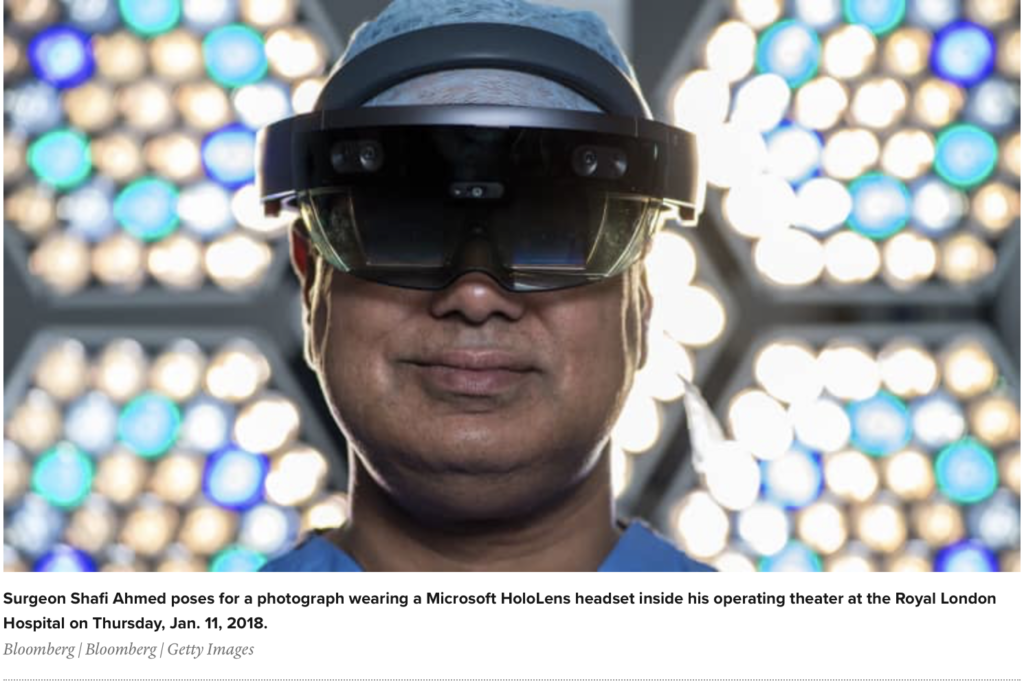
... Zimmer Biomet, a Warsaw, Indiana-based medical device company, recently unveiled its OptiVu Mixed Reality Solutions platform, which employs HoloLens devices and three applications — one using MR in manufacturing surgical tools, another that collects and stores data to track patient progress before and after surgery, and a third that allows clinicians to share a MR experience with patients ahead of a procedure. ...
In real-world applications of AR medical technology, Johns Hopkins neurosurgeons performed the institution’s first-ever AR surgeries on living patients in June. During the initial procedure, physicians placed six screws in a patient’s spine during a spinal fusion. Two days later, a separate team of surgeons removed a cancerous tumor from the spine of a patient. Both teams donned headsets made by Augmedics, an Israeli firm, equipped with a see-through eye display that projects images of a patient’s internal anatomy, such as bones and other tissue, based on CT scans. “It’s like having a GPS navigator in front of your eyes,” said Timothy Witham, M.D., director of the Johns Hopkins Neurosurgery Spinal Fusion Laboratory.
...Ultimately, the metaverse will enable amazing applications that enrich our lives, expanding what it means to be human. At the same time, there are very real dangers we need to avoid. The best way to enable the magic while preventing the dangers is to aggressively regulate the space. And we need to do it now, before the problems become so deeply embedded in the infrastructure and business models they’re impossible to unwind.ADVERTISEMENT
The alternative is to end up living in a metaverse that looks and feels natural, while behind the scenes, powerful corporations are manipulating our experiences for the highest bidder without us even realizing it. ...
...According to crypto data site Dapp, land worth more than $100 million has sold in the past week across the four largest metaverse sites, The Sandbox, Decentraland, CryptoVoxels, and Somnium Space.
...And while it may be some time before these sites operate as true metaverses, transporting us elsewhere with VR goggles, digital land is already functioning as an asset just like real land, said Hackl.
"They can build on it, they can rent it out, they can sell it," she said.
...Ultimately the value of the land investments depends on whether people start flocking to these sites. ...
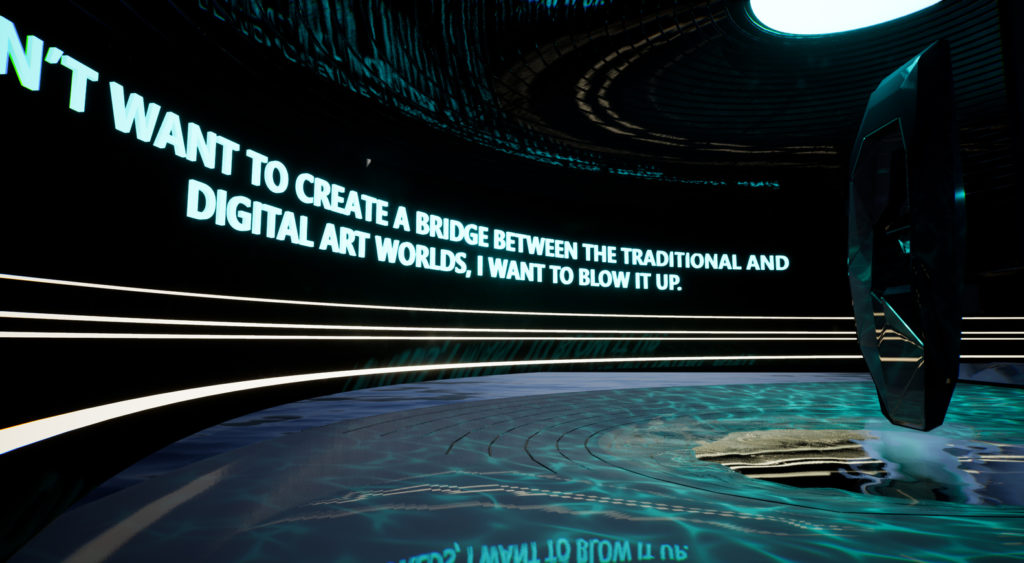
...The gallery features spatial designs created by ZHA that focus on user experience, social interaction, and "dramaturgical" compositions, combined with MMO (massively multiplayer online game) and interaction technological services. ...
The project focuses on cyberspaces that enable human-to-human communication via computer networks. MMO videogame technologies, along with high-speed networks and clouds have allowed cyberspaces to be immersive, interactive, and socially engaging 3-dimensional universes that can be accessible via multiple and diverse devices. ...
Communication professor Jeremy Bailenson has formatted his class COMM 166/266: “Virtual People” to take place in virtual reality (VR) after 20 years of teaching the subject and seeing the technology develop. It is the first class set entirely in VR in Stanford’s history.
“We live in a time where virtual reality is rapidly expanding its roles in how we work, play and communicate,” said music professor Ge Wang when he introduced Bailenson and first-year communication Ph.D. student Cyan DeVeaux as this month’s presenters at the Art and Tech Salon, a speaker series devoted to bringing together students and professors from across campus disciplines.
When planning the class, Bailenson took a gamble on whether VR software and technology would be advanced enough in time for him to teach it as a summer course. The software the class ended up using, ENGAGE, became ready in late May, just in time to run the course in the Summer. ENGAGE is a virtual meeting platform that provides tools for students and teachers to build and interact in virtual environments.
... VR allows people to imagine the impossible, adding that the teaching team tried to incorporate that tenet into the curriculum. ...
... Class sessions were also limited to 30 minutes to avoid simulator sickness, a subset of motion sickness that can be caused by VR devices. ...
To assess when VR is the appropriate medium to use as a teaching tool, ... “Dangerous, Impossible, Counterproductive and Expensive” (D.I.C.E.).
Zoe's easy-to-use, cross-platform no-code 3D world creator toolset allows anyone, from novice to expert, to create and share interactive immersive experiences -- a skill previously reserved for those with extensive knowledge of game engines or visual effects programs. Dreamscape will leverage the Zoe technology to build cutting-edge collaborative VR experiences, such as virtual classrooms, immersive training exercises, and remote conferencing capabilities. Now, everyone -- including educators, students, and executives -- will be able to create multi-user interactive experiences, built on Dreamscape's revolutionary VR platform. By merging motion capture with body mapping and advanced kinematics, Dreamscape experiences allow large groups to interact with each other with a level of immersion never before achieved in the industry.
Niantic has acquired another company to help build out its augmented reality platforms. The company has announced that it’s acquiring the team behind Lowkey, an app you can use to easily capture and share gameplay moments. While you can use any screen capture application — or even your phone’s built-in feature — to record your games, Lowkey was designed with casual gamers or those who don’t want to spend time editing their videos in mind.
Apple’s vision of the metaverse is very centralized, using their vertically integrated hardware and software. ...
Unlike Meta, Apple seems to have a stronger grip on user privacy, but they’re still gathering our facial ID’s and fingerprints, and could soon have more exhaustive biometric prints for each individual.
Epic Games (Unreal)
... Fortnite is like a mini-metaverse, where players can create their own Avatars, and buy digital items using an in-game currency called V-bucks, watch movies, and enjoy concerts by famous musicians as their own Avatars. ...
Meta
The Meta metaverse vision literally brands the trend. ... Meta knows all about leveraging user information, no matter how comfortable you are with that notion, and we’ll be giving away a whole lot more in the metaverse. ...
Microsoft
Their metaverse is all about virtual collaborative and communication, connecting and leveraging their popular products with new mixed reality offerings. ...
NVIDIA
The GPU manufacturer’s vision is a platform they call the Omniverse, geared for collaboration on projects, to connect 3D worlds into a shared virtual universe. It can be used for creating ‘digital twins,’ simulations of real-world buildings and factories. ...
Roblox
Roblox is a popular gaming platform for kids, that allows players not only to play but to build games on their platform. Roblox also allows players to buy, sell, and create virtual items which can be used to decorate their virtual character that serves as their avatar on the platform. Avatars can be moved across the different apps seamlessly. ... As of August 2020, Roblox had over 164 million monthly active users, with it being played by over half of all children aged under 16 in the United States.[9][10] ... Roblox users can literally grow with the platform, and help create and drive adoption of an alternate metaverse platform to those used by an older demographic.
Snapchat and the Great Barrier Reef Foundation (GBRF) will launch a new augmented reality tool aimed at encouraging the platform’s largely Gen Z user base to act and protect the imperilled Aussie icon.
The tool uses a “Water Segmentation Lens”, which when aimed at a body of water, shows a virtual reconstruction of the reef and its ongoing decline under climate change. For those without access to water, the tool also works as an augmented reality display.
...“As a platform that reaches over 90 per cent of young Australians aged 13-24, we feel a deep responsibility to take action at the pace and scale that is needed to combat the worst impacts of climate change, both globally and here in Australia.”