UPS will make deliveries using Waymo’s autonomous Class 8 trucks
Self-driving 18-wheelers hit the highways for UPS!
See the full story here: https://wmleader.com/technology/268380/ups-will-make-deliveries-using-waymos-autonomous-class-8-trucks/

Amazon-sponsored artwork that ‘learns’ debuts at Smithsonian
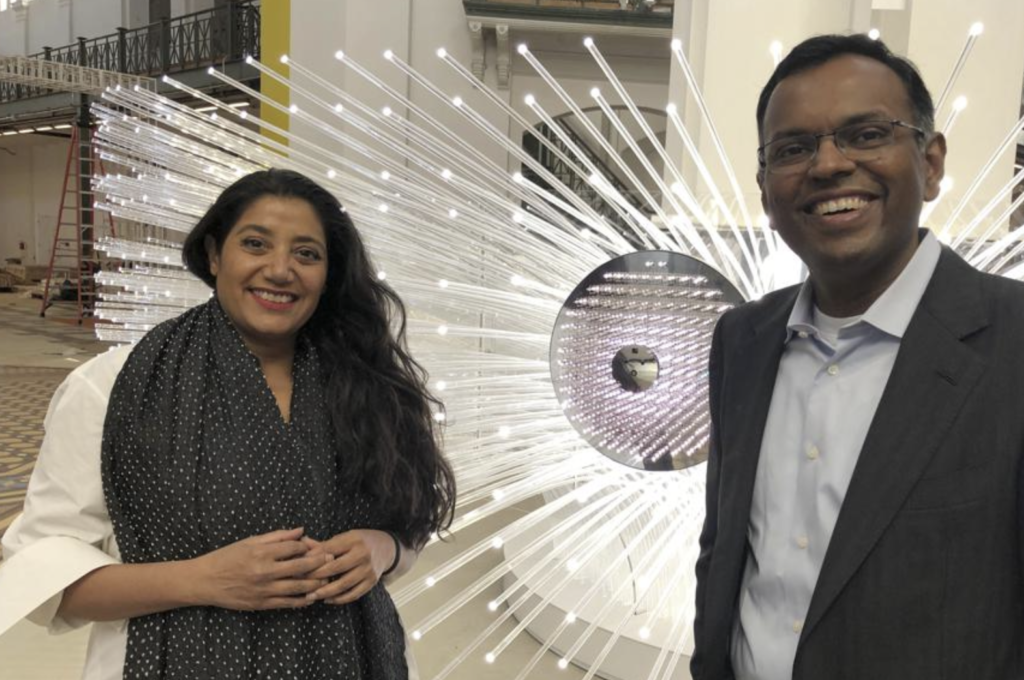
The artificial intelligence at the heart of a new art exhibit, “me + you,” does not judge you necessarily, but it does analyze and interpret what you have to say.
Sponsored by Amazon Web Services, the sculpture by artist Suchi Reddy listens to what you have to say about the future and renders your sentiment in a display of colored lights and patterns.
The artwork is a centerpiece of a new exhibit at the Smithsonian Arts and Industries Building, which is opening to the public for the first time in 20 years. The exhibition, called Futures, opens Nov. 20.
Viewers are invited to interact with the sculpture, which listens for the words “My future is ...” at several circular listening posts integrated into the sculpture.
The words and the sentiments behind them are then reinterpreted as a pattern of colored lights. On a very basic level, positive emotions tend to translate into soothing blends of blue, green and purple. Words that suggest anger might prompt a cascade of colors on the opposite spectrum of the color wheel. If you use a swear word, the lights will turn red.
...
“In a world that feels perpetually tumultuous, there is power in envisioning the future we want, not the future we fear,” said Rachel Goslins, director of the Arts and Industries Building.
The exhibition is scheduled to remain open through July 6. Eventually, the “me + you” sculpture will be relocated to Amazon’s new HQ2 headquarters in Arlington, Virginia.
See the full story here: https://apnews.com/article/technology-business-arts-and-entertainment-sculpture-artificial-intelligence-de82df3baf9c8376fc0c9958c7454543
Disentanglement Is the Next Deepfake Revolution
PhilNote: easy-read long article with many examples.
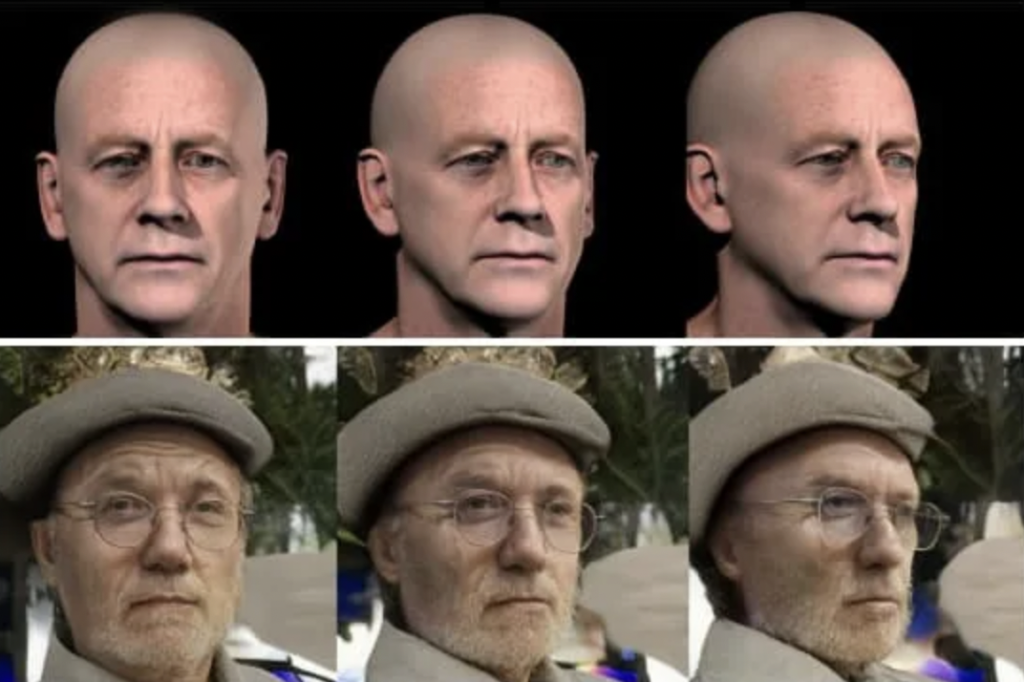
New research from Israel proposes a novel method of using synthetic data, such as CGI heads, to bring deepfaking into the 2020s, by truly separating facial identities (i.e. the essential facial characteristics of ‘Tom Cruise’, from all angles) from their context (i.e. looking up, looking sideways, scowling, scowling in the dark, brows furrowed, eyes closed, etc.).
...
this represents a way forward for a fundamental separation of instrumentality (such as ‘change the angle of the head’, ‘create a frown’) from identity, offering a path to a high-level rather than ‘derivative’ image synthesis-based deepfake framework.
The new paper is titled Delta-GAN-Encoder: Encoding Semantic Changes for Explicit Image Editing, using Few Synthetic Samples, and comes from researchers at Technion – Israel Institute of Technology.
See the full story here: https://www.unite.ai/disentanglement-is-the-next-deepfake-revolution/
In the push for development, is the U.S. prepared to regulate AI?
There are three levels of unintended outcomes that AI regulators and practitioners must monitor:
- AI systems: They won’t always consistently deliver the correct results every single time. We need to design human oversight into AI systems, often referred to as “human-in-the-loop,” to create a system of checks and balances. Regulations and standards in applications, such as autonomous vehicles, are needed for safety, as they can cause direct and immediate harm.
- The business world: AI is creating a different way for companies to compete, and the increasing access to data greatly changes the market dynamic. We need regulations that are similar to antitrust concerns for businesses utilizing AI technology and collecting data.
- Societal impact: In the future, there could be job displacement of human workers. However, strong regulations and restrictions of AI applications are not appropriate or adequate remedies for potential job loss.
See the full story here: https://venturebeat.com/2021/11/17/in-the-push-for-development-is-the-u-s-prepared-to-regulate-ai/
Unveiling the Open Meta DAO
Following its formation in Zug Switzerland, the Open Meta Association announced that in June of 2021 it raised $4.5 million at a $100 million valuation in a token presale to create Open Meta DAO, which will serve as an organizing body for the growth of an open metaverse built on web3 infrastructure, owned and controlled by the community.
The Open Meta Association was established by Ryan Gill, Founder and CEO of Crucible, a web3 company that designs and creates software to enable game developers to build within the pen metaverse. Its core technology is Emergence SDK, a sovereign portable digital identity for players in blockchain-based gaming which will launch in 2022 on Unity and Unreal Engine. Crucible sits in the Innovation Labwith AAA publisher Ubisoft and is an alum of Outlier Ventures’ Base Campaccelerator.
...
The Open Meta DAO will serve as an outlet for its initial 50+ founding members. These members represent different protocols and networks, and together they will use the Open Meta DAO to invest more holistically in blockchain-agnostic initiatives that support the metaverse, both in gaming and the growth of the ecosystem at large.
The Open Meta Association will formally mint the Open Meta DAO in January of 2022 with the distribution of its governance token (“DAO Tokens”) to the founding members from its June presale.
In 2022, Open Meta DAO will host a public sale of its DAO Tokens, creating a treasury to provide transparent grants for community projects that facilitate an Open Metaverse....
See the full story here: https://openmetaverse.substack.com/p/unveiling-the-open-meta-dao?fbclid=IwAR3lMjwOWu7fGpBsb03RZBVQdf-U_3knfHhJrCOu1U9ukC9Ce-fT_-AHefU

Augmented reality: Puratos launches digital support tool for bakers, patissiers and chocolatiers
The app is user-friendly for artisan, industrial and in-store bakeries who need expert advice about recipes and technical challenges.
Ramping up digitalization
Digital AdvisAR forms part of the digitalization strategy of Puratos, which has 600 technical experts in 71 countries.
...The app has universal symbols that can easily be interpreted by users across the world and experts can speak to customers live during the interaction which was an important feature in its development, says Surdiacourt.
Digital AdvisAR was tested in several countries during the pandemic and will be launched first in Austria, Brazil, France, Italy, Turkey and the US. The app is available in the user’s language. ...
Digital AdvisAR can be downloaded from a regular app store. In-person visits from technical advisors will continue when issues cannot be resolved virtually.
See the full story here: https://www.foodingredientsfirst.com/news/augmented-reality-puratos-launches-digital-support-tool-for-bakers-patissiers-and-chocolatiers.html

What Does the Future of the Adult Entertainment Industry Look Like
Every industry in the world is subject to the changes that development and technology bring, so the adult industry is no exception to this rule. Sometimes there will be bigger changes and bounces, but sometimes they will be slow, which we will not even notice at first.
When it comes to technology, we can expect literally everything, from virtual reality experience to holograms and simulations in which we will feel like we are part of them. These are big steps, but in the meantime, smaller ones are happening. For example, some porn productions are already doing socially useful work, helping critical groups of people, or caring for the environment. Their earnings are high, so it is really noble that they do, although such a thing is rarely expected (at least if we believe what the conservative people say).
CONCLUSION
The adult industry as we know it today will not stay that way. There will be many changes, many innovations, but also adjustments to the old ones, as well as their improvement. ...
It is up to us to fight prejudice and, of course, to respect that choice which is diametrically different from ours – because differences make the world beautiful.
See the full story here: https://thevideoink.com/future-of-adult-entertainment-industry/

A Perspective of Americans’ Attitudes Toward Artificial Intelligence (Market Research by the Stevens Institute of Technology
PhilNote: this research covers a good spectrum of issues and beliefs, with lots of graphs.
KEY FINDINGS
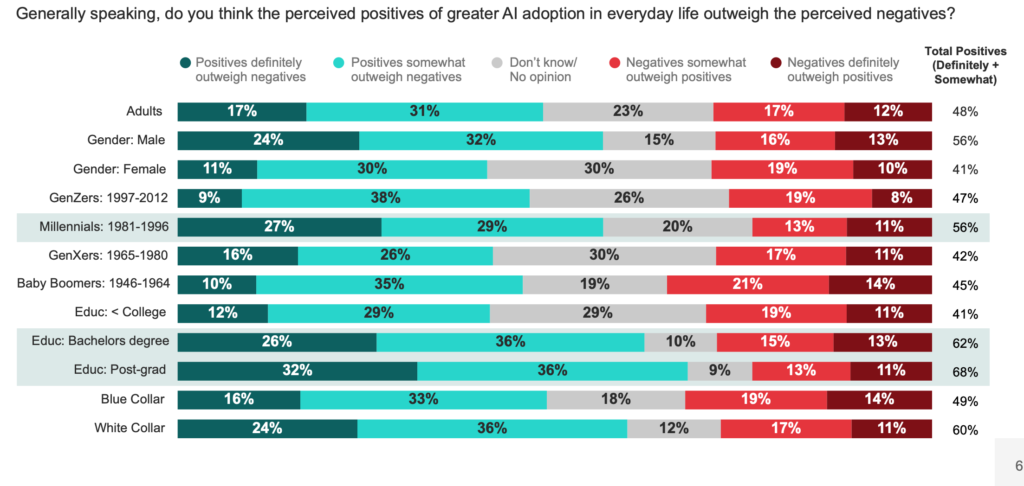
- Although adults have concerns about the potential negative consequences of greater AI adoption, nearly half (48%) believe the perceived positives of greater AI adoption in everyday life outweigh the perceived negatives.
- Adults believe AI should play a greater role in a number of tested industries in the future, including technology (66%), manufacturing (61%), logistics (58%), and retail (52%).
- Despite a general openness to AI playing a larger role in different industries, adults believe that among the specific tasks tested, most are still best accomplished by humans alone or with some degree of assistance from AI.
- Concern about AI’s potential negative consequences is high, with adults most concerned about a loss of personal privacy (74%), AI being used irresponsibly (72%), reduced employment opportunities (71%) and reduced human connectedness (71%), among the tested options.
• Half of adults (52%) believe it is likely that AI will become smarter than humans, and nearly two thirds (63%) believe AI will control too much of everyday life.
3. Majorities of adults believe AI has played a role in loss of trust in elections (57%) and institutions (56%), as well as the spread of misinformation (58%), political polarization (53%), and threats to democracy (52%).
• Democrats are more likely than Republicans to believe that AI has played a role in the spread of misinformation (64% vs. 56%) and in loss of trust in institutions (62% vs. 54%).
4. Adults view facial recognition as a responsible use of AI technology, and are comfortable with using it for tasks such as finding missing persons (70%) and pets (68%), for law enforcement use such as identifying and monitoring criminals (65%), and for identifying fraudulent behavior when making purchases (64%).
• Deepfakes, which are highly convincing digitally altered sound and images that are made to appear real, prove to be more divisive. Adults are nearly evenly split on whether using AI to create deepfakes is a responsible (38%) or irresponsible (36%) use of the technology.
See the full report here: https://www.stevens.edu/sites/stevens_edu/files/files/AI-survey/AI-Summery-Deck.pdf
WHY AI CAN’T REALLY FILTER OUT “HATE NEWS”
Michael Egnor: What terrifies me about artificial intelligence — and I don’t think one can overstate this danger — is that artificial intelligence has two properties that make it particularly deadly in human civilization. One is concealment. Even though every single purpose in artificial intelligence is human, it’s concealed. We don’t really understand it. We don’t understand Google’s algorithms.
There may even be a situation where Google doesn’t understand Google’s algorithms. But all of it comes from the people who run Google. So the concealment is very dangerous. We don’t know what these programs are doing to our culture. And it may be that no one knows, but they are doing things.
Michael Egnor: And the second problem, which René Girard (1923–2015) , a French philosopher, wrote about extensively, is the concept of mimetic contagion… we are imitating animals, and no other animal imitates anywhere near the way we do. And we imitate particularly other humans desires’. Advertisers notice that if they show a popular quarterback drinking a certain brand of soda, other people will want to go out and buy that same soda. But that’s kind of an odd thing. Why would we imitate what that guy wants? ...
I can imitate a guy in China, at exactly the same moment that everybody else in the world imitates the same guy. And it takes zero seconds to do it. And that’s never happened before. Humanity has never had that kind of interconnectedness. And that mimetic contagion, according to Gerard is lethal to mankind.
...Michael Egnor: And it can happen like kerosene with a match. It can happen at incredible velocity and incredible ferocity. And these are incredibly dangerous things that we’re dealing with it. Frankly, I think that some of our political crisis in this country right now is because of that. It’s because of the bias inherent in our information and the enormous potential for imitation for mimetic contagion.
...Note: Billionaire investor Peter Thiel is not buying into this widespread belief. He told COSM 2021 last week, Artificial General Intelligence isn’t happening. What is happening is a huge increase in surveillance — control by AI companies who continually monitor us, not by “thinking machines.”
See the full story here: https://mindmatters.ai/2021/11/why-ai-cant-really-filter-out-hate-news/