Internal organizational data seen by The Information shows that about one-fifth of Facebook’s total global workforce or close to some 10,000 employees are currently working in the development of its AR and VR devices.
According to Facebook‘s own information, the company employed 58,000 full-time specialists at the end of 2020 and about 17% of these employees are working on its XR technologies. This represents close to a fifth of its workforce working on the computing platforms of the future.
... Facebook Reality Labs is working on a number of XR projects that include both hardware and software development. Some of Facebook’s projects such as the development of ultra-slim and powerful Augmented Reality glasses are a long-term goal and will be ready in 5 to 10 years.
Some of Facebook’s known XR products and research projects include the following: –
Oculus Quest VR Headsets: A next-generation product is already under development.
VR game development by the first-party studios Beat Games, Ready at Dawn, and Sanzaru Games all of which have been acquired by Facebook in the past year or so.
The Facebook metaverse Horizon
Research on next-generation VR technology such as the Half-Dome
The smartphone AR platform SparkAR
The AR-compatible video chat device Portal
The AR research project Project Aria
New smart Facebook data glasses in collaboration with Ray-Ban set to appear in 2021
Advanced augmented reality glasses which have been codenamed, Orion
A smartwatch set to be released in 2022 combined with a neural interface and haptic simulation
Haptic gloves for AR and VR
A Facebook Assistant that is similar to the Google Assistant and Amazon Alexa
An operating system specifically for VR and AR devices
A chip specially developed for AR glasses
Live Maps, a 3D mapping service for the Augmented Reality cloud infrastructure.
“No nation can survive nor stand the test of time without enmeshing itself in science and technology. The Science, Technology, Engineering and Mathematics (STEM) initiative is a way forward but we need to do more. The difference between one country and another is the Level of science and technology at which each other operates.
He affirmed that Nigeria has remained backward technology-wise because the needed investment, support and attention meant for young talents in science and technology have been jettisoned. He said, “Nigeria cannot compete with developed economies not because of color nor any other thing, but because we have relegated Science & Technology to the background by not giving enough attention to STEM and not celebrating champions emerging from the sector.
“Citizens have placed Music, Sports & fashion far above Science & Technology which eventually resulted into moral decadence and value disorientation for us, however, entertainment and fashion are not bad in its entirety, but as we celebrate and support young people in the entertainment industry, we should more than proportionately pay more attention to young Stars in the Science and Technology space.
Spatial will soon work on PC-connected virtual reality headsets. Previously, the app had only been available on standalone VR headsets like the Oculus Quest 2, as well as augmented reality headsets like Microsoft's HoloLens and Magic Leap. The beta version for PC-tethered headsets is now available — with a final version slated to launch ahead of summer. Users will be able to access the app through the Steam storefront on the following headsets:
HTC Vive
Valve Index
Windows Mixed Reality headsets
Varjo
Oculus Rift
Oculus Rift S
Of course, users can also access Spatial on their phones through a mobile app for iOS and Android that launched back in December.
Is being human still a prerequisite for being an ‘artist’?
We don’t mean the ability to display humanity. We quite literally mean: does an artist really need to be a human to be considered an actual artist, who can perform and record music, generate streams, market singles and albums, and build a fanbase?
The answer to that question, according to Anthony Martini, co-founder of ‘virtual’ record label Factory New, is no.
Factory New describes itself as a “first of its kind, next-generation music company, specializing in virtual beings”. Its roster is comprised exclusively of virtual artists.
The firm’s first ‘signing’ was AI-powered robot rapper, FN Meka, who has 9 million followers (and over a billion views) on TikTok.
Technically speaking FN Meka is voiced by a human. But as you’ll learn here, everything else about him – from his lyrics to the chords and tempo underpinning his music – is based on AI.
... If a song is good, people will listen to it. Maybe the fact that it’s made by a robot makes it even more interesting. Not to get all philosophical but, what is an “artist” today? Think about the biggest stars in the world. How many of them are just vessels for commercial endeavors?
Most hits are written by teams of people who get paid to make music that will “sell”. We think machines can eventually run this process more efficiently than humans. How many fans ever actually meet the stars they idolize anyway?
The partnership aims to innovate 5G and Mobile Edge Compute (MEC) virtual-reality applications for enterprise, public sector, education and entertainment
Verizon and Dreamscape Learn will form a 5G innovation lab to develop immersive VR learning experiences for various education levels and environments
As part of the partnership, Verizon Ventures has taken an equity stake in Dreamscape
Verizon and Dreamscape Immersive today announced a partnership aimed at innovating virtual reality (VR) applications using 5G and mobile edge computing (MEC). The partnership’s first priorities will focus on 5G immersive-learning and training innovations for use in enterprise, public sector, and education environments.
“Verizon’s partnership with Dreamscape shows how innovative tech built on our 5G network can revolutionize industries,” said Tami Erwin, CEO of Verizon Business.
...
Outside of the classroom, Verizon and Dreamscape will collaborate to develop and market avatar-driven synthetic training and simulation experiences for government and specialized professional learning uses. The experiences will combine Verizon's 5G capabilities and Dreamscape’s ADEPT (Avatar Driven Educational and Practical Training) Platform, which leverages Dreamscape’s proprietary tracking and rendering technologies, to deliver vivid and life-like VR scenarios. ...
A virtual reality company based in Fort William First Nation in Ontario that is using their technical know-how to promote Indigenous cultures.
Partnering with Uber and the Canadian Council for Aboriginal Business (CCAB), ORIGIN is hosting a competition called Share Your Roots, looking for more people to share their culture.
The company started out as an interactive way for kids to learn more about jobs, primarily in the trades industry.
There are four prizes of $35,000 dollars each and each winner will get a personalized virtual reality experience that will be a part of the ORIGIN library. Along with the money, winners will also receive a one year membership to CCAB.
The library includes both career and cultural experiences including learning how to be a boilermaker, electrician, and millwright among other careers. On the cultural side, experiences include fancy shawl dance, scraping a moose hide and smudging with medicines just to name a few.
Hardy-Giles said the cultural side of ORIGIN is not business generated, rather they use the profits from their career experiences to fund the cultural experiences, and that one day she hopes ORIGIN can become international and have VR experiences from around the world from various Indigenous cultures.
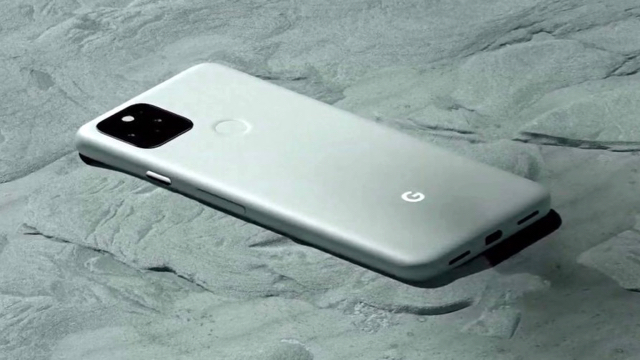
Google recently formed the Android Ready SE Alliance with the goal of enabling the speedier distribution of Secure Element (SE) technology for digital wallets and digital car and home keys among other products. In Google’s Pixel phones, the SE is a Titan M chip which, separate from the phone’s processor, stores encryption keys and validates the operating system. The Android Ready SE Alliance’s device manufacturers and SE sellers hope to speed up the timeline to bring a variety of these digital products to market.
Engadget reports that members of the Alliance, which will “work together to create a collection of open source and ready-to-use applets for SE chips,” have debuted StrongBox, its applet that is a “tool for storing cryptographic keys.”
StrongBox is “also available on WearOS, Android Auto and Android TV devices.” Initially, “the Alliance will focus on use cases like digital car keys and mobile driver’s licenses.” With regards to the former, “Google is playing catch-up to Apple.”
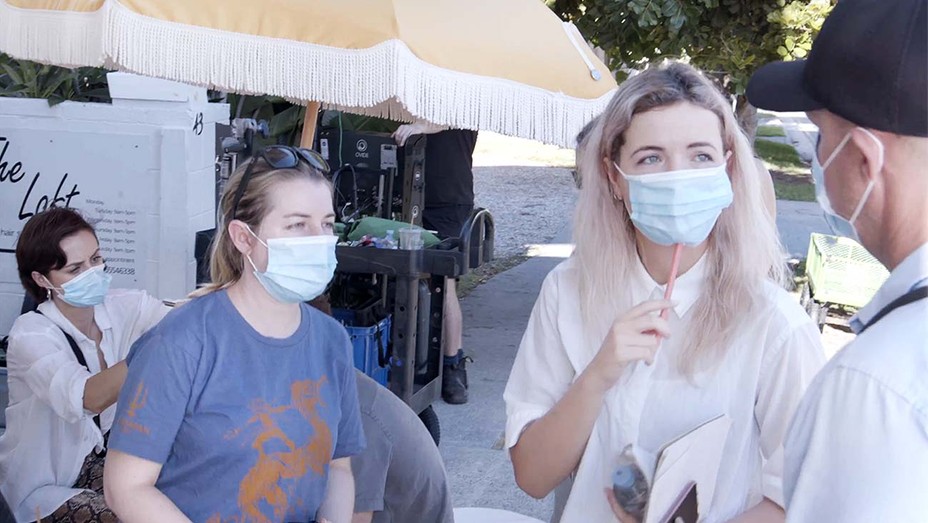
The effort, led by veteran color scientist Joachim “JZ” Zell through the Hollywood Professional Association, grew as filmmakers in more and more countries found cloud collaboration to be critical to working amid the pandemic. The result is six shorts made by using the cloud, filmed in five cities around the world — Hollywood, Dubai, Brisbane, London and Mexico City — plus with an animated entry from Ulaanbaatar, Mongolia. Postproduction involved collaborators from the countries involved in the shoots, as well as additional countries including Brazil, Colombia and Lithuania. Additionally, diversity is a priority and each short was directed, lensed and/or produced by women filmmakers.
The broad takeaway: Cloud production has arrived, though the project identified areas where more technological advancement is needed.
Each production implemented COVID safety procedures and used different combinations of technologies, allowing the participants to experiment with numerous workflows that enable remote, cloud-based production tasks including live review of camera footage, dailies, and participation in editorial, color grading and mixing sessions. The experiment involved the Amazon, Google and Microsoft clouds, as well as a range of technologies from participating manufacturers including 5th Kind, Adobe, ARRI, Avid, Bebop, Blackmagic, Colorfront, Evercast, Frame.io, Moxion, Sohonet, Teredek and Teradici. The shorts were also made with the collaboration of many companies from VFX house Framestore and Skywalker Sound (which mixed four of the shorts).
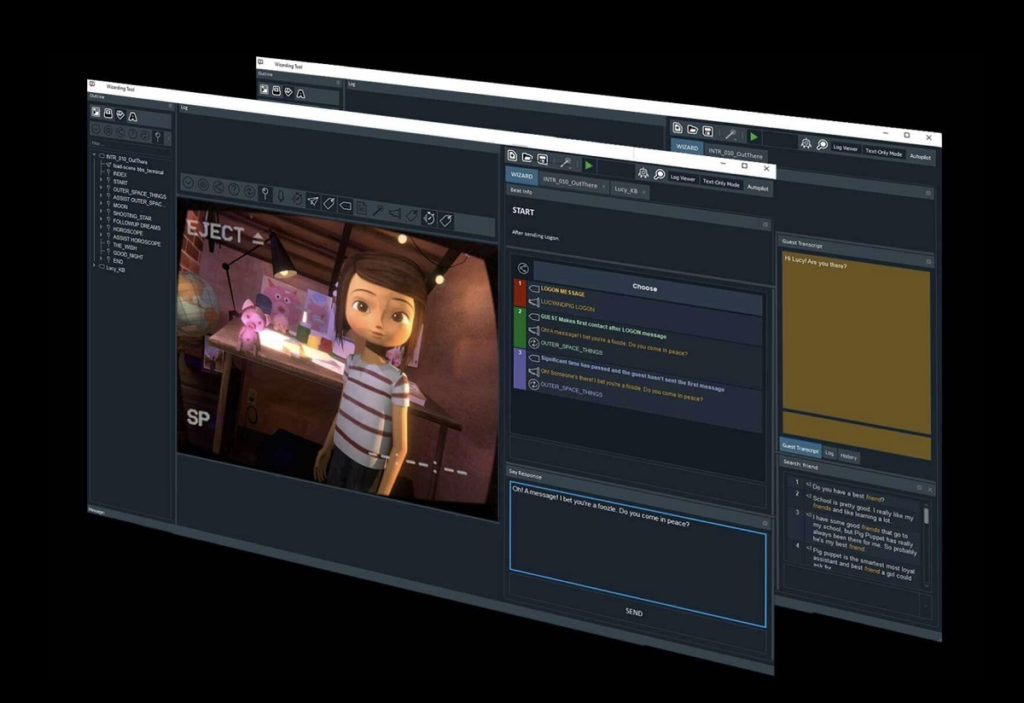
Fable Studio is opening its virtual beings Wizard Engine to collaborators in fashion and nursing. The San Francisco company built the engine to manage its virtual character Lucy, an 8-year-old animated girl from the Wolves in the Walls virtual reality experience.
The Wizard Engine lets creators schedule events on different platforms for a virtual being and create new milestones in the lives of the characters, Saatchi said.
You’ll be able to create the AI characters, distribute them on Twitch, Instagram, and YouTube. We use it to create these monthly beats in Lucy’s life.”
The tool lets Fable take a virtual being as conceived — the bible and backstory of their life, a synopsis of what will happen to them — and uses that to generate on an ongoing basis the content of their life. It generates the voice, animation, text dialogue, and video. These things would realistically make up the virtual beings life (what their knowledge base about their past is, what happened yesterday, what’s happening right now, what are they looking forward to etc).
One of the tools the Wizard Engine uses is OpenAI’s GPT3 technology to generate Lucy’s responses.
You could almost think of the Wizard Engine as an AI game engine, he said. It allows collaborators to generate and deploy interactive experiences with virtual beings to delight millions of users. So far the interactive/gaming and deep learning worlds have remained very separate, but virtual beings will only exist if they can work together.
Dr. Katia Walsh, Chief Strategy and AI Officer at Levi's, is looking to combine fashion, data science and the creative process to improve everything from the customer experience and demand to supply chain and design.
Levi's is best known for its denim, but the company's master plan is to redefine itself with artificial intelligence, machine learning and data science. And the apparel company has 168 years of data to become more efficient, predict and create trends and improve the customer experience.
ZDNet caught up with Dr. Katia Walsh, Chief Strategy and AI Officer at Levi's, to talk about implementing AI, machine learning and data science at a 168-year-old company during a pandemic. Here are a few highlights. The full conversation is in the video.
...
In the case of Levi's all the products that the company has created and manufactured in the past 160 years are data. The Bing Crosby jacket that he wore in Canada is data. Once it's photographed, and that photograph is digitized, that's data. The Einstein jacket that he was photographed as man of the year by Times Magazine in 1939 that we created a replica of in the past year, that's data. So we are now using images of products to predict demand for new products based on using computer vision that can tell us based on similarity between certain products that have been sold in the past new products that have never been sold, what the demand for new products would be. So the opportunities are absolutely endless when it comes to data and Levi's.
We are absolutely predicting right now what demand for products will be like. The further you go into time, the less accurate the model will be because there are just so many unknowns that happen to accumulate as time goes by. And we are looking to predict demand in the next half of the year, in the next month, in the next three months.
The role of algorithms in product design. Walsh said:
Well, product design is a very creative process. I've worked in financial services, I've worked in telecommunications, I've worked in technology. This is my first time leading AI and helping drive digital transformation in the creative company, in a fashion company. It is incredibly creative. It is a highly imaginative process. What we are doing is partner with designers, partner with planners, planning is the original data science function in a company like Levi's and retail and apparel, and bringing the latest tools and this combination, this flywheel of digital data and AI to be able to drive demand, to predict demand, to optimize costs, and to also really deepen the connection with consumers.