As easy to follow as tennis is visually, on an audioscape level, it’s as tough to follow as an episode of Twin Peaks you’ve switched on halfway through. That’s a challenge engineers from Tennis Australia, digital design and communications agency AKQA, and Monash University in Melbourne, Australia are working to solve with something called Action Audio. It’s an online audio stream that was developed for last month’s Australian Open broadcasts to assist the 285 million people globally — many of whom are tennis fans — living with blindness or a visual impairment.
“[We wanted people to be able to] make their own appraisal of what’s happening on the court,” Devine said. “So they can have their own insights, rather than just having the insights created by a commentator. They have more information. They’re able to say, ‘wow, Federer’s really hammering the backhand tonight.’
Over the past month, established artists and newcomers alike have complained about their publicly viewable work being transformed into NFTs and peddled to potential buyers at eye-watering prices, without their permission. Those responsible sometimes hide behind anonymous Twitter accounts, making it difficult to know where to start in order to contest copyright violations.
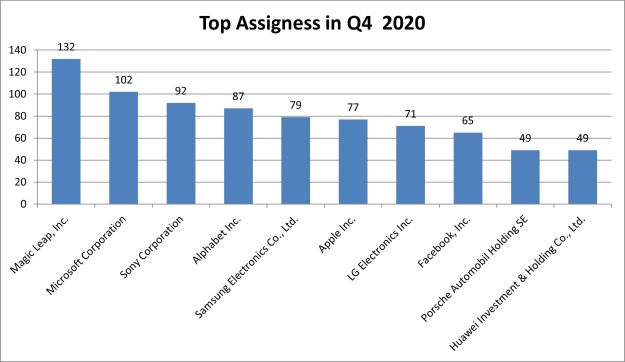
In this series, we track the growth in AR/VR patents worldwide that we expect will accompany the rapid innovation in this technology space. We highlight trends in patenting AR/VR technologies—who is obtaining AR/VR patent protection, and where. We track the various technology centers at the United States Patent and Trademark Office that handle AR/VR applications. And, from time to time, we shine the spotlight on interesting new AR/VR patents.
Over the past few months, music stars have been scrambling to cash in on the latest craze in collectibles by selling art, merch and even albums in the form of non-fungible tokens, or NFTs. But this week, the phenomenon became more confusing than ever for the music industry, when many of the top artists went on sale as pseudo-NFTs themselves.
The culprit: BitClout, a new platform that promises to allow creators and musicians to monetize their celebrity. The decentralized social network and marketplace has been quietly bubbling under the radar, with backers rumored to include big-name venture capital firms. Over recent weeks, the platform had uploaded the top 15,000 influencers from Twitter and issued coins for each, allowing early site users to buy and sell them. Prices for the coins of celebs like Billie Eilish and Elon Musk soared.
IMAX Corporation (NYSE: IMAX) and Maximus, a next-generation visual effects company founded by artificial intelligence entrepreneur Dr. Daniel Nadler, today announced a joint venture to deliver A.I.-based high-resolution video enhancement technologies across home entertainment, including solutions for streaming services and smart devices. Previously, Dr. Nadler founded Kensho Technologies, the artificial intelligence firm he sold in 2018, establishing Kensho as the world's most valuable independently owned A.I. company at the time.
The new joint venture, IMAX AI, will advance A.I.-based solutions for Ultra High Definition (UHD) 4K enhancement across smart devices, new and library content, as well as real-time enhancement of live entertainment and sports. The IMAX Enhanced home entertainment initiative will work closely with IMAX AI to accelerate its current growth across streaming platforms and high-end consumer devices around the world. Dr. Nadler will also serve as Special Advisor to the IMAX Board of Directors.
Following the sale of Kensho to S&P Global in 2018, Dr. Nadler, who received his PhD from Harvard, focused on his work as a visual artist under the pseudonym Daniel Wallace, which involves generative artificial intelligence algorithms, photography, motion capture, digital painting and digital sculpting techniques. To support this work, Dr. Nadler founded Maximus as a privately-held visual effects firm, on the model of Industrial Light & Magic. Maximus ultimately developed A.I.-based high-resolution video enhancement technologies that are broadly applicable beyond visual art, and Dr. Nadler is partnering with IMAX to commercialize those technologies in the entertainment industry.
The joint venture will be overseen by Vikram Arumilli, Senior Vice President of IMAX Corporation; Samantha Whitmore, COO & Head of Engineering of Maximus; and Zachary Ziegler, Head of A.I. of Maximus. Arumilli most recently served as Chief of Staff for IMAX. He joined the company in 2019 from McKinsey & Company and holds a B.A. and M.S. from Stanford University and an M.B.A. from The Wharton School. Whitmore most recently served as Head of Engineering at Kensho Technologies and holds an A.B. from Harvard University and an M.S. from the University of Cambridge. Ziegler is currently completing his PhD at Harvard University.
The military branch, started under former president Donald Trump, is working with government contractor SAIC on a gamified training platform that allows employees to interact with full-scale digital replicas of national security satellites. The platform lets the armed forces practice responding to missile warning scenarios and collaborate in cyberspace.
They’re not exactly rehearsing how to destroy alien spaceships. But if satellite solar panels need to be fixed, they can practice doing that — without having to travel to space to do it.If a spacecraft needs to be repositioned, they can execute that too. If troops need more information about a mission, it’s as simple as pressing a button. No space suits or textbooks necessary.
More directly, Space Force’s job is to maintain, protect and expand the U.S. fleet of advanced military satellites.
Wang says his goal for the startup, which he began with friends after they all graduated from Carnegie Mellon, is simple: Focus on serving its most consistent users, bring in customization elements to make virtual spaces feel homey and hire a lot of engineers.
“We’re a much broader communication platform that is going to be used across all things, but we are leaning heavily into the virtual HQ [use case],” Wang said. The 37-person team has embedded features to promote spontaneity, such as “shoulder taps” to prompt a co-worker to chat, or pool tables where employees can circle around and start a virtual game of pool. The platform also uses spatial audio technology, which is popular in video games, so that users can get the feel of running into each other. The technology basically allows you to hear someone’s voice louder when you are near them, and softer as you walk away. Wang says that it built its own video-conferencing system from scratch because other solutions didn’t work well with spatial technology.
One of the challenges of building a community platform is figuring out monetization without extracting value. This is one of the reasons that Wang, when I first talked to him in November, always wanted to avoid venture capital money (because the incentives might rush the platform into pursuing business models that weren’t user-friendly).
Months later, Wang said his mind changed when he met with Sequoia Capital’s Shaun Maguire and saw an opportunity to scale the metaverse with venture dollars.