The Void Co-founder Unveils VR Skydiving Attraction ‘JUMP’, Locations Coming 2021
James Jensen, co-founder and creator of VR attraction The Void, recently unveiled his next VR startup which aims to bring the thrills of wingsuit skydiving to people particularly averse to jumping out of a perfectly good airplane.

The company, called JUMP, exited its two-year stint in stealth mode this past weekend. According to Jensen’s LinkedIn page, he’s been working as CEO of Jump since March 2018, or just a few months before he left his position as Chief Visionary Officer at The Void.
Academy Award-winning designer John Gaeta has signed onto the project as an advisor; Gaeta is best known for pioneering ‘Bullet Time’ for The Matrix films, his work on volumetric capture methods, and for co-founding Lucasfilms’ immersive skunkworks ILMxLAB.
WHAT IS INTELLIGENCE?
Neuroeconomist Daeyeol Lee discusses his new book and the development of artificial intelligence, asking 'Will AI ever surpass human intelligence?'

How might AI impact the relationship between humans and machines, or human civilization as a whole?
Increasingly powerful artificial intelligence and machines equipped with such AI will continue to develop, undoubtedly increasing the productivity for people who control such tools. While increased productivity is good, this process will unfold unevenly throughout society, amplifying already existing wealth inequality. I think this is something we have witnessed many times throughout history. Sharing the benefits of technological advances fairly among all the members of a society has always been a much harder problem than developing the technology itself, and we have frequently failed to find a good solution for everyone. In order to truly gain the most from technological advances, we also need to be aware of their limitations and potential for abuse. Reflecting on these and how we resolve them might even give us an opportunity to better understand human nature as the gap between our intelligence and AI continues to narrow.
See the full story here: https://hub.jhu.edu/2020/10/05/artificial-intelligence-daeyeol-lee/
Come Back with a Warrant for my Virtual House
Nearly twenty years ago, the Supreme Court examined another technology that would allow law enforcement to look through your walls into the sanctity of your private space—thermal imaging. In Kyllo v. United States, the Court held that a thermal scan, even from a public place outside the house, to monitor the heat emanating in your home was a Fourth Amendment search, and required a warrant.
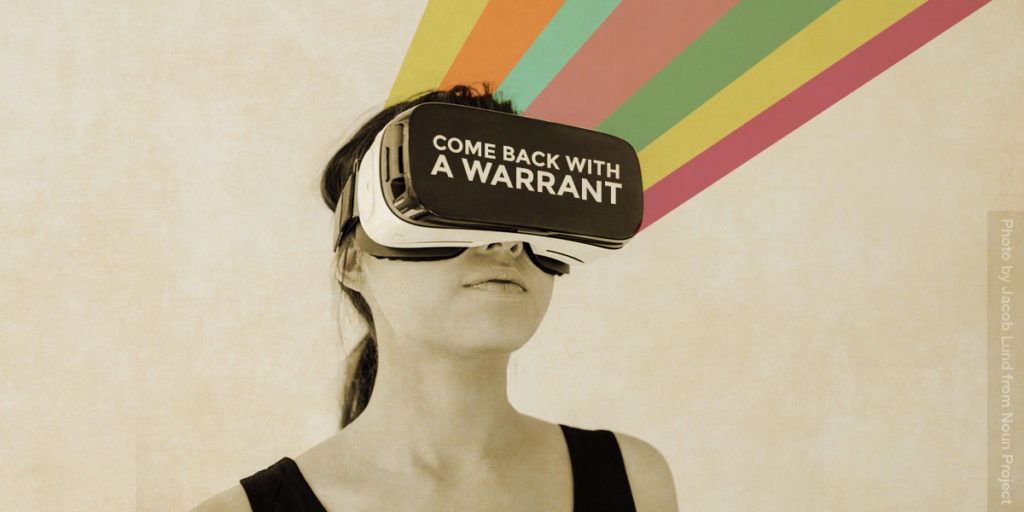
More critically, Kyllo established the principle that new technologies1 that can “explore details of the home that would previously have been unknowable without physical intrusion, the surveillance is a 'search' and is presumptively unreasonable without a warrant.” A VR/AR setup at home can provide a wealth of information—“details of the home”—that was previously unknowable without the police coming in through the door.
No court has yet ruled on a warrant for a virtual search of your house. For now, it is up to the service providers to give a pledge, backed by a quarrel of steely-eyed privacy lawyers, that if the government comes to knock on your VR door, they will say “Come back with a warrant.”
See the full story here: https://www.eff.org/deeplinks/2020/10/come-back-warrant-my-virtual-house
New Hires to the Holodeck: Fidelity Investments Tries Collaboration Via Virtual Reality
As coronavirus lockdowns drag on, IT leaders are feeling hard-pressed to keep collaboration fresh among their remote workforces through video chat and other digital tools.

So some are turning to virtual reality. Fidelity Investments Inc., the financial services firm, has been exploring how virtual reality could be used to build workplace relationships among new employees working remotely. In May, it shipped brand-new virtual reality headsets made by Pico Interactive Inc. to more than 140 employees in its operations division. The workers were either new to Fidelity, or had recently moved into an operations role.
The goal was to replicate some aspects of a new-employee training program that would normally have happened in person in Boston over two weeks.
Movements, such as turning one’s head and raising one’s arms, correspond with the movements of the person’s chosen avatar in the digital world.
That very feature has attracted corporations as they look to VR as a way to mimic real-world collaborations lost because of the pandemic.
See the full story here: https://www.wsj.com/articles/new-hires-to-the-holodeck-fidelity-investments-tries-collaboration-via-virtual-reality-11601890201
What’s New In Gartner’s Hype Cycle For AI, 2020
Gartner sees potential for Composite AI helping its enterprise clients and has included it as the third new category in this year's Hype Cycle.
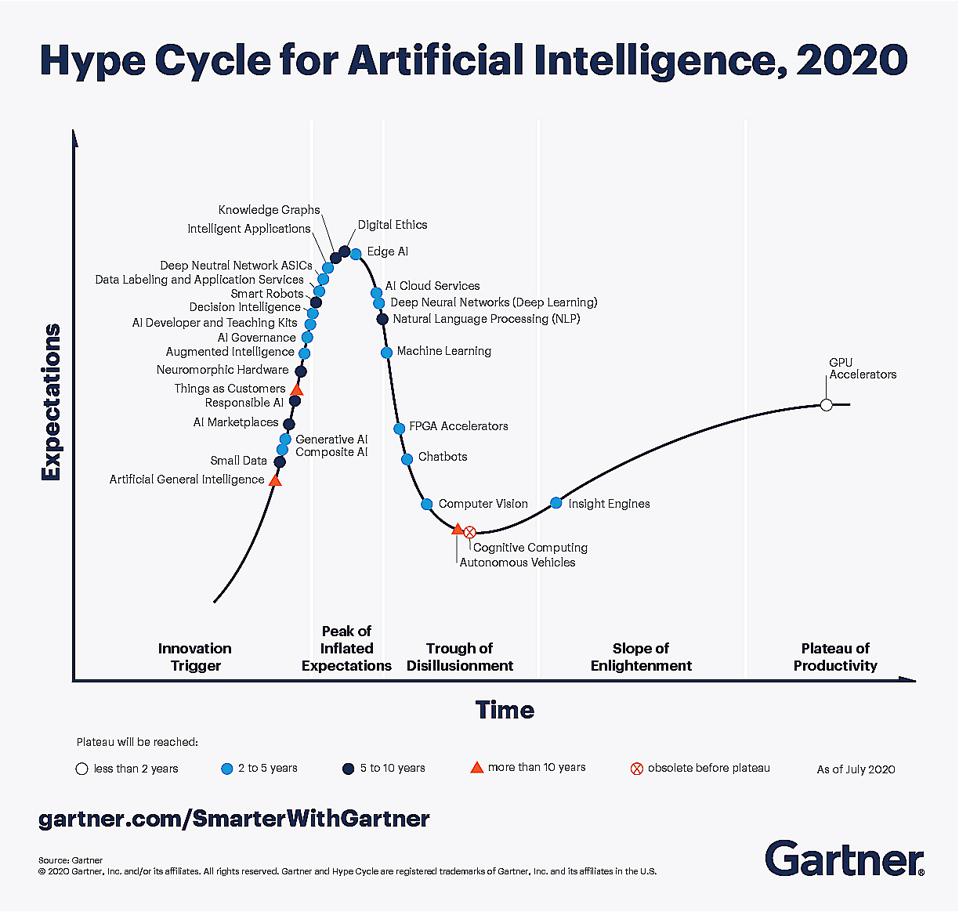
Concentrating on the ethical and social aspects of AI, Gartner recently defined the category Responsible AI as an umbrella term that's included as the fourth category in the Hype Cycle for AI.
The exponential gains in accuracy, price/performance, low power consumption and Internet of Things sensors that collect AI model data have to lead to a new category called Things as Customers, as the fifth new category this year.
Thirteen technologies have either been removed, re-classified, or moved to other Hype Cycles compared to last year. Gartner has chosen to remove VPA-enabled wireless speakers from all Hype Cycles this year. AI developer toolkits are now part of the AI developer and teaching kits category. AI PaaS is now part of AI cloud services. Gartner chose to move AI-related C&SI services, AutoML, Explainable AI (also now part of the Responsible AI category in 2020), graph analytics and Reinforcement Learning to the Hype Cycle for Data Science and Machine Learning, 2020. Conversational User Interfaces, Speech Recognition and Virtual Assistants are now part of the Hype Cycle for Natural Language Technologies, 2020. Gartner has also chosen to move Quantum computing to the Hype Cycle for Compute Infrastructure, 2020. Robotic process automation software is now removed from the Hype Cycle for AI, as Gartner mentions the technology in several other Hype Cycles.
See the full story here: https://www.forbes.com/sites/louiscolumbus/2020/10/04/whats-new-in-gartners-hype-cycle-for-ai-2020/?ss=ai#29e0548d335c
Parkland parents create AI video of slain son to spur voters
From the grave, the teen is now begging his peers to cast the vote that he will never cast. “I've been gone for two years and nothing's changed, bro. People are still getting killed by guns,” he implores in the video created by his parents' charity to end gun violence.

“You've got to replace my vote.”
See the full story here: https://www.devdiscourse.com/article/entertainment/1237637-parkland-parents-create-ai-video-of-slain-son-to-spur-voters
AUGMENTED REALITY OFFERS A PROMISE OF INCISION-FREE AUTOPSIES
This is one vision of the virtual future of autopsies, based on interviews with forensic and digital health-care experts: Using digital reconstructions and machine-learning algorithms to diagnose the cause of death, identify a victim, and even triage battlefield or motor-vehicle injuries in live patients by analyzing images of victims who died in similar incidents. It would mark a step change for the field of forensic science, where the standard methods of autopsy have remained nearly unchanged for a century.
None of this would be possible without computed tomography, or CT scans that use rotating X-ray machines to create cross-sectional images of the body. CT scans are common in clinical practice, but still relatively rare in forensic pathology, especially in the U.S. where the medical examiner system is fragmented and some states have coroners who aren’t medically trained.
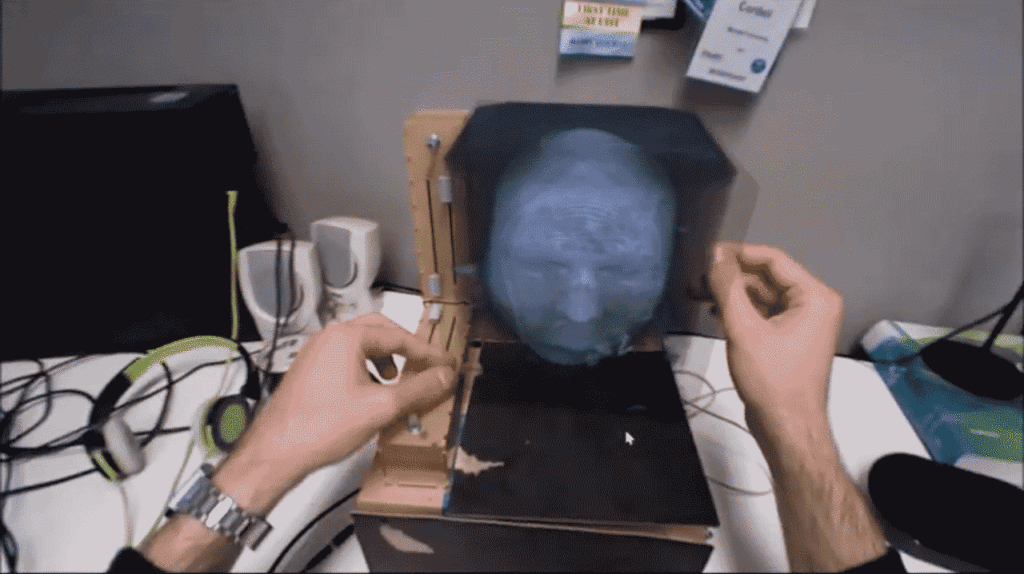
One global reference point for forensic imaging is the Victorian Institute of Forensic Medicine in southeastern Australia, which has built up a database of some 80,000 CT scans representing deaths ranging from traumatic injuries to homicide and suicide. Experts there are turning to machine learning to put millions of images to future use, from providing airtight evidence in criminal cases to quicker identification of victims of mass disasters.
See the full story here: https://www.wsj.com/articles/augmented-reality-offers-a-promise-of-incision-free-autopsies-11601485158
Language-Generating A.I. Is a Free Speech Nightmare
Mitigating the harmful effects of sophisticated language models will require addressing information campaigns more generally. This means approaches that span the technical (textfake/bot detection and new social media), social (model release norms and digital literacy), and political (antitrust and regulatory changes). GPT-3 doesn’t change the problem; it just further entrenches it. As we have seen, our institutions have largely failed in the face of the challenges posed by the internet. GPT-3 and language models like it will only make safeguarding healthy public discourse online more difficult—and more important.

Future Tense is a partnership of Slate, New America, and Arizona State University that examines emerging technologies, public policy, and society.
See the full story here: https://slate.com/technology/2020/09/language-ai-gpt-3-free-speech-harassment.htmlhttps://slate.com/technology/2020/09/language-ai-gpt-3-free-speech-harassment.html