Pizza topping narc tattles on gloveless employees
 "Our unique AI camera already helps hundreds of stores recognize even the smallest of errors often undetected by the human eye, for example, pizza toppings above and below the cheese, or even the food's temperature. Now we are upgrading our technology to monitor processes that may lead to virus spread or contamination. In doing so, we expect to develop more impactful insights that foster transparency and ensure quality standards set by the businesses and the end-customer."
"Our system is designed to take on the role of the super manager, processing every relevant data point inside and outside the restaurant and taking into consideration multiple variables such as the number of orders and locations of customers and drivers, in order to optimize decisions at every point in the supply chain," says Levanon. "This enables us to work directly with our customers to find more ways to streamline operations while bringing in more business, guaranteeing meals arrive hot and fresh, reducing costs and increasing repeat-customers."
See the full story here: https://www.zdnet.com/article/pizza-topping-narc-tattles-on-gloveless-employees/
B2B PAYMENTSPreventing Payroll, Insurance Pains From Killing The Movie Magic
 Wrapbook aims to tackle this issue by giving employees greater control over their payroll data, which, Javid explains, enables a professional to manage their own information across all employers within a Wrapbook profile, enabling a more seamless onboarding experience for both employee and employer. The company recently announced a $3.6 million seed funding round, a show of support from investors for the company's technology, and one that El-Nahhas and Javid said would go toward expanding its own talent pool across the U.S. and Canada.
Managing the safety and security of employees on set has become an even more difficult challenge as a result of the pandemic. El-Nahhas noted that in addition to maintaining social distance, "hyper-sanitary diligence" and COVID-19 testing, crews are also facing unfamiliar challenges as projects downsize to support the need for remote workers and fewer professionals in close proximity with one another.
See the full story here: https://www.pymnts.com/news/b2b-payments/2020/wrapbook-entertainment-payroll-insurance/
9/11 Augmented Reality Video Reveals “Hidden History” at Ground Zero
An online video that uniquely memorializes imagery from 9/11 was filmed in lower Manhattan using an augmented reality (AR) app that overlays scenes from past events on the present-day locations right where they happened. The result is a haunting sequence of clips in which the New Yorkers of September 11, 2001 intermingle with the New Yorkers of today, neither aware that they will have ever crossed paths.

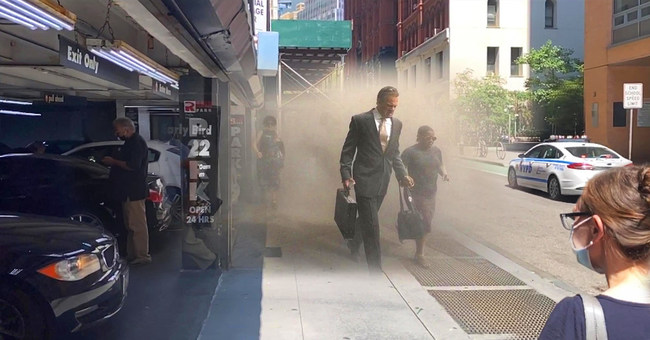
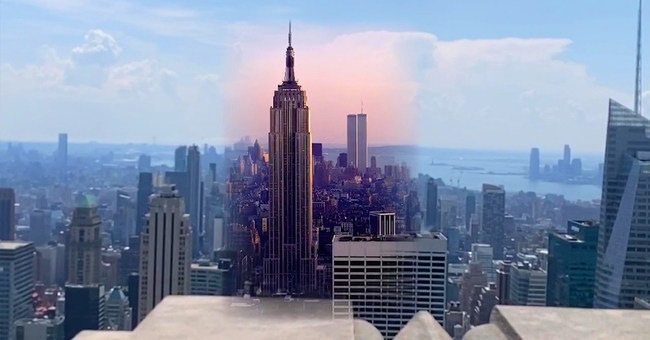
The project is part of ReplayAR's "AR Time Capsule" series which uses patented locational AR technology to explore the hidden history that surrounds us in everyday life.
"I showed the footage to a friend of mine who was actually there on 9/11 when it happened. He mentioned how the audio reminded him of that day when in fact, we didn't do any sound design at all," Martin said. "It turns out that in this age of the COVID-19 pandemic, the natural sound of the city now echoes the same eerie stillness and quietude heard in the aftermath of 9/11."
This is not Huddy's first digital creation born from the tragic events of 9/11. In 2003, he created a controversial video game based on the real-life timeline of events leading up to and following the attacks called "Blood of Bin Laden" which was discussed in MIT Technology Review and From Sun Tzu to Xbox, a book by former Village Voice writer Ed Halter.
About ReplayAR:
ReplayAR, Inc. is an augmented reality software company. Its mission is "to pioneer innovative technologies that preserve and protect historical truth while connecting and inspiring a global community through the shared continuum of our human experience."
See the full story here: https://www.prnewswire.com/news-releases/911-augmented-reality-video-reveals-hidden-history-at-ground-zero-301120655.html
Travelers Are Paying Real Money To Take VR Flights To Nowhere
PhilNote: This idea is not new (Japanese tour firm offers virtual reality holidays – with a first-class seat https://www.theguardian.com/world/2018/feb/15/japanese-tour-firm-offers-virtual-reality-holidays-with-a-first-class-seat ), but it is gaining new attention
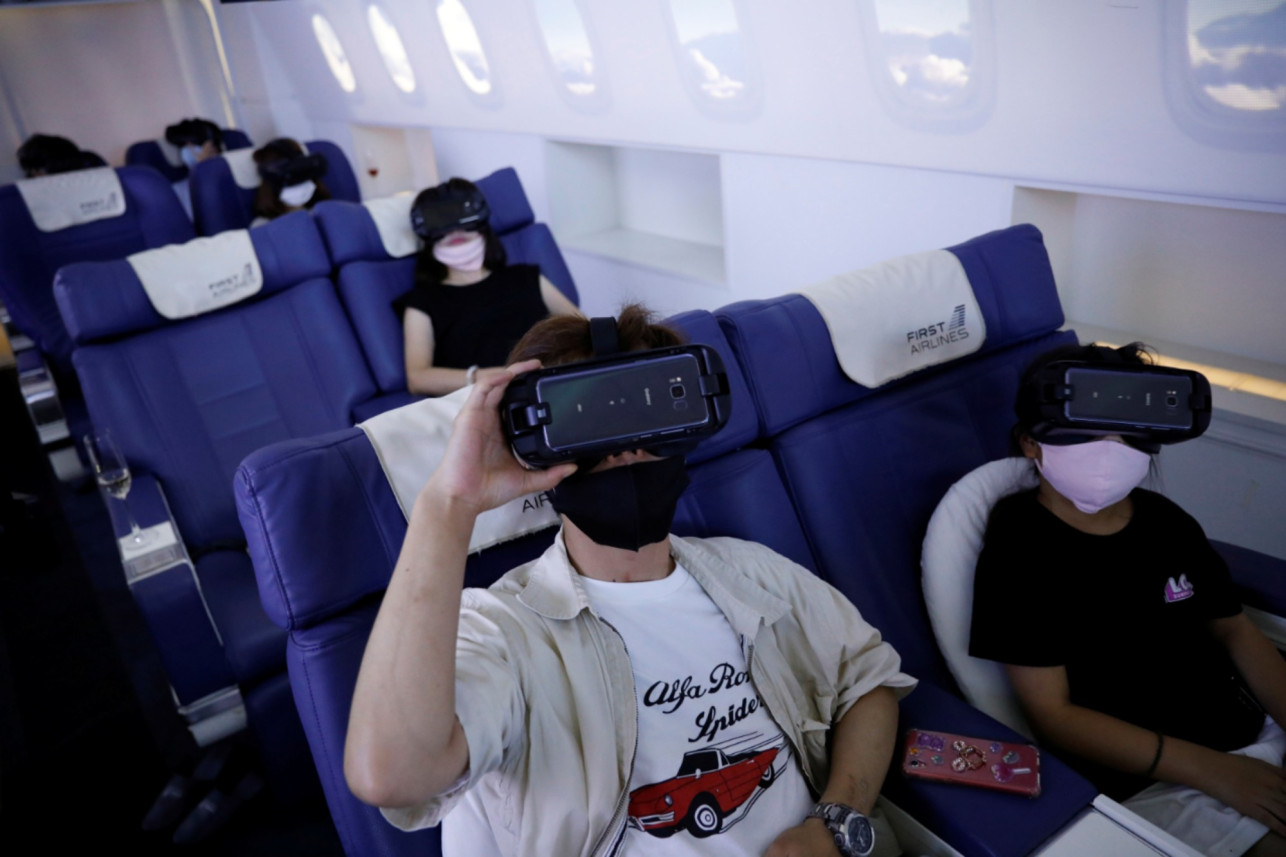 Several airlines have begun using VR technology to immerse “travelers” in exotic locations such as the Colosseum and Pantheon in Rome, New York Times Square in NYC, Market Square in Helsinki, and Fiordland National Park in New Zealand, all without leaving their respective countries.
First Airlines is one such company offering this remote traveling experience, going so far as to call themselves the world’s “first virtual aviation facility”. “Passengers” can purchase tickets to board one of their VR flights, each of which designed to replicate the experience of a real commercial flight. Since the COVID19 Pandemic started, the company has seen a 50% jump in ticket sales and now require advanced reservations.
First Airlines isn’t the only airline doing these types of virtual flight experiences. EVAAir’s Hello Kitty Dream Jet, an actual flight in the US that has been around since 2017, features a wonderful Hello Kitty-themed flying experience designed specifically for fans of the Japanese icon. Unfortunately, the all-pink aircraft has remained grounded due to the ongoing COVID-19 outbreak, much to the dismay of Hello Kitty super fans.
The Resurgence of EDM and VR
See the full story here: https://magazine.weraveyou.com/wdw2929100w021/issues/aug2020/
Tomorrowland around the world (EDM virtual festival)
See the full story here: https://magazine.weraveyou.com/wdw2929100w021/issues/aug2020/
Ten Days of Virtual Reality Come to Portland
NW Film Center and Portland Art Museum partner for the VR Venice Biennale: Venice VR Expanded 2020. Here are five experiences to watch for.
Terrain
/s3.amazonaws.com/arc-wordpress-client-uploads/wweek/wp-content/uploads/2020/08/27112914/agnesepietrobon-terrain-venezia77.jpg)
Terrain, the installation created by artist Lily Baldwin, animator Saschka Unseld and filmmaker Kumar Atre, is difficult to describe, which is maybe the point. The audio-visual production is entirely nonverbal, allowing participants to reevaluate the space between the self and the other through our physical––or virtual––bodies. As an alternative to the traditional documentary format, Terrain brings viewers to characters across the globe, using the freedoms of virtual reality to emphasize our interconnectedness in times of isolation.
See the full story here: https://www.wweek.com/promotions/2020/08/28/ten-days-of-virtual-reality-comes-to-portland/
Burning Man Goes Virtual This Year As Sacramento Artists Prepare For ‘The Multiverse’
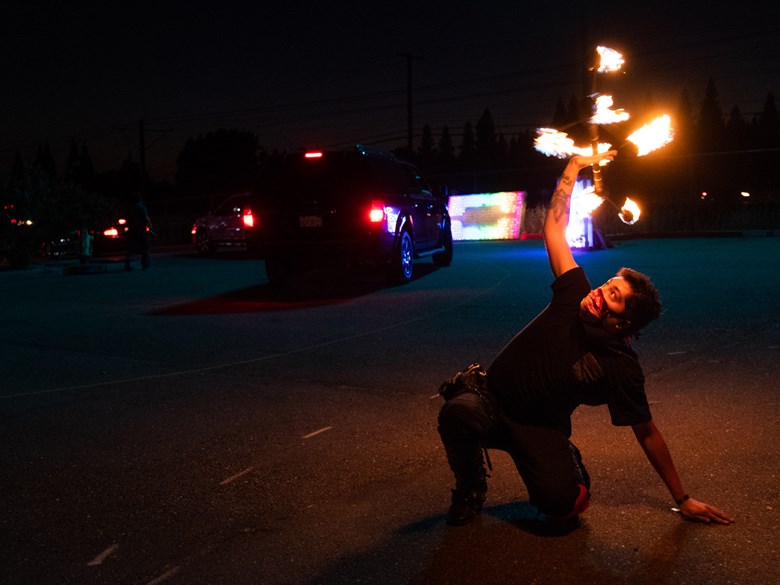 Burning Man has gone virtual, but not by choice. The COVID-19 pandemic forced the cancellation of the in-person experience. But rather than going dark, organizers decided to lean into “The Multiverse” theme, which was named months before the pandemic was declared.
“Burning Man will happen this year wherever Burners are living the Burning Man spirit — both in physical space and virtual space,” Burning Man Project CEO Marion Goodell told participants in June.
Each of these worlds varies in technology. Some don't require expensive virtual reality headgear. All of the content — virtual and real-world — is available through a Burning Man website.
See the full story here: https://www.capradio.org/articles/2020/08/28/burning-man-goes-virtual-this-year-as-sacramento-artists-prepare-for-the-multiverse/