Eschaton is a surreal Zoom nightclub — and a theater for the age of social distancing
 You can now hire a magician for a birthday party over Zoom. Companies have reworked escape room puzzles for players who can’t even escape their apartments. Video games like Fortnite and Minecraft are hosting big events like concerts and graduations. As interactive art site No Proscenium notes, Eschaton’s cast includes several veterans of Sleep No More and other prominent productions, trying their hand at a new kind of show. It’s currently in the preview phase, running every Saturday.
The virtual nightclub in Eschaton follows a similar formula to its offline counterparts. Participants buy a ticket and wander between a series of dramatic vignettes, taking in fragments of a loose, nonlinear story. You’re encouraged to dress up for “a night on the town” and have a drink, either alone or with friends. While most of the performers ignore their voyeurs, there’s always a chance of one-on-one interaction and an expectation that you’ll get an experience not quite like anybody else’s.
The experience also plays off the strange intimacy of group video chats. You can’t feel the body heat of another visitor, but you can see everyone else at the top of your Zoom screen, many with their full names on display and their cameras active, giving you a window into their homes. If you stumble onto a room with just a few people, abandoning it feels a little weird — leaving a performer to an empty live stream is somehow more awkward than an empty physical room.
Eschaton adds a gloss of ‘90s cyberpunk movie, taking place in a new reality where a hazy video chat room nightclub really can replace its real-life counterpart... if only because the real thing no longer exists.
If more people decide they can permanently live and work away from America’s biggest cities, it’s not unthinkable that their cultural products might also become a little more diffuse.
See the full story here: https://www.theverge.com/21266127/eschaton-chorus-productions-immersive-theater-zoom-nightclub-experiment
Xiaomi’s see-through OLED TV is a transparent attempt at attention, and it’s working
 This TV is able to be transparent partly due to the fact that Xiaomi put all of the guts into its circular base instead of behind the display. But the more magical part of how it actually made a see-through OLED screen comes down to utilizing transparent OLED technology (TOLED). As mentioned on the Universal Display Corporation’s site that breaks down all the specs, TOLED screens use transparent components all the way through the stack that makes up the screen, and with no need for backlighting (each diode emits its own light, hence the acronym), images can look like they’re floating. Most other OLED screens use a reflective cathode layer, which prevents you from seeing through it, even if its back was removed.
The result is a 55-inch transparent TV that “looks like a mere glass display” when it’s off. Powered on, it has a 120Hz refresh rate, 1ms response time, 150,000:1 contrast ratio, and it has 93 percent of the DCI-P3 color profile. In display terms, it seems great, but I have a few concerns that Xiaomi’s press release doesn’t really answer.
This TV is only set to release in China for RMB 49,999 (around $7,200), and it will be available to order on August 16th.
See the full story here: https://www.theverge.com/2020/8/11/21363861/xiaomi-oled-tv-transparent-mi-lux-china-specs-price-release
How Teachers In Poland Used Half-Life: Alyx And VR For Remote Teaching During A Global Pandemic
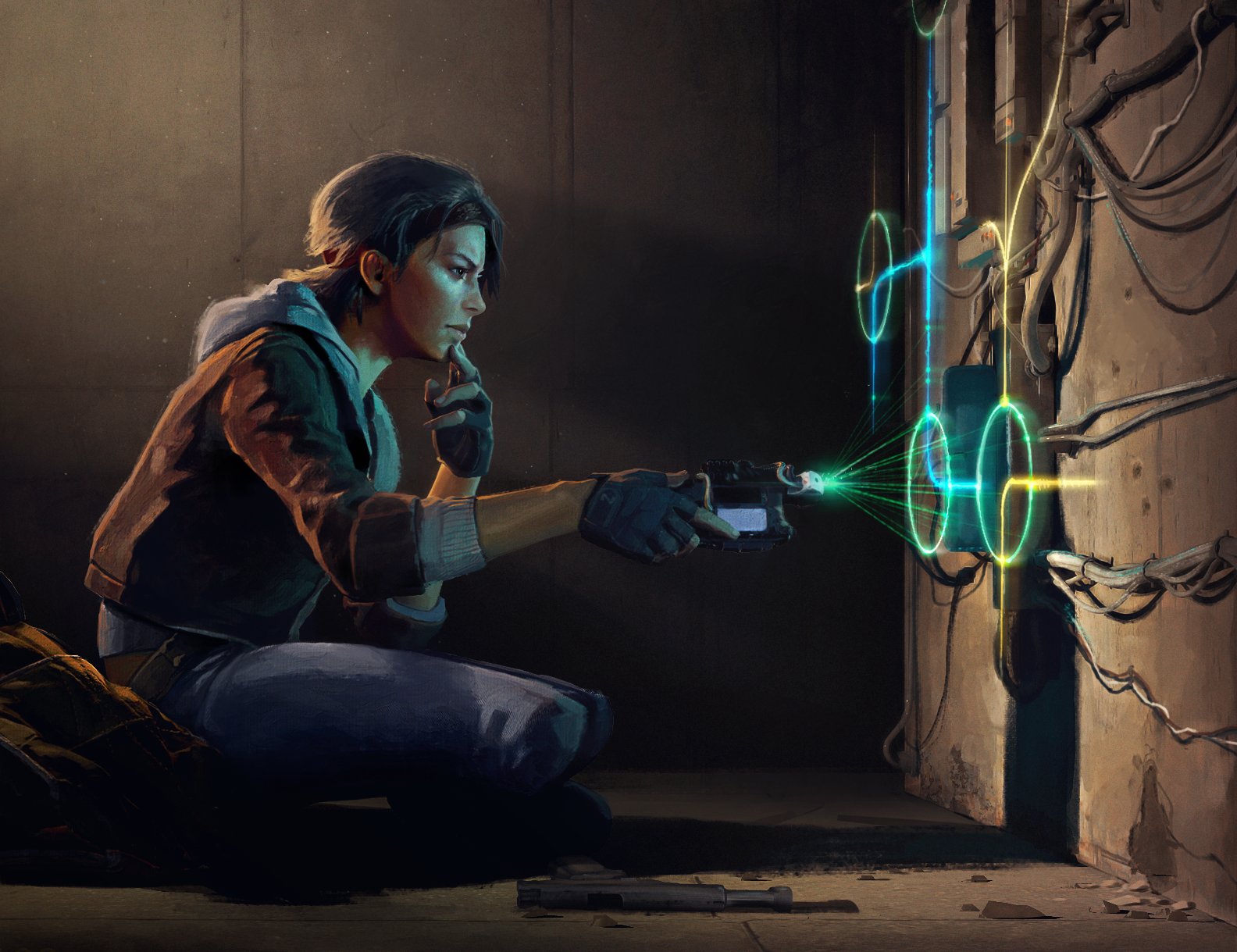 I’m watching a video from Szkoła 33, a high school in the city of Poznań, western Poland. The camera tracks through the school, taking in rows of empty tables, discarded toys, and unused equipment. Eventually, it fades out to a teacher, who welcomes the children to the lesson.
Then the footage cuts away completely, and Half-Life: Alyxbegins.
Dystopia might be correct – but in fact, the game was used by Szkoła 33 to conduct lessons for children in lockdown. A total of six VR sessions in Half-Life: Alyx were made by the school to teach various subjects, with many of the videos lasting over two hours. The lessons combined live and pre-recorded material, and were uploaded to Facebook, Twitch, and YouTube
...
“The pandemic had just started back then, the schools were closed, and we wanted to interest our students in the classes somehow. We also hoped that it would help them with the uncomfortable situation everyone found themselves in – those first few weeks were not easy for kids, being on lockdown in their homes and not able to roam freely.” ...
The teachers cooperated with local media company OFFshot to make the Half-Life: Alyx VR classes. ...
Equipped with an HTC VIVE Pro and three cameras, the school recorded languages, math, and science lessons, with the teachers using pens inside the game to draw diagrams, as well as teaching children vocabulary in a virtual kitchen. ...
There’s an experimental feel to the videos, and a small picture-in-picture in the corner of the screen shows exactly what’s happening in the real world: the teacher – clad in a VR headset – tiptoeing around and drawing into the empty space of the real-life classroom. ...
“We believe the students liked them,” she says. “From younger kids to teenagers, we have seen all of the age groups of our school gather together on Facebook to watch them. Going by the emojis they shared and reacted with, as well as the comments, they enjoyed them very much.”
See the full story here: https://uploadvr.com/teachers-poland-half-life-alyx-vr/?fbclid=IwAR2-j8zmbjtUloGDavoS-wX0NWVrq-2p1_b4-zvomOvQK_gyI9Np2OZOPog
Using artificial intelligence to smell the roses
 "We now can use artificial intelligence to predict how any chemical is going to smell to humans," said Anandasankar Ray, a molecular biologist and senior author of a study that appears in iScience. "Chemicals that are toxic or harsh in, say, flavors, cosmetics, or household products can be replaced with natural, softer, and safer chemicals."
Humans sense odors when some of their nearly 400 odorant receptors, or ORs, are activated in the nose. Each OR is activated by a unique set of chemicals; together, the large OR family can detect a vast chemical space. A key question in olfaction is how the receptors contribute to different perceptual qualities, or percepts.
See the full story with a link to the original study here: https://www.nsf.gov/discoveries/disc_summ.jsp?cntn_id=300998&fbclid=IwAR18FC7980hwRe-wrRI7Aor4rlp_2FEKMIkge95NLl9JYdS5H9GxWFWQs9Q
The complicated world of AI consciousness

3D rendering artificial intelligence AI research of robot and cyborg development for future of people living. Digital data mining and machine learning technology design for computer brain.
But verifying whether an AI system is conscious or not is easier said than done, Susan Schneider discusses in Artificial You. Consciousness is not a binary, present–not present quality. There are different levels of consciousness that can’t be covered by a single test.
For instance, a chimpanzee or a dog won’t pass a language test, but does it mean that they totally lack consciousness. Likewise, humans with some disabilities might not be able to pass tests that other average humans find trivial, but it would be horrendous to conclude they’re not conscious. Is there any reason to treat advanced AI any differently?
“At the heart of this book is a dialogue between philosophy and science,” Schneider writes. “The science of emerging technologies can challenge and expand our philosophical understanding of the mind, self, and person. Conversely, philosophy sharpens our sense of what these emerging technologies can achieve: whether there can be conscious robots, whether you could replace much of your brain with microchips and be confident that it would still be you, and so on.”
See the full story here: https://bdtechtalks.com/2020/08/05/artificial-you-susan-schneider/
Live-Streamed Game Collects Sounds To Help Train Home-Based Artificial Intelligence
 From yawning to closing the fridge door, a lot of sounds occur within the home. Such sounds could be useful for home-based artificial intelligence applications, but training that AI requires a robust and diverse set of samples. A video game developed by Carnegie Mellon University researchers leverages live streaming to collect sound donations from players that will populate an open-source database.
"This data could be used to create extremely useful technologies," said Jessica Hammer, an assistant professor with joint appointments in the HCII and the Entertainment Technology Center. "For example, if AI can detect a loud thud coming from my daughter's room, it could wake me up. It can notify me if my dryer sounds different and I need to change the lint trap, or it can create an alert if it hears someone who can't stop coughing."
Hammer and her team developed the game, "Rolling Rhapsody," specifically to be played on the live-streaming platform Twitch. The streamer controls a ball, which they must roll around to collect treasure scattered about a pirate base. Viewers contribute to the game by collecting sounds from their homes using a mobile app. "When they submit sounds, they are donating them to the database for researchers to use, but those sounds are also used as a part of the game on the live stream, incentivizing viewers with rewards and recognition for collecting many sounds or unique sounds," Hammer said.
Privacy is paramount, and all players and viewers must opt in and provide consent to upload sounds. Additional privacy measures have also been taken, including opportunities for viewers to redact sound files that may have accidentally captured something personal. They can delete submissions, choose to store sounds locally and withdraw their consent at any time. "We can collect data in a way that's fun and feels good for everybody involved," Hammer said.
See the full story here: https://www.cmu.edu/news/stories/archives/2020/august/game-collects-sounds.html