Weta Digital Launches Paradigm-Shifting LED-Stage Virtual Production
Weta Digital partners with Avalon and Streamliner to bring LED-stage virtual production to New Zealand.
 Similar in concept to Industrial Light & Magic’s LED-screen StageCraft platform, launched for “The Mandalorian” series, Weta’s system also relies on the real-time Unreal engine from Epic Games in accelerating a paradigm shift for the industry, offering social distancing and smaller crews, while reducing the size and scope of location shoots, set builds, and crowd scenes for the foreseeable future.
In the short term, we are probably more likely to see shots moving to full CG to help reduce shoot days or replace entire location shoots. For us and many facilities, these workflows offer stability and predictability, two things currently in short supply.”
Gary Watkins, CEO, Avalon Studios, is looking to provide “the safest work environment possible as productions look to ramp back up. This new setup allows producers to think strategically about what they shoot and limit the number of actors and onset crew required, changing post-production requirements. Avalon has four main stages of varying sizes and dedicated spaces to house additional departments, making it a perfect hub for local and international productions.”
See the full story here: https://www.indiewire.com/2020/07/weta-digital-led-stage-virtual-production-service-1234574877/?fbclid=IwAR1N7sk4xnqbVqaAdGKVFR_W74C4ZzO32iDCNQbT0hpO12puPgC3K6ktaQA
Tesseract: The company behind the JioGlass
 One of the biggest unveilings by the Ambanis at Reliance's Annual General meet was the JioGlass, a virtual reality eyewear that allows people to connect with each other in real time. At RIL's 43rd AGM, the JioGlass was demonstrated by heir Isha Amban...
The JioGlass was designed and built by Tesseract — a five-year old deep-tech startup that was acquired by RIL in 2019. Founded by Kshitij Marwah at a Mumbai warehouse, the startup is a subsidiary of RIL but is run independently, it told BloombergQuin...
https://tesseract.in
See the full story here: https://www.deccanherald.com/business/tesseract-the-company-behind-the-jioglass-863500.html
Everything you need to know about Palantir, the secretive company coming for all your data
 “I think it’s worth keeping in mind that Palantir sees itself not alongside Uber, Twitter, and Netflix, but alongside Raytheon, Lockheed Martin, and Booz Allen,” said the Intercept’s Sam Biddle, who has covered Palantir for years. “Palantir wants to be a defense contractor, not a Silicon Valley unicorn.”
“Palantir’s core business, and probably its most profitable business, is its government business — especially work for three-letter agencies and the Department of Defense,” Garg said. “I don’t think that’s going to change.”
What remains to be seen, then, is if Palantir’s ability to marry 21st-century Silicon Valley disruption to 20th-century defense contracting will live up to its valuation when it hits the stock market. At a time when Big Tech companies are trying to make their data collection practices more transparent and say they’ll give consumers more control over them (and are facing increased pressure from lawmakers to do so), Palantir has been able to keep much of its work with our data secret. A successful IPO will only give it more reasons and opportunities to do so.
See the full story here: https://www.vox.com/recode/2020/7/16/21323458/palantir-ipo-hhs-protect-peter-thiel-cia-intelligence
Deepfake used to attack activist couple shows new disinformation frontier
‘A VENTRILOQUIST’S DUMMY’
The Taylor persona is a rare in-the-wild example of a phenomenon that has emerged as a key anxiety of the digital age: The marriage of deepfakes and disinformation.
The threat is drawing increasing concern in Washington and Silicon Valley. Last year House Intelligence Committee chairman Adam Schiff warned that computer-generated video could “turn a world leader into a ventriloquist’s dummy.” Last month Facebook announced the conclusion of its Deepfake Detection Challenge - a competition intended to help researchers automatically identify falsified footage. Last week online publication The Daily Beast revealed a network of deepfake journalists - part of a larger group of bogus personas seeding propaganda online.
Brahmy said investigators chasing the origin of such photos are left “searching for a needle in a haystack – except the needle doesn’t exist.”
See the full story here: https://www.reuters.com/article/us-cyber-deepfake-activist/deepfake-used-to-attack-activist-couple-shows-new-disinformation-frontier-idUSKCN24G15E
Twitch tells US Army to stop sharing fake prize giveaways that sent users to recruitment page 4
 Twitch has intervened to stop the US Army using fake prize giveaways on its esports channel to redirect viewers to army recruitment pages.
The practice was brought to light by a report from The Nation on the use of esports as a recruitment tool by the American military. The US Army, Navy, and Air Force all field esports teams comprised of active and reserve personnel who stream on Twitch and chat with young viewers about life, video games, and the opportunities afforded by military service.
This outreach included automated links dropped into the army’s stream chat that told viewers they could win an Xbox Elite Series 2 controller in a “giveaway.” But when anyone clicked the link, says The Nation, they were directed to “a recruiting form with no additional mention of a contest, odds, total number of winners, or when a drawing will occur.”
See the full story here: https://www.theverge.com/2020/7/17/21328130/us-army-twitch-esports-gaming-recruitment-fake-prize-giveaway
OpenAI’s fiction-spewing AI is learning to generate images
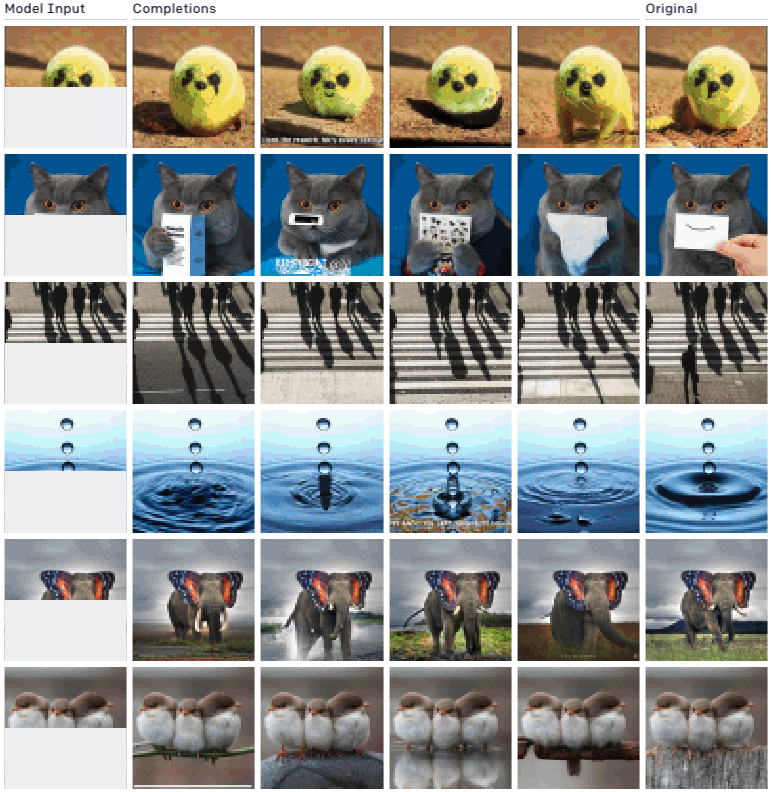 At its core, GPT-2 is a powerful prediction engine. It learned to grasp the structure of the English language by looking at billions of examples of words, sentences, and paragraphs, scraped from the corners of the internet. With that structure, it could then manipulate words into new sentences by statistically predicting the order in which they should appear.
So researchers at OpenAI decided to swap the words for pixels and train the same algorithm on images in ImageNet, the most popular image bank for deep learning. Because the algorithm was designed to work with one-dimensional data (i.e., strings of text), they unfurled the images into a single sequence of pixels. They found that the new model, named iGPT, was still able to grasp the two-dimensional structures of the visual world. Given the sequence of pixels for the first half of an image, it could predict the second half in ways that a human would deem sensible.
The results are startlingly impressive and demonstrate a new path for using unsupervised learning, which trains on unlabeled data, in the development of computer vision systems.
At the same time, the method presents a concerning new way to create deepfake images.
Shakespeare’s ‘The Tempest’ Provides Charming Live Theater From The Under Presents
The Under Presents is an experience of two halves…You enter The Under, an otherworldly club that can only be described as Lynchian in nature. It is a strange and wonderful place; you’ll discover a stylish cabaret room with a rotating variety show that suddenly sprawls out into an expansive, mystic dune, the horizon populated with misplaced landmarks. Crabs spring up from beneath the sand to pinch items away from you and the stage itself is housed neatly inside the remains of an enormous behemoth of a ship, left upturned and dried out. If you weren’t already getting Lost island vibes, wait until you discover the hatch in the sand.
This is The Under Presents’ multiplayer and live segment and where it’s at its most fascinating, clearly influenced by the silent social discovery of games like Journey. When you boot up the game, you’ll be loaded into this area with other players (you can go offline, too). There’s no mic support; every player is totally mute save for the ability to click your fingers to help draw attention. From there you’re free to watch shows, which include elaborate dance numbers and comedy routines, or you can venture out into the wastes to explore.
This new production is not available in the Steam version of The Under Presents and its launch accompanies a shift to pricing for the overall project, at least on Rift and Quest. Now the introduction to the software is free — providing roughly 45 minutes of gameplay, according to Tender Claws — with an in-app purchase of $11.99 buying The Timeboat single player experience and granting “ongoing access to The Under multiplayer space.”
See the full story here: https://uploadvr.com/the-tempest-the-under-presents