THOUGHT LEADERS Introducing New Levels of Transparency with AI – Thought Leaders
 But it was a Canadian health monitoring platform that had beaten them both to the punch, sending word of the outbreak to its customers as early as on December 31, 2019! The platform, BlueDot uses artificial intelligence-driven algorithms that scours foreign-language news reports, animal and plant disease networks, and official proclamations to give its clients advance warning to avoid danger zones like Wuhan.
Yet, for all the hope that AI brings, it still poses unanswered questions around transparency and trustworthiness.
There is currently no direct mechanism to trace the reasoning implicitly used by deep learning models.
This concern has created a need for transparency in machine learning, which has led to the growth of explainable AI, or XAI. It seeks to address the major issues that hinder our ability to fully trust AI decision-making — including bias and transparency. This new field of AI brings accountability to ensure that AI benefits society with better outcomes for all involved.
Explainable, predictable and traceable AI
One way to gain explainability in AI systems is to use machine learning algorithms that are inherently explainable. For example, simpler forms of machine learning such as decision trees, Bayesian classifiers, and other algorithms that have certain amounts of traceability and transparency in their decision making. They can provide the visibility needed for critical AI systems without sacrificing too much performance or accuracy.
Noticing the need to provide explainability for deep learning and other more complex algorithmic approaches, the US Defense Advanced Research Project Agency (DARPA) is pursuing efforts to produce explainable AI solutions through a number of funded research initiatives. DARPA describes AI explainability in three parts which include: prediction accuracy, which means models will explain how conclusions are reached to improve future decision making; decision understanding and trust from human users and operators, as well as inspection and traceability of actions undertaken by the AI systems.
The launch of the first global conference exclusively dedicated to XAI, the International Joint Conference on artificial intelligence: Workshop on Explainable Artificial Intelligence, is further proof that the age of XAI has come.
See the full story here: https://www.unite.ai/introducing-new-levels-of-transparency-with-ai-thought-leaders/
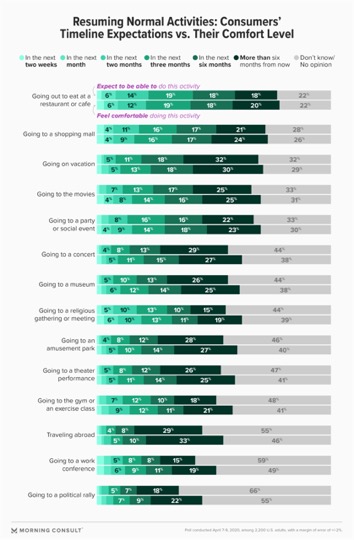
When Consumers Say They’ll Feel OK About Dining Out and Other Activities
See the full story here: https://morningconsult.com/2020/04/10/consumer-expectations-normal-activities-comfortable/?fbclid=IwAR24W4eTAporhXmP5x1N0LfUta_cBLtEdTAUCQUCcmYWI8tO8RrYnd9TUsY
Collaborating in XR
The “Global Resource Guide to XR Collaboration” is a comprehensive guide to using Augmented Reality (AR), Virtual Reality (VR) and Mixed Reality (MR) collaboration platforms for business and education.
Produced by the XR Ignite and assembled by coalition members from technology companies and associations – including AREA, AWE, Deutsche Telekom, Cleanbox, MetaVRse, Qualcomm Technologies, VR/AR Association and XR Bootcamp – the guide and website are meant to become a one-stop-shop for all your XR collaboration questions and needs.
See the full story here: https://techtrends.tech/tech-trends/collaborating-in-xr/

Hauser & Wirth unveils VR program to explore virtual exhibitions
PhilNote: Hauser & Wirth has a gallery in the DTLA Arts District.
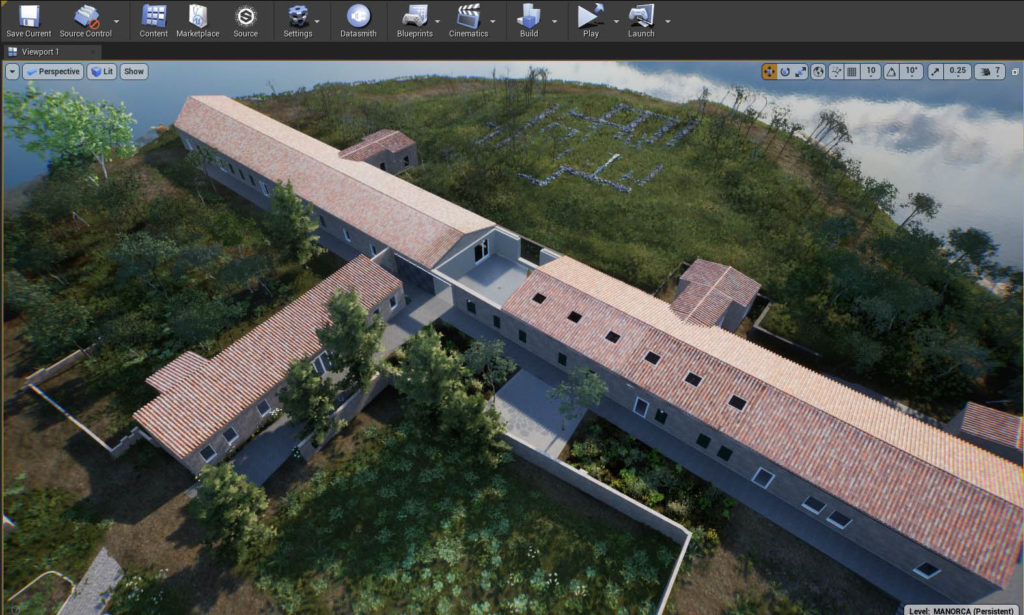 Hauser & Wirth claims that the program is the first initiative of its kind to be developed entirely within the art world to create true-to-life exhibition spaces, comparable to the fidelity found in the latest video game technology, by developing a technique for converting the gallery’s database of artworks in 3D assets. “HWVR builds the virtual 3D space from the ground up at a pixel level, rather than relying on combined photos, which gives an unprecedented level of flexibility,” the gallery boasted.
See the full story here: https://archpaper.com/2020/04/hauser-wirth-unveils-vr-program-to-explore-virtual-exhibitions/
"Artist Spotlight" will highlight one artist each week and present a single artwork along with pricing information on the gallery's website for a 48-hour period.
Participating artists include Sarah, Sze, Stanley Whitney, Jennifer Guidi, Roe Ethridge, Titus Kaphar, Katharina Grosse, Theaster Gates, Dan Colen, Urs Fischer, Mark Grotjahn, Mary Weatherford, Rudolf Polanszky, Damien Hirst and Jenny Saville.
https://news.yahoo.com/hauser-wirth-launches-virtual-reality-platform-reaction-covid-150316525.html
REGULATION The Different Challenges and Approaches to AI by Country
 China - facial recognition and surveillance
US - cybersecurity and skills gap
Germany - disinformation and the economic impact
UK - business value and retraining
France - integrating the technology and retraining
Canada - slow adoption and lower emphasis on AI's importance
See the full story here: https://www.unite.ai/the-different-challenges-and-approaches-to-ai-by-country/
Mirror Arrays Make Augmented Reality More Realistic
 ...it has remained challenging to make virtual images appear more “solid” in front of real-world objects, an effect that’s essential for us in achieving depth perception.
Now, a team of researchers has developed a compact AR system that, using an array of miniature mirrors that switch positions tens of thousands of times per second, can create this elusive effect. They describe their new system in a study published February 13 in IEEE Transactions on Visualization and Computer Graphics.
Their design relies on a dense array of miniature mirrors that can be individually flipped between two states—one that allows light through and one that reflects light—at a rate of up to tens of thousands of times per second.
Krajancich notes some trade-offs with this approach, including some challenges in rendering colors properly. It also requires a lot of computing power, and therefore may require higher power consumption than other AR systems. While commercialization of this system is a possibility in the future, she says, the approach is still in the early research stages.
See the full story here: https://spectrum.ieee.org/tech-talk/sensors/imagers/mirrors-augmented-reality-more-realistic
IEEE link is https://ieeexplore.ieee.org/document/8998139
Augmented-reality cable technicians are here to fix your internet
But what if there were a way for that technician to come to your home and guide you through the diagnostics and repair in real time without once stepping inside? That’s what Cox Cable‘s On-site with Virtual Assist service does, using an augmented reality (AR) platform created by Birmingham, Alabama-based Help Lightning.
As long as you have a phone or tablet with a rear-facing camera and a working Wi-Fi or mobile data connection, a tech support representative can see what you’re seeing and insert their hands, tools, parts, or diagrams onto your screen so you can see exactly what needs to be done.
The Help Lightning app effectively merges two video feeds: The one captured by your device’s camera and a second video shot by the technician of their hands. The result is a combined video that lets the technician virtually point to the different devices and connections in your home while they talk you through the fix.
Cox Cable has the on-site virtual assist option in all of its markets right now, but the company isn’t alone. Siemens Healthineers, Otis Elevator, Ricoh, Bunn, and Johnson Controls are among Help Lightning’s other clients, and they too can offer virtual assistance if needed.
See the full story here: https://www.digitaltrends.com/home-theater/cox-cable-augmented-reality-tech-support-for-help-while-social-distancing/