When Brian Ritchey attends a meeting, he's almost always the one running it. But when the COO and VP of Pennsylvania-based metal supplier Ritchey Metals put on a virtual reality headset, he wasn't at the head of the table.
“I was in the boardroom with a group of diverse women. I was the only male in the room. They would try to interrupt me,” Ritchey remembers. “I was so annoyed at everyone in the meeting—no one would listen to me.”
Then came the next tweak: the makeup of the roomful of executives who exclude the person with the VR headset on. When DDI at first developed the VR experience to resemble the real world—with mostly male executives committing the same slights—the real-life men participating in the training didn’t register that they were being excluded. “We had a few guys going, ‘Hey, what’s up?’ They felt like they were part of the group,” Sipe says. Putting women in those seats flipped the switch to help C-suite men understand that something was wrong.
While the mantra of tech start ups is infamously “move fast and break things,” in San Francisco it might be more like “get a permit and do a pilot program.”
Earlier this week, the president of San Francisco’s Board of Supervisors introduced a bill to create an Office of Emerging Technology (OET), a one-stop permitting shop for any entrepreneurs looking to launch their tech on city property (think ride hailing or e-scooters).
Companies would have to persuade the OET that their tech provides a public good to get a permit, at which point they’d launch a pilot program, lasting up to a year. Then the OET would re-assess and potentially give the company a permanent permit.
Listen to the 17 minute podcast, which features USC's Brad Beren, here: https://www.scpr.org/programs/airtalk/2019/10/29/65033/trying-to-launch-a-start-up-you-might-have-to-go-t/
The firm’s focus on entertainment technologies has a B2B bent, with a geographic focus on Israel as its primary hub and with most of its initial portfolio selling to enterprise media companies. That makes Remagine’s ability to guide entrepreneurs through the halls of traditional media giants highly relevant; it also means it can gauge whether traditional media companies are likely to buy a startup’s product before they invest.
Kevin Baxpehler: Our investment thesis is based on two main drivers: new advancements in so-called AI technologies — specifically deep-learning, computer-vision and NLP — coupled with new consumer trends such as esports, visual search, and engaging with computer-generated imagery (CGI) like Lil Miquela.
We believe that recent technological developments such as GANs (generative adversarial networks), coupled with new powerful computing power like new microprocessing chips and 5G, will change how brands, consumers, and stars/influencers will all interact. It creates tremendous opportunities to invest.
Another example is Vault, which uses deep learning to predict the success of scripted projects, whether it’s movies or TV shows down to the box office opening Rotten Tomatoes scores, the probability of there being a season two, the demographics that are most impacted, etc. So bringing a more data-driven approach to marketing films and shows.
Inspired by these spiders, researchers at the Harvard John A. Paulson School of Engineering and Applied Sciences (SEAS) have developed a compact and efficient depth sensor that could be used on board microrobots, in small wearable devices, or in lightweight virtual and augmented reality headsets. The device combines a multifunctional, flat metalens with an ultra-efficient algorithm to measure depth in a single shot.
Evolution, as it turns out, provides a lot of options.
Jumping spiders have evolved a more efficient system to measure depth. Each principal eye has a few semi-transparent retinae arranged in layers, and these retinae measure multiple images with different amounts of blur. For example, if a jumping spider looks at a fruit fly with one of its principal eyes, the fly will appear sharper in one retina’s image and blurrier in another. This change in blur encodes information about the distance to the fly.
“Instead of using layered retina to capture multiple simultaneous images, as jumping spiders do, the metalens splits the light and forms two differently-defocused images side-by-side on a photosensor,” said Shi, who is part of Capasso’s lab.
An ultra-efficient algorithm, developed by Zickler’s group, then interprets the two images and builds a depth map to represent object distance.
Army wants digital image processing to improve image quality, intelligent toggling to modulate power, and ability to display only relevant information.
U.S. Army researchers are looking for companies able to write software that would enable digital night-vision goggles to enhance warfighter augmented and virtual reality capabilities on the battlefield.
This architecture should use high-frame-rate digital image feeds; 2-D and 3-D terrain data; and full-color displays to provide a more intuitive and ergonomic augmented reality interface, and a more realistic virtual reality experience.
The Army particularly is interested in an architecture that has digital image processing to improve image quality, as well as an intelligent toggling system to modulate power and dataflow to save power and display only relevant information.
Hardware in the architecture must communicate via a hard-wired connection like USB 2.0, with options for wireless operation via Bluetooth, 802.11g, Wireless Personal Area Network (WPAN), or Ultra Wide Band (UWB). The radio shall be either wave relay radio such as an MPU-5 or wideband waveform such as a Harris 152A/163.
Prototypes may not be fully functional if they adequately demonstrate ways to enhance performance of the user and the system.
RealAR, an Australian startup that creates 3D, augmented reality models of homes and other buildings based off of 2D floorplans. In order to view the models, RealAR uses a phone or tablet app. “We wanted our spatial visualization tech to be mass market (AR works on about 1BN+ phones/tablets), life-sized experiences and portable, so it works in almost any space without additional gear,” said RealAR’s CEO and cofounder Dan Swan in an email interview with Propmodo.
The first one is the DreamWalker. This allows users to recreate an environment in virtual reality and walk as if a user were present in it. But the important thing is that the program could adapt the desired place (virtual) to the streets where the player lives, since the software would choose the ones that best fit the real one in order for the user to navigate safely.
This would also be achieved with the help of sensors, which would detect the obstacles discovered in reality and that the user could not see, but would be represented in the virtual world and thus avoid them.
Another one is the Mise-Unseen project, which has great potential to provide more interactive virtual reality experiences, since its technology could alter what the user sees on the screen to such an extent that he does not realize. (Only items outside the fovea change!)
With the new ‘Avengers: Damage Control’ in the Grand Canal Shoppes at The Venetian Resort, the company brings guests into the action of a new Avengers plot to save the world.
The experience is available Monday through Sunday at The Venetian until Nov. 15.
Spots are available for $39.95 with time slots open every 15 minutes from 10:00 a.m. to 11:00 p.m.
A group of Hong Kong students have developed a virtual reality game they hope will allow people to experience the anti-government demonstrations from the view of a “frontline protester”.
Lam, who developed the game with two classmates, said it does not allow protesters to inflict violence or do anything illegal. That would stymie their chances of getting it published by an online distributor, Lam said.
However, she added it did have a “pro-protester” stance.
 Inspired by these spiders, researchers at the Harvard John A. Paulson School of Engineering and Applied Sciences (SEAS) have developed a compact and efficient depth sensor that could be used on board microrobots, in small wearable devices, or in lightweight virtual and augmented reality headsets. The device combines a multifunctional, flat metalens with an ultra-efficient algorithm to measure depth in a single shot.
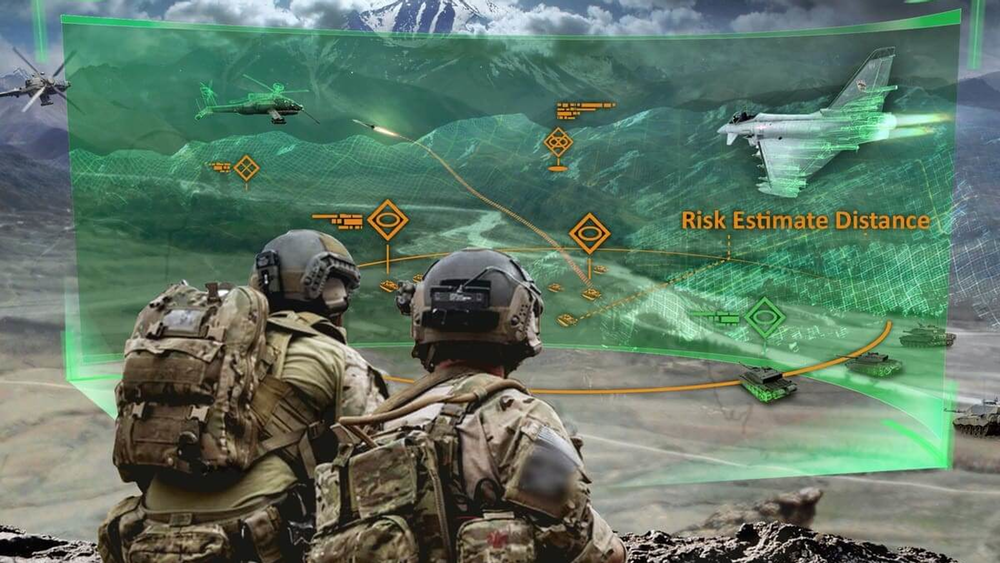 U.S. Army researchers are looking for companies able to write software that would enable digital night-vision goggles to enhance warfighter augmented and virtual reality capabilities on the battlefield.
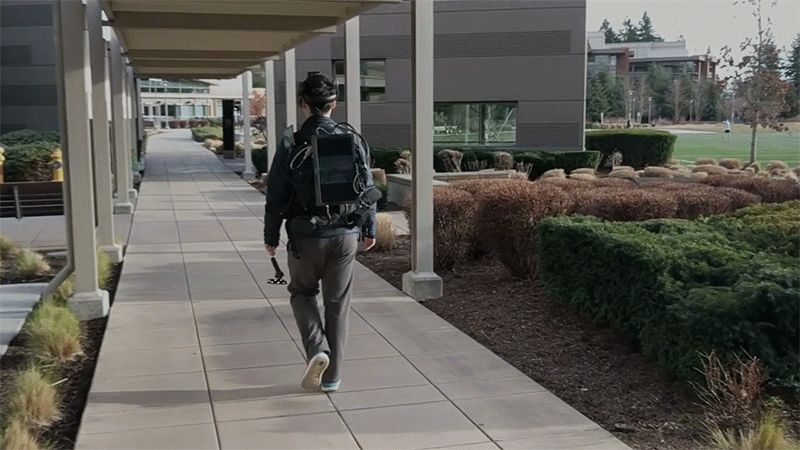 The first one is the DreamWalker. This allows users to recreate an environment in virtual reality and walk as if a user were present in it. But the important thing is that the program could adapt the desired place (virtual) to the streets where the player lives, since the software would choose the ones that best fit the real one in order for the user to navigate safely.