Inspired by jumping spiders
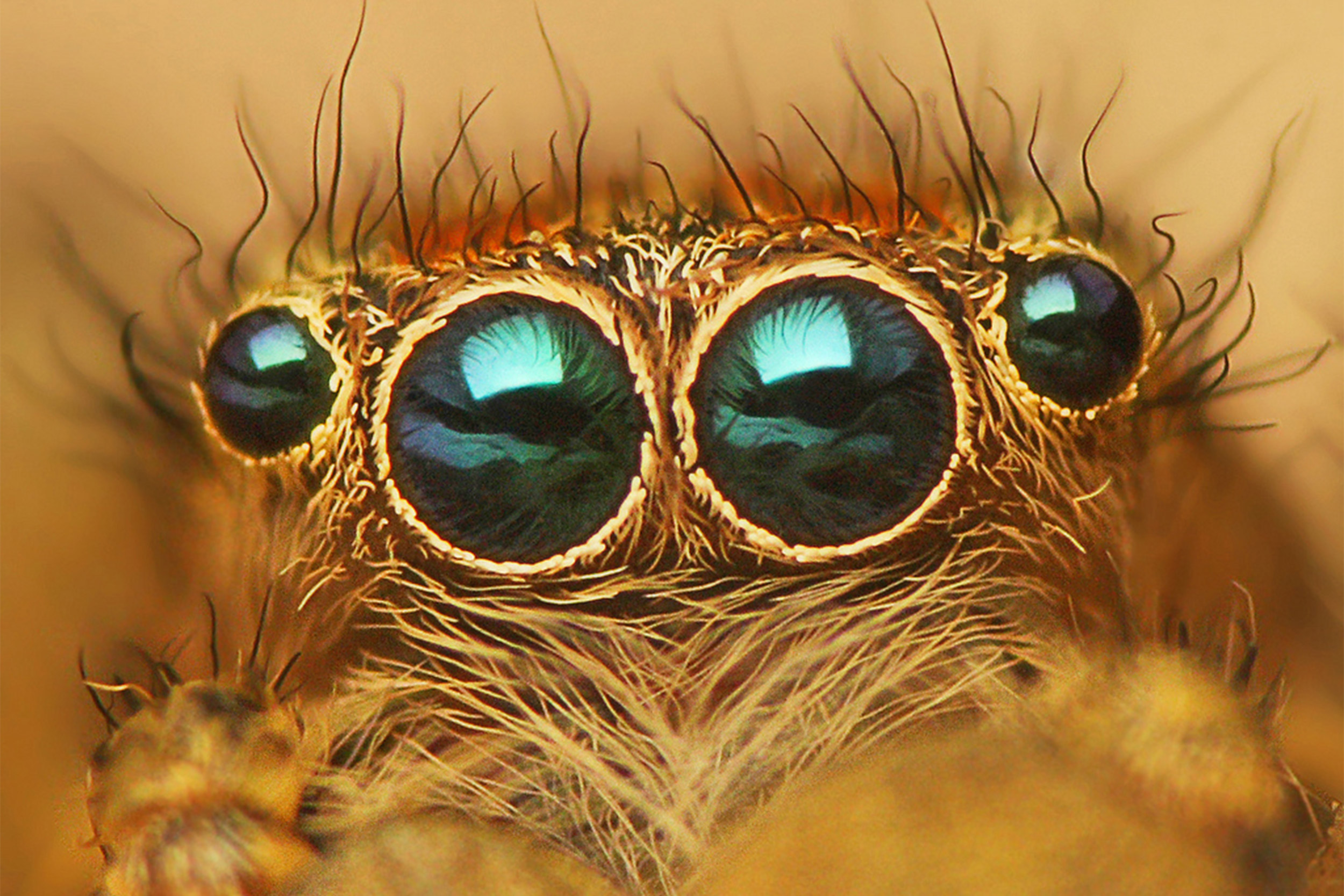 Inspired by these spiders, researchers at the Harvard John A. Paulson School of Engineering and Applied Sciences (SEAS) have developed a compact and efficient depth sensor that could be used on board microrobots, in small wearable devices, or in lightweight virtual and augmented reality headsets. The device combines a multifunctional, flat metalens with an ultra-efficient algorithm to measure depth in a single shot.
Evolution, as it turns out, provides a lot of options.
Jumping spiders have evolved a more efficient system to measure depth. Each principal eye has a few semi-transparent retinae arranged in layers, and these retinae measure multiple images with different amounts of blur. For example, if a jumping spider looks at a fruit fly with one of its principal eyes, the fly will appear sharper in one retina’s image and blurrier in another. This change in blur encodes information about the distance to the fly.
“Instead of using layered retina to capture multiple simultaneous images, as jumping spiders do, the metalens splits the light and forms two differently-defocused images side-by-side on a photosensor,” said Shi, who is part of Capasso’s lab.
An ultra-efficient algorithm, developed by Zickler’s group, then interprets the two images and builds a depth map to represent object distance.
See the full story here: https://news.harvard.edu/gazette/story/2019/10/a-depth-sensor-inspired-by-the-way-spiders-eye-flies/