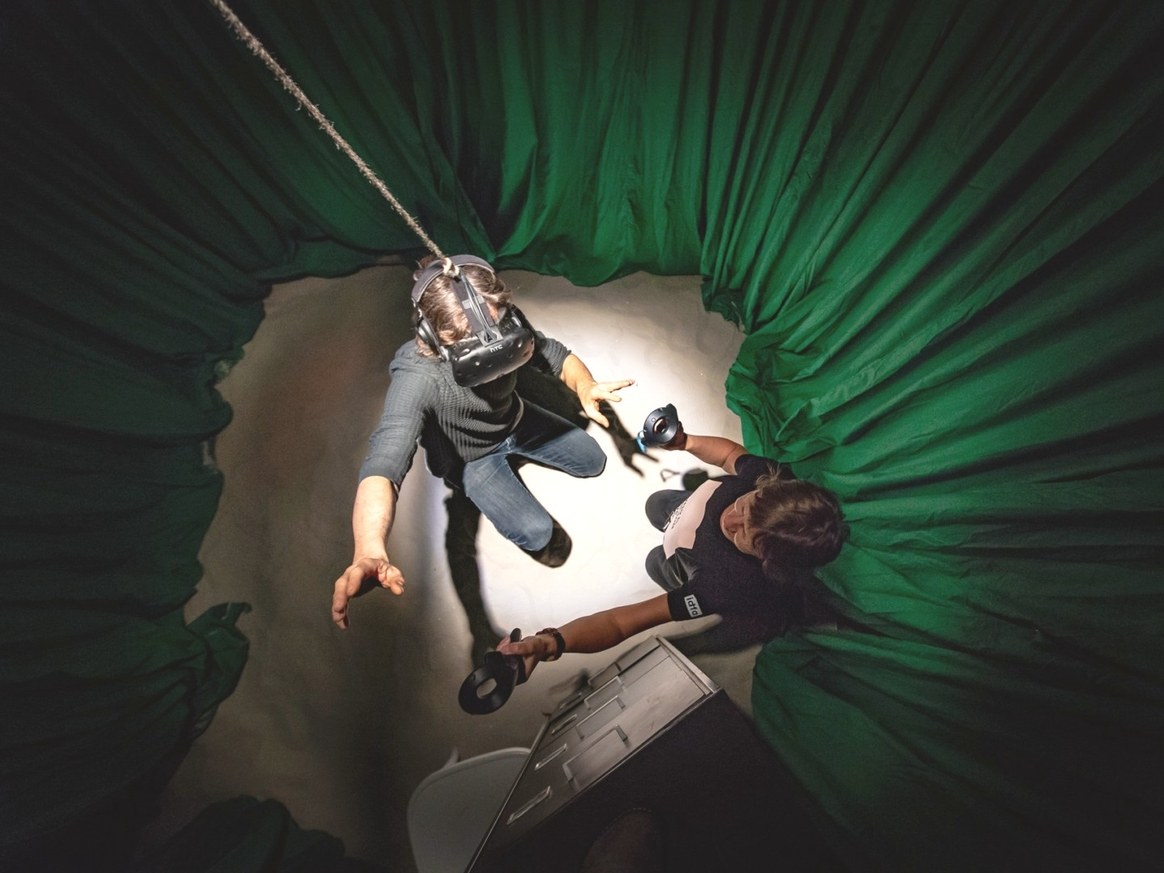
Once deemed That Thing You Do in Between Screenings, interactive offerings—a mix of virtual reality, augmented reality, mixed reality, performance, and other internet-y projects—have blossomed into packed events that generate as much buzz as premieres. Traditionally, they've offered somewhat solitary experiences: Sit in this chair, wear these goggles, lose touch with the festival around you. Now, programmers are looking to make interactive experiences fun for the whole family.
"I believe that festivals are a crucial part of the ecosystem of location-based entertainment, particularly as it relates to [VR, AR, and mixed reality]," says Loren Hammonds, programmer for the Tribeca Film Festival's Immersive slate. "We don't have the Netflix 'problem' yet of losing audiences to their living rooms, mostly because the majority of people haven't adopted headsets for at-home usage yet. What we're offering are premium experiences that simply can't be duplicated at home, with fully realized installations, live actors, and more that can truly complement the digital work of the creators."
The ultimate question with all of this, though, is: Where do all of these projects belong? Experiences that need live actors, huge installations, or big audiences will only ever be available in a handful of places.
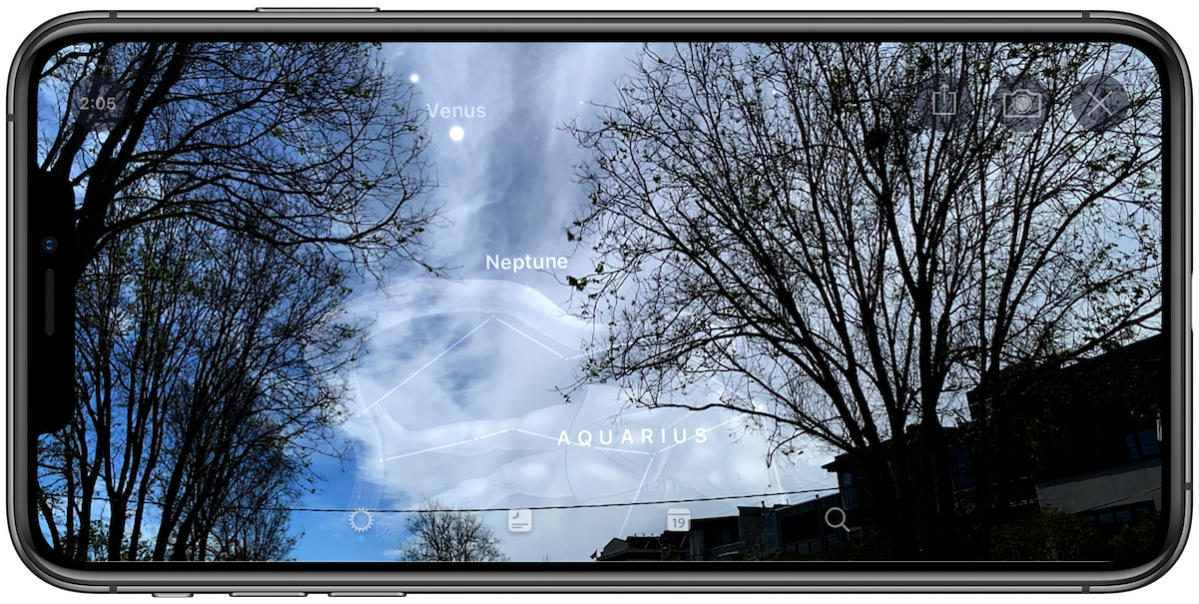
...That's what Jessica Brillhart is hoping to create. Her Tribeca project, called Into the Light, is an immersive audio installation that will pipe Yo-Yo Ma's rendition of Bach's "Unaccompanied Cello Suite No. 2 in D Minor" through multiple floors of Tribeca's Spring Studios location. The experience at the festival will be unique, but it was created with Brillhart's audio platform, Traverse, which has an app version that anyone with an iPhone can use. Right now, Traverse requires Bose AR glasses, but soon the app should be usable with standard headphones (and also compatible with Android devices).
Austrian parliament building with Athena statue on the front in Vienna on the sunrise
It's not just China that wants to reduce anonymity online. Austria's government has introduced a draft law that would require you to provide your real name and address to larger sites before commenting. You could still use a nickname in public, but authorities would have an easy way to find you if they believe you're harassing users or otherwise violating the law. Companies that didn't honor the law could face fines up to €500,000 (about $562,000) if they didn't comply, and twice that with a repeat offense.
It would only affect sites with more than 100,000 registered users, bring in revenues above €500,000 per year or receive press subsidies larger than €50,000. There would also be exemptions for e-commerce sites as well as those that don't earn money from either ads or the content itself.
As always, there's also the simple question of privacy. While requiring names and addresses could discourage harassment and hate speech, it might also discourage people from coming forward with insightful stories and opinions. Moreover, this would turn sites into veritable gold mines for hackers -- if they could breach a database, they might swipe personal information for thousands or millions of users. Simply put, there could be a chilling effect on freedom of expression even as Austria attempts to preserve it.
By 2025, two billion of the global population is going to be made up by the youngest generation: Generation Alpha, also known as the iGeneration. Generation Alpha are children born between 2010 and 2025.
This is the first generation entirely born in the 21st century. These children are considered to be the most technological-infused demographic up to date.
Alpha children are accustomed to acquiring knowledge by doing, screen-touching, and experiencing. Schools need to provide an adequate environment that enhances this type of learning.
This type of environment requires changes and a new approach to education at all levels. Schools and colleges should get ready by creating programs of study that require deep learning.
Schools need to start preparing programs that are flexible enough to be adapted and modified quickly according to the young Alphas' inquisitive mind.
Video Summary:A specialized camera that TIME, in collaboration with Felix & Paul Studios, sent to the space station is recording the first cinematic virtual reality experience in space.
There's a limit to the volume of death metal humans can reproduce -- their fingers and vocal chords can only handle so much. Thanks to technology, however, you'll never have to go short. CJ Carr and Zack Zukowski recently launched a YouTube channel that streams a never-ending barrage of death metal generated by AI. Their Dadabots project uses a recurrent neural network to identify patterns in the music, predict the most common elements and reproduce them.
The result isn't entirely natural, if simply because it's not limited by the constraints of the human body. There are no real pauses. However, it certainly sounds the part -- you'll find plenty of hyper-fast drums, guitar thrashing and guttural growling. In a chat with Motherboard, Carr noted that death metal's rapid-fire pace is ideal for this as it creates more consistent output than you'd get with other, slower genres.
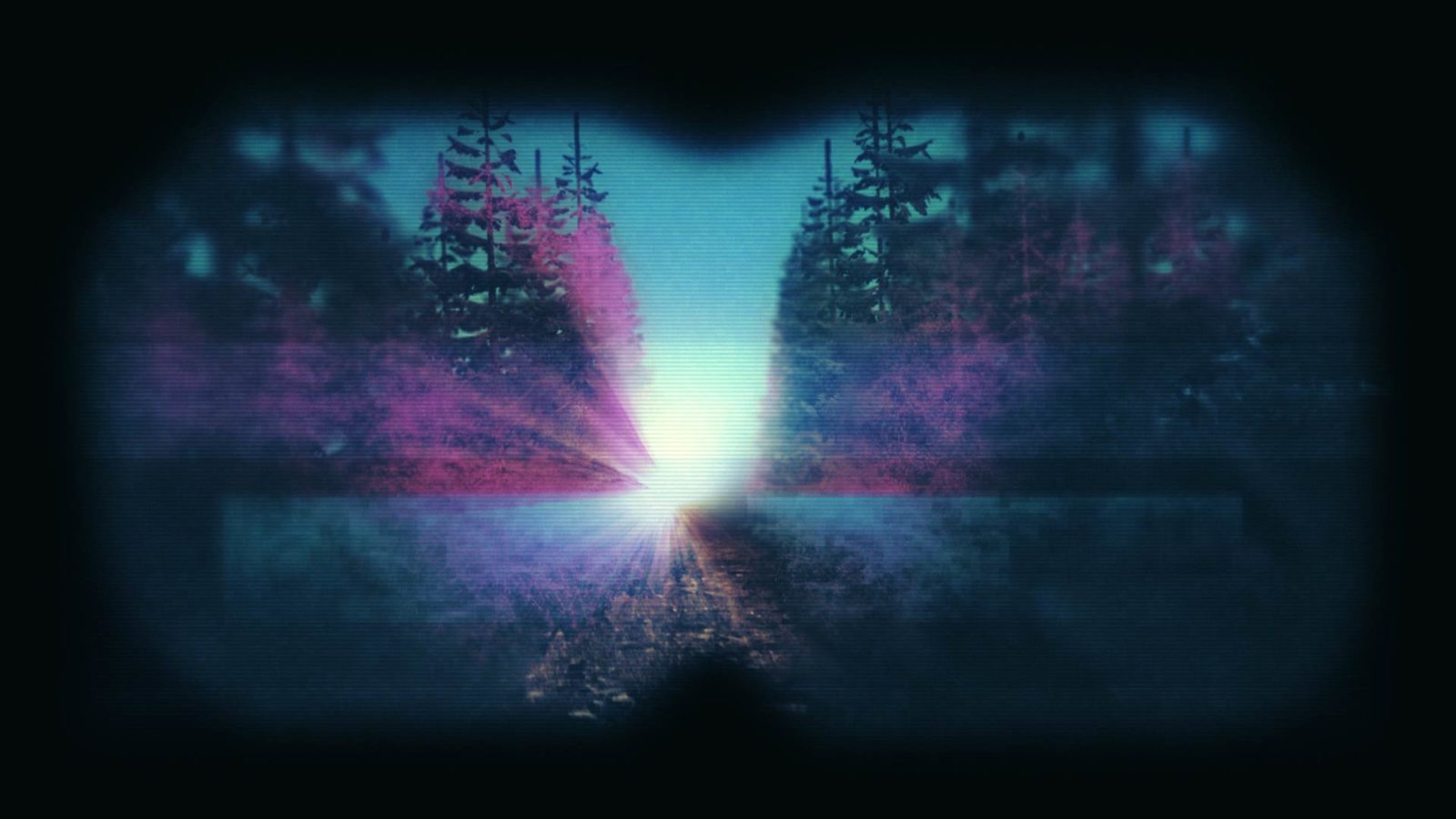
The University of California, Los Angeles, psychiatry researcher and her colleagues are testing whether virtual reality can curb anhedonia, a symptom of depression and other serious mental health conditions that’s marked by a lack of interest or ability to feel pleasure. They’re putting patients into pleasant scenarios — like a stroll through a sun-soaked forest while piano music plays — and coaching them to pay close attention to the positive parts.The idea is to help patients learn to plan positive activities, take part in them, and soak up the good feelings in the process.
It’s an unconventional strategy — not just for its use of virtual reality, but also for how it approaches a patient’s symptoms. Treatments for depression and other serious mental health conditions primarily target negative symptoms, like hopelessness, sadness, and anxiety — but they often don’t help with the lack of positive feelings that some patients experience.
There aren’t data yet to determine whether virtual reality treatment can make a meaningful difference in anhedonia. But the technology is increasingly popular in mental health care.
The foundation of Craske’s approach is an intervention developed by Craske and her colleagues known as positive affect therapy. The gist: put a person into a situation that might be pleasurable, talk to them about it in painstaking detail, repeat.
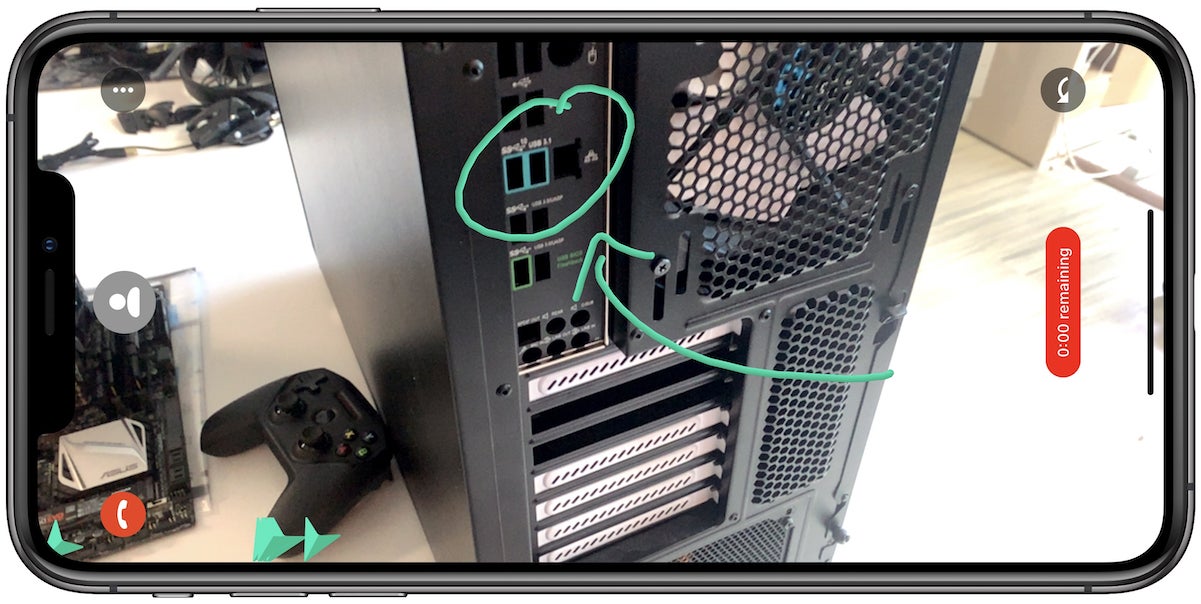
Whenever I imagine AR becoming part of our everyday future lives, I think of something like Vuforia Chalk. It’s a little like FaceTime in that it’s basically a video call, but in this case you can “circle” items you’re looking at through the camera and draw arrows, all the better to, say, point out faulty pieces of equipment or to show someone which buttons to press.
It’s a little wonky sometimes, perhaps because the rear iPhone lenses still don’t have proper TrueDepth sensors that can accurately map out a surface. Both of the people on the call need to have a Chalk account, so there’s some setup involved. And then the free version only lets you use it for three minutes at a time. Still, it’s fun to try out.
Once this kind of technology gets built into FaceTime itself, I think we’ll be taking a giant leap toward the AR-powered future that Apple wants us to get excited about.
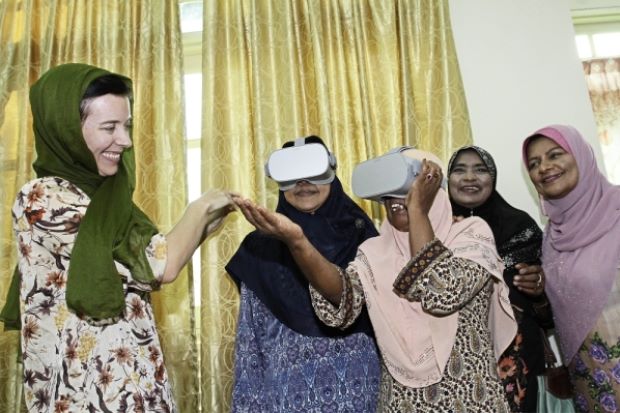
A documentary, believed to be the first 360-degree VR film produced in Malaysia, allows viewers to experience being “inside the mosque” as if they are part of the congregation of the faithful.
Shot during Friday prayers at the mosque in George Town, the Call to Prayers documentary takes viewers to explore the many rites and rituals that make up the Islamic faith which is usually not for visitors of other faiths.
“Viewers can see how religious programmes and daily activities are carried out here. Viewers can experience attending Friday prayers from the melodic call to prayer, to the ablutions, to joining the congregation as they pray,” the 28-year-old, who is also the video director, said. “This project brings the mosque towards modernity,” he said.
Canopi Studio co-founder and senior producer Peta Khan said the documentary was shot at the highest quality of 8k resolution using a 360-degree camera with immersive 3D technology.
There are more reasons why it isn't exactly a fair fight between the two technologies. Even bereft of the sensory augmentation, the HTC Vive gets to call upon a powerful desktop PC to generate its visuals. In contrast, the Magic Leap One must rely on a puck worn at one's side powered by an SoC with tighter thermal constraints. The VR experience also takes more time and results in an unpleasant ending for the wearer's character, which could have also contributed to the greater emotional reaction. Calibration difficulties encountered while trying the Magic Leap One led to my hearing the simulation's introduction four times, which also likely reduced some of its impact.
Removed from the souped-up VR comparison, however, the Magic Leap One experience impressed. The Game of Thronesscenario reminded me somewhat of one of the first-gen HoloLens games -- but with a field of view closer to that of the second-gen HoloLens. And while the emotional reaction was not as intense, it was palpable.
Real estate is getting a bit more virtual with 3D immersive tours at Zillow, a major player in online home sales.
The company added a feature called 3D Home to its site and app Monday that lets you step from virtual room to virtual room as you're shopping online. Real estate agents can capture the imagery using an iPhone or Ricoh's 360-degree cameras like the Theta V and Theta Z1.
The result, Zillow hopes, is you should get a better feel for what might well be one of the most expensive purchases in your life. Virtual reality has limited mainstream appeal, even among gamers, but it still holds potential for when you want to be transported to a different realm.
For now, stepping through the 3D home is like using Google Maps' Street View: you see arrows that let you click or tap around to different rooms. You won't be swooping through a 3D zone like you might in a VR video game.
Zillow's 3D Home tool is designed to be easy for photographers to use so home sellers and their agents can add the 3D views affordably to ordinary homes for sale, not just luxury mansions, Weisberg said. Photographing a 3,000-square-foot home takes about 10 or 15 minutes, with shots taken for each room.


 Real estate is getting a bit more virtual with 3D immersive tours at Zillow, a major player in online home sales.