New virtual reality tool allows you to see the world through the eyes of a tiny primate
 Imagine that you live in the rainforests of Southeast Asia, you're a pint-sized primate with enormous eyes that are roughly the same size as your brain, and you look a little like Gizmo from the movie, "Gremlins". You're a tarsier-- a nocturnal animal whose giant eyes provide you with exceptional visual sensitivity, enabling a predatory advantage. A new virtual reality software, Tarsier Goggles, developed at Dartmouth College, simulates a tarsier's vision and illustrates the adaptive advantage of this animal's oversized eyes. Both the virtual reality build and the team's findings published recently in Evolution: Education and Outreach are available for free online.
"Most ninth- and 10th-grade students in the U.S. learn about optics and natural selection, but the two topics are usually treated in isolation," says Dominy, who served as one of the co-authors. "The tarsier is an effective means of unifying both concepts. You have to understand optical principles to understand why natural selection would favor such enormous eyes in such a tiny predator."
"The Tarsier Goggles project engaged my students first-hand in a learning experience, which could not have been achieved through any other medium," explains Marilyn Morano Lord '95, MALS '97, an anthropology and world history teacher at Kimball Union Academy, who also served as one of the co-authors of the paper.
See the full story here: https://www.eurekalert.org/pub_releases/2019-03/dc-nv032519.php
Deepfakes are solvable—but don’t forget that “shallowfakes” are already pervasive
 Malicious synthetic videos are not yet mainstream, which gives tech companies a chance to prevent future misinformation. But it won’t fix our current flood of fake news.

The technology industry has a unique opportunity to tackle “deepfakes”—the problem of fake audio and video created using artificial intelligence—before they become a widespread problem, according to human rights campaigner Sam Gregory.
Speaking on Monday to an audience at EmTech Digital, an event organized by MIT Technology Review, he said that the deepfakes we’re currently seeing are “the calm before the storm.”
Fake information today does not generally use AI or complex technology. Rather, simple tricks like mislabeling content to discredit activists or spread false information can be devastatingly effective, sometimes even resulting in deadly violence, as happened in Myanmar.
“Now is really the time for companies, researchers, and others to build these very strong connections to civil society, and the different country offices where your products might launch,” he said. “Engage with the people who are closest to the issues in these countries. Build those alliances now. When something does go wrong—and it will—we can start to have the foundation for collaboration and knowledge exchange.”
See the full story here: https://www.technologyreview.com/s/613172/deepfakes-shallowfakes-human-rights/
Smart talking: are our devices threatening our privacy?
 He argues that voice devices are creating a snarl of new ethical and legal issues. “Will personal assistants be responsible for the ... knowledge that they have?” he says. “A feature like that sometime in the future could become a liability.”
The uses of AI surveillance make clear that you should scrutinise each one of these technologies you allow into your life. Read up on just how and when the digital ears are turned on. Find out what voice data is retained and how to delete it if you desire. And if in doubt – especially with applications made by companies whose privacy policies can’t be easily understood – pull the plug.
See the full story here: https://www.theguardian.com/technology/2019/mar/26/smart-talking-are-our-devices-threatening-our-privacy
How GMU students’ eating habits changed when delivery robots invaded their campus
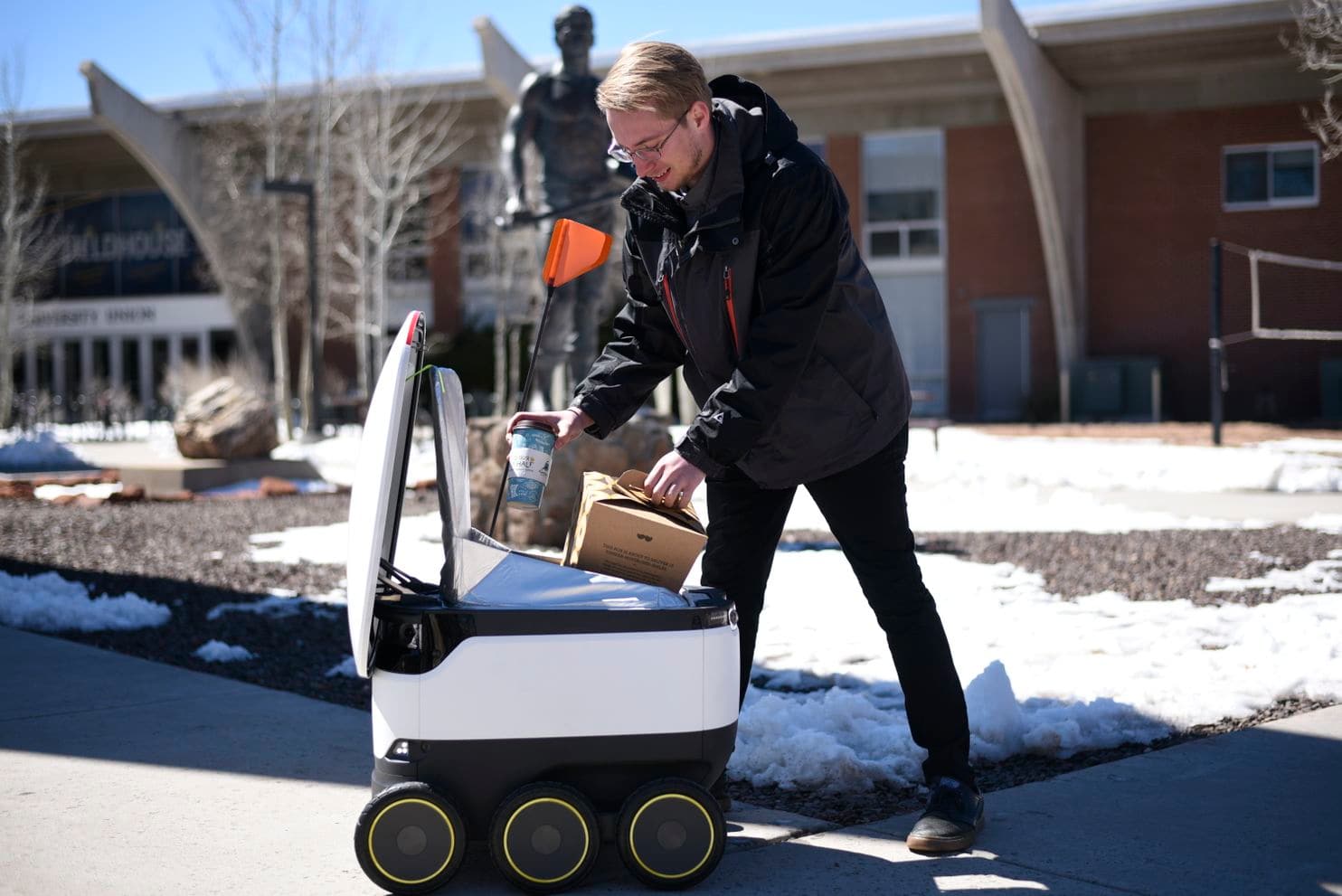 In the two months since the robots arrived at the Fairfax, Va.-based school, an extra 1,500 breakfast orders have been delivered autonomously, according to Starship Technologies and Sodexo, a company that manages food services for GMU on contract and works closely with the robots.
“Research has shown that up to 88 percent of college students skip breakfast, primarily because of lack of time, but that number is starting to turn around when delivery robots arrive on campus,” Starship Technologies said in a statement released Monday.
“This follows a similar pattern seen at corporate campuses where delivery robots were added,” the statement added, referring to an uptick in breakfast orders.
Each robot is opened using a delivery code and can carry as much as 20 pounds — the equivalent of about three shopping bags of goods, Starship Technologies said.
Two months later, breakfast has replaced dinner as the go-to meal for robot delivery. The question is why.
Blockchain-powered marketplaces will be like steroids for crowd investing
 Crowdfunding, but for promising cancer drugs. Like a Kickstarter campaign, but instead of a memento or special access to the product, you get an actual share in the drug’s potential future sales. Would you do it? Biotech firm Agenus wants to give you a chance—something it says is now possible thanks to blockchain technology.
As for Agenus, the problem it is trying to solve is that biotech companies often have trouble raising money to develop new drugs and bring them to market, since the process is so risky and expensive. Agenus is betting its new crypto-token, which it calls the Biotech Electronic Security Token (BEST), will be more compelling to investors than traditional biotech financing instruments. Particularly attractive will be the ability to trade them on regulated internet marketplaces, the first of which are just now starting to go live. The new approach, proclaims CEO Garo Armen, has the potential to “revolutionize the financing of drug development.”
Whether they have issued or plan to issue “digital securities,” “tokenized securities,” or “security tokens” (pick your buzzword), this is essentially what Agenus and every other such project is aiming to pull off: an ICO that follows the rules.
See the full story here: https://www.technologyreview.com/s/613135/blockchain-powered-marketplaces-will-be-like-steroids-for-crowd-investing/?utm_campaign=the_download.unpaid.engagement&utm_source=hs_email&utm_medium=email&utm_content=71132857&_hsenc=p2ANqtz-91lX_sT138-yWBoFtQX11Kcmx1I711hWn5zi_AEXyhDHorefp4XQKxQhaNhbLMkKUu8LVAKup1opR8m4t5bAnH23xz_w&_hsmi=71132857
The Digital Art Market Heats Up
 [NOTE: 2 photos of USC’s Perry Hoberman’s work are featured in the PRINT version of this story (but not in the online version)]
VR experts predict bright future
 VFX house Framestore, meanwhile, is experiencing growing demand for virtual reality work. Its VR team has grown from three to approaching 100, according to head of VR Karl Woolley.
He said the early hype around VR led people to think it would take off quickly and that there would soon be headsets in every home. Instead, he added: “The real demand for VR is coming from the rollout of more location-based experiences. And this is where I think we’ll see it continue for the time being.”
Meanwhile, location-based VR company Dreamscape Immersive, whose investors include AMC and Steven Spielberg, has just opened its first VR experience centre in a Westfield shopping mall in Los Angeles and plans to open four more in the US this year.
See the full story here: https://www.broadcastnow.co.uk/tech/vr-experts-predict-bright-future/5137971.article
MIT’s AI can train neural networks faster than ever before

Abstract network molecular block chain structure - 3d rendered image on black background
Today, AI can design machine learning systems known as neural networks in a process called neural architecture search (NAS). But this technique requires a considerable amount of resources like time, processing power and money. Even for Google, producing a single convolution neural network -- often used for image classification -- takes 48,000 GPU hours. Now, MIT researchers have developed a NAS algorithm that automatically learns a convolution neural network in a fraction of the time -- just 200 GPU hours.
While this is certainly not uncomplicated, it could be a step toward putting AI and machine learning in the hands of more people and companies, freeing it from the towers of tech giants.
See the full story here: https://www.engadget.com/2019/03/22/mit-ai-automated-neural-network-design/