Billionaire Has a New Goal for His 17,000 Workers: Learn to Code
 Less than a decade after stunning workers at his Japanese tech giant with an edict to learn English, billionaire Hiroshi Mikitani wants to do the same with computer programming.
“If you’re working for Toyota, for example, you know how the automobile works -- basic structure of the engine, suspension and so forth,” Mikitani told Emily Chang of Bloomberg Television. “So if you work for an IT services company, you need to have the basic knowledge of what’s in the computer.”
How Laika blends 3D printing and CGI to make mesmerizing stop-motion movies
 Laika Studios does animation differently.
One of the most intriguing elements of Laika’s ever-expanding toolkit is its growing collection of 3D printers. Using the cutting-edge technique of rapid prototyping, Laika has revolutionized stop-motion animation, using advanced handmade puppets with incredibly expressive faces to walk an intriguing line between realism and fantasy.See the full story here: https://www.digitaltrends.com/movies/how-laika-used-advanced-3d-printing-and-movie-magic-to-create-missing-link/
UC San Diego’s Qualcomm Institute Shows Off Virtual Reality, Wildfire Technology
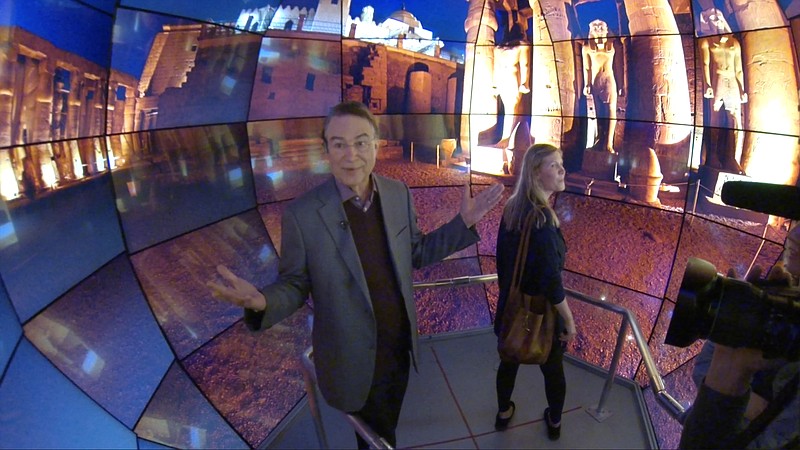 The "SunCAVE" at UC San Diego's Qualcomm Institute has 70 monitors with 4K resolution that researchers said create the world's highest resolution virtual reality system.
"One of the things we’re doing here at UC San Diego is generating scientific and archaeological content at high resolution," said California Institute for Telecommunications and Information Technology Director Larry Smarr.
Researchers have created models that when combined with wind speed and other weather conditions can predict what a fire will do.
"Wind-driven fires move really fast, but if you can get ahead of it you can manage it better," Altintas said.
See the full story here: https://www.kpbs.org/news/2019/mar/20/uc-san-diegos-qualcomm-institute-shows-virtual-rea/
The Oculus Rift S is real and arrives in spring for $399
 ...the biggest improvements to the Oculus Rift S are a move to the company’s inside-out “Insight” camera tracking system and modest updates to the display resolution. The biggest surprise is that this headset is being built in partnership with Lenovo and the Rift S seems to have strongly inherited Lenovo’s design ethos for its VR products, for better or worse…
The Rift S will be replacing the Rift in the Oculus product lineup.
Here’s what’s different:
- Small resolution increase per eye from (1080 x 1200) to (1280 x 1440), improved lenses
- Frame rate is dropping from 90hz to 80hz
- Switched from OLED to the LCD panels used on Oculus Go
- 5 onboard cameras for inside-out camera tracking
- Ships with updated Oculus Touch controllers, same as what ships with Quest
- Loses the on-ear headphones for cheaper-sounding near-ear speakers similar to Oculus Go
- Ditches the flexible strap for a rigid “halo” design like the PlayStation VR headset
- FoV is “slightly larger” on the Rift S compared to the Rift, Oculus tells us
- No manual adjustment of distance between your eyes (IPD)
- PC spec requirements are largely the same, though you may need a faster CPU we are told
- More expensive than the last generation at $399 versus $349
- Launching in spring 2019
See the full story here: https://techcrunch.com/2019/03/20/the-oculus-rift-s-is-indeed-real-and-arrives-in-spring-for-399/
Augmented reality when? We asked Magic Leap, Facebook, Google, and more
[Over a dozen short interviews in this article.]
 THE FUTURE OF COMPUTERS IS SPATIAL

There’s no question that some serious technical challenges stand in the way of developing a pair of XR glasses that are stylish enough that you’d want to wear them for extended periods in public. The components needed to put enough computing power into a small space on a person’s face—and keep it all cool—just isn’t yet ready for prime time. Tech companies still struggle to deliver graphics at the kind of resolution the human eye is capable of seeing, to extend the field of view to something approaching the eye’s natural field of view, and to create eye tracking that follows the human gaze accurately. From a consumer point of view, the mixed reality experiences I’ve seen so far feel like works in progress.
Plenty of XR content–the experiences–will have to be available, too, including games and other entertainment. And there’s a chicken-and-egg problem: Software developers don’t want to invest big dollars in creating XR experiences until they see that the hardware is selling but that people won’t want the hardware until there are plenty of games and entertainment to play on it.
These issues will be worked out. The days of squinting into a little black rectangle and pecking at apps are probably numbered. Will it be some form of XR glasses that liberate us from that paradigm? Maybe. Or, as Camera IQ’s Allison Wood suggests, XR may show up in a variety of devices.
It may come down to a question of how truly important digital content is to living life productively and enjoyably—and how much control companies give consumers over that content. Will people really want digital layers and holograms to be showing up in their worldview all day? If they’re OK with that in XR glasses then will they be equally comfortable with it in something like AR contact lenses? How about just jacking the digital content right into the optical nerve? How close is too close?
It’ll be consumers that decide these things over time. The people and companies above, and others like them, will have to listen closely to successfully navigate the technological shift over the next decade.
See the full story here: https://www.fastcompany.com/90315733/augmented-reality-when-we-asked-magic-leap-facebook-google-and-more