“A major aim is to understand how our brains process self-motion cues in general,” Harris noted, “and to provide a quantitative model for how sensory information is combined together to do this.”
28Dec/18Off
The affordance of virtual reality to enable the sensory representation of multi-dimensional data for immersive analytics: from experience to insight
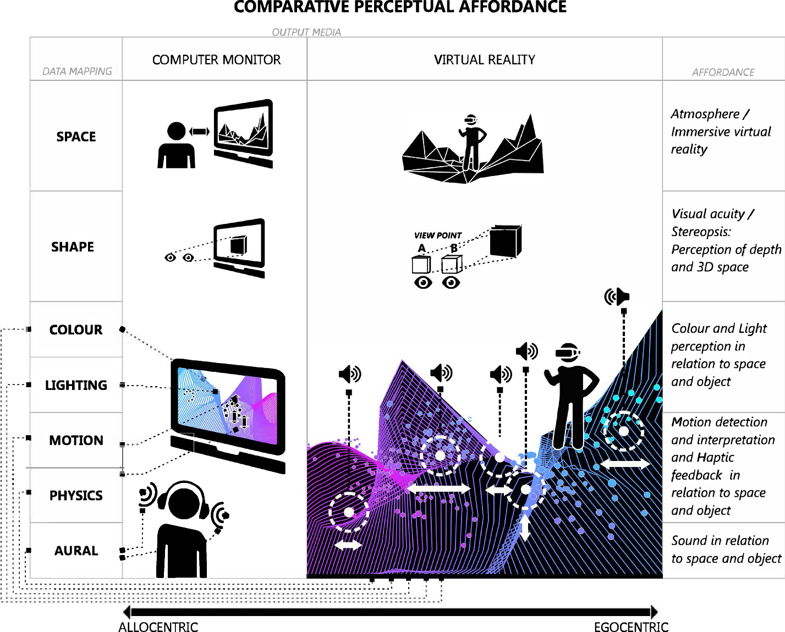 ABSTRACT: Using the theory of affordance from perceptual psychology and through discussion of literature within visual data mining and immersive analytics, a position for the multi-sensory representation of big data using virtual reality (VR) is developed. While it would seem counter intuitive, information-dense virtual environments are theoretically easier to process than simplified graphic encoding—if there is alignment with human ecological perception of natural environments. Potentially, VR affords insight into patterns and anomalies through dynamic experience of data representations within interactive, kinaesthetic audio-visual virtual environments. To this end we articulate principles that can inform the development of VR applications for immersive analytics: a mimetic approach to data mapping that aligns spatial, aural and kinaesthetic attributes with abstractions of natural environments; layered with constructed features that complement natural structures; the use of cross-modal sensory mapping; a focus on intermediate levels of contrast; and the adaptation of naturally occurring distribution patterns for the granularity and distribution of data. While it appears problematic to directly translate visual data mining techniques to VR, the ecological approach to human perception discussed in this article provides a new framework for big data visualization researchers to consider.
“… we use the concept of affordance to refer to the latent possibilities for action presented by an artefact, tool or environment” [10].
From this definition it would follow that VR tools and environments present different possibilities as compared to computer monitor displays, where data visualizations are based on gestalt perceptual principles.
See the full article here: https://preview-journalofbigdata.springeropen.com/articles/10.1186/s40537-018-0158-z
28Dec/18Off
Feelreal VR mask brings scents to virtual reality experiences
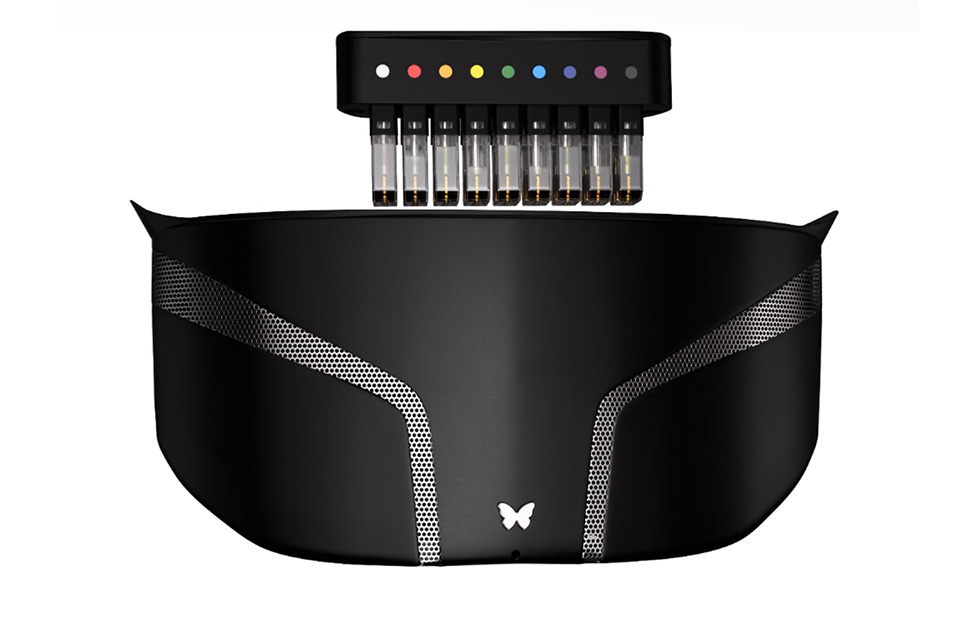 The Feelreal VR mask is something of an oddity, featuring a Darth Vader-like contraption that pairs with an existing VR headset so that it is positioned in front of the wearer’s lower face. Aroma capsules contain various scents that are released to augmented the VR experience.
A VR scene in a coffee shop, for example, may result in a coffee scent being released. Less common scents are also options, including things like burning rubber for a car race scene. On top of that, the mask also uses small heaters and coolers to push temperature-controlled air onto the user’s face, helping provide the illusion of exposure to rain or heat.
The company’s mask is supposedly compatible with the HTC Vive, Gear VR, Oculus Rift and Go, and PlayStation VR, covering some of the most popular models currently on the market. The device connects wirelessly using Bluetooth and WiFi. The Feelreal mask can run for four hours on a charge and weighs only 7 ounces. The company plans to launch its product on Kickstarter “soon.”
See the full story here: https://www.slashgear.com/feelreal-vr-mask-brings-scents-to-virtual-reality-experiences-27559423/
27Dec/18Off
Virtual Reality May Be Headed to Nev. Casinos
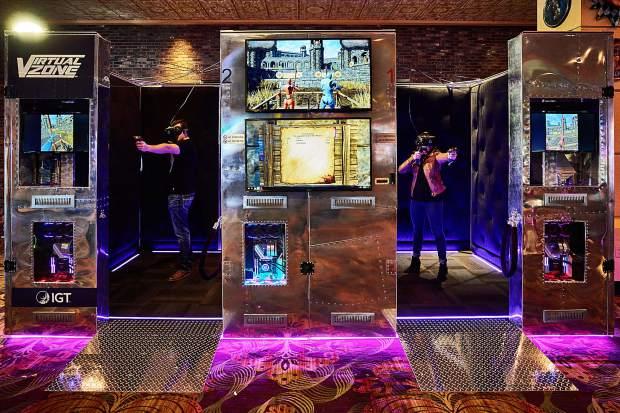 These VR experiences may be fantasy, but the money on the line is real. International Game Technology, or IGT, in Reno has developed what it calls Virtual Zone booths for players to try their hand at archery-themed VR games. The company and casino industry are looking to evolve due to changing gambling habits.
The company initially rolled out a pair of competitive VR booths at two casinos in Las Vegas in the spring. Currently, there are no longer any in Nevada casinos. The game received a variety of mixed feedback.
Officials with IGT say they are refining the product before looking at a mass launch.
See the full story here: https://www.kunr.org/post/virtual-reality-may-be-headed-nev-casinos#stream/0
27Dec/18Off
Astronauts are using VR to study perception in space
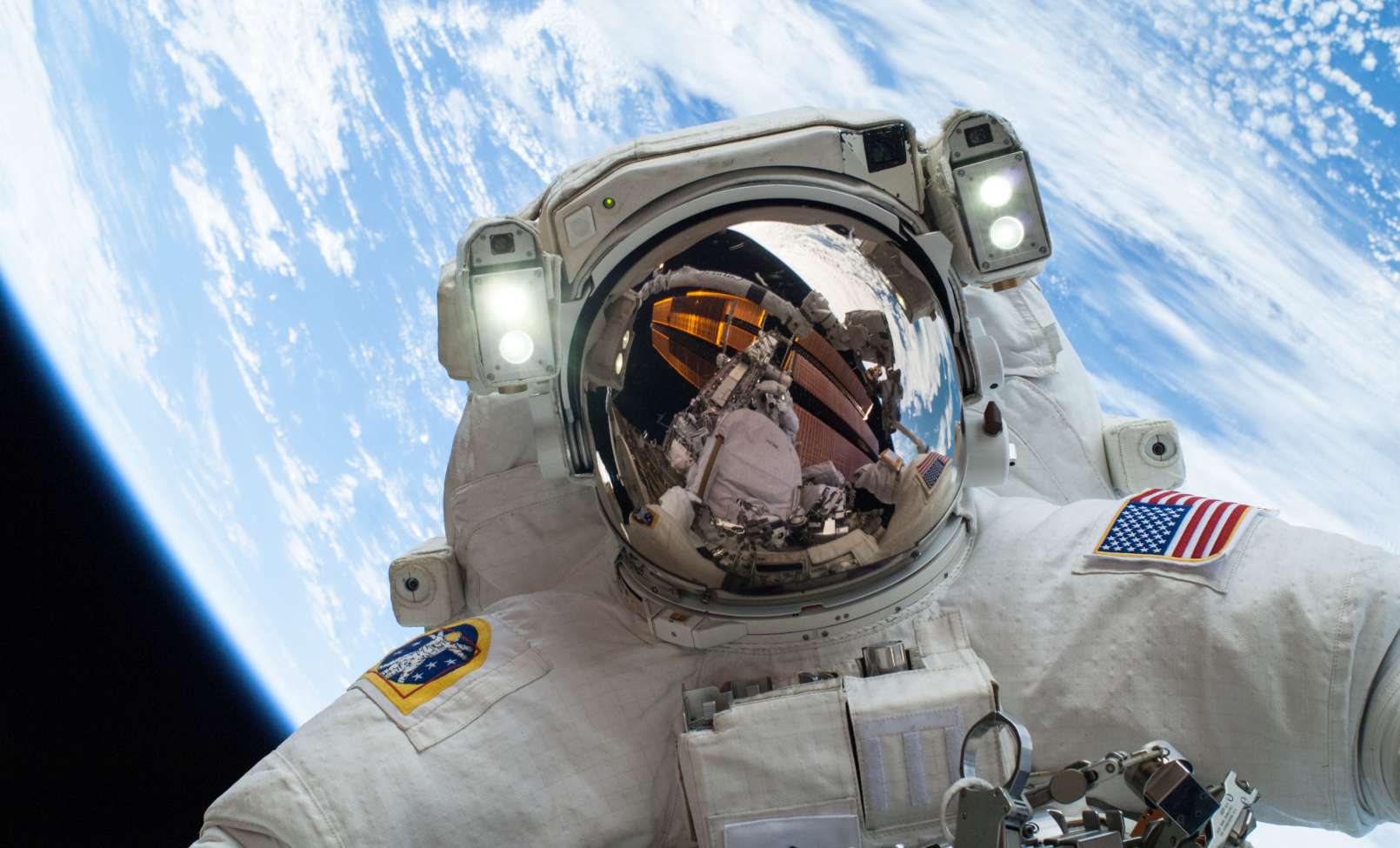 Scientists know that astronauts in microgravity often feel like they’re moving if they see another object moving, even when they’re immobile, which is a phenomenon that makes depth perception more difficult. This would especially be a problem when capturing a cargo spacecraft using the robotic Canadarm2.
This is where Saint-Jacques’ experimental challenge came in. Saint-Jacques spent a half hour participating in Vection, a virtual reality experience that will help scientists learn more about how astronauts estimate the size and motion of objects in space. He donned a VR headset and took part in three experiments: estimating the size of an object, “moving” in the virtual world to where he thought the object was placed in a hallway, and determining how he perceives tilt and visual acceleration.
The results of the experiment could be used to enhance the safety of operations aboard the ISS, and also help future astronaut crews working on the moon or on Mars.
There are applications on Earth as well, such as better controlling moving vehicles or assisting people who have trouble with balance, such as the elderly.
See the full story here: https://www.seeker.com/space/astronauts-are-using-virtual-reality-to-study-perception-in-space
27Dec/18Off
Meta’s Optical Expert Delivers AR Reality Check via TED Talk, & Takes a Few Veiled Swipes at Magic Leap
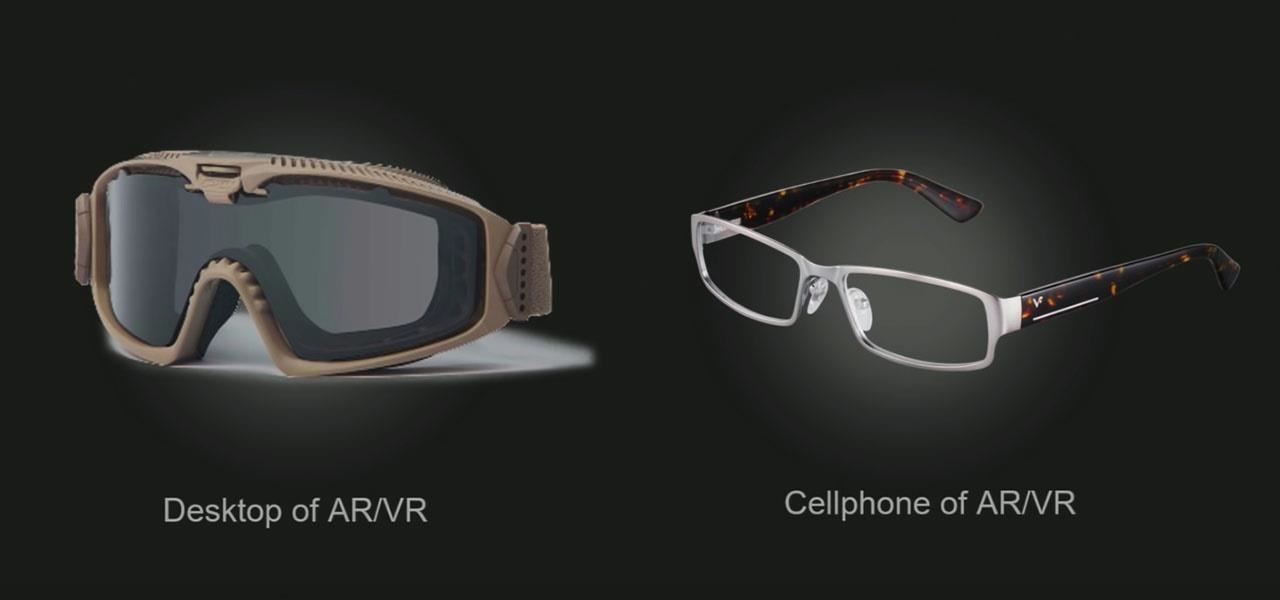 ...company's optics engineers, Dr. Barmak Heshmat, ...
"Some businesses are trying to make [lightfield technology] sound as if it's some crazy neurological, quantum physics thing, which it's absolutely not," says Heshmat. "Let me tell you what lightfield is for you as a consumer in 30 seconds. Lightfield means that the light that's coming to your eye from the display is not coming from a single flat plane like [an] IMAX screen. But it's ideally coming from the different optical depth of different objects in the scene. That's it."
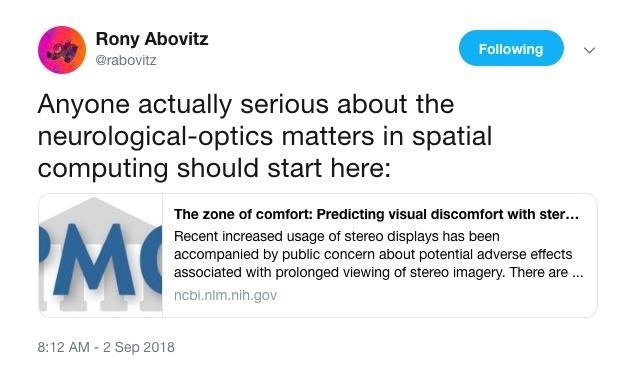
Of course, in terms of the hardware, we now know that Magic Leap is using (unremarkable at this point) stacked waveguides (or, in Magic Leap parlance, "photonic lightfield chips"), but Abovitz still makes a point of outlining Magic Leap's approach to the human brain when delivering AR.
"Please, please, don't get too excited about immersion. This is why 3D TVs died. I don't need to get immersed in my emails or in Fox News, for God's sake. I also don't need to augment video games in my living room that already has a 72-inch, high dynamic range, 4K screen for half the price of a headset. I want to get work done. 10 times faster, 10 times easier … think along those lines, real value."
In the meantime, Heshmat's pleas to ignore cool may sound level-headed, but as I pointed out recently, cool might be exactly the strategy AR needs to go from edge technology to full blown mainstream linchpin in the next few years.
See the full story here: https://next.reality.news/news/metas-optical-expert-delivers-ar-reality-check-via-ted-talk-takes-few-veiled-swipes-magic-leap-0191869/
27Dec/18Off
2019 Preview: 4 Event Tech Trends in the New Year
 One reason many tech providers will be stuffing the envelope instead of pushing it in the coming year is that buyers and users can't adopt as fast as developers can develop. “There is often disproportionate excitement around things that are shiny and new, but people don’t know what to do with them yet,” explained James Johnson-Miller, director of event technology for the IMEX Group.
Behavior Tracking
For example, the Indoor Lab in Dana Point, California, a provider of indoor foot traffic solutions for events, has recently partnered with Sunnyvale, California’s Quanergy to bring 3-D light detection and ranging (LiDAR) to trade shows and events. In addition to its ability to monitor attendee behavior, LiDAR can detect and classify objects, such as an active shooter or someone leaving an unattended package, allowing security personnel to react quickly to threats.
Portable Office Space Grows
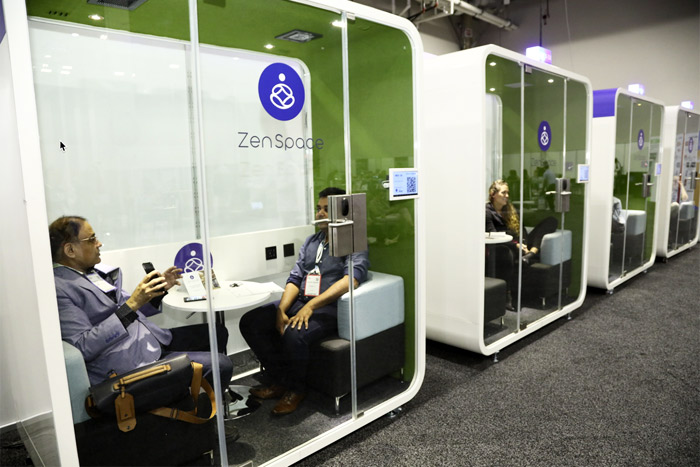
ZenSpace Event Solutions of San Jose, California, builds on-demand portable and private meeting spaces. The company’s “Smart Pods” are Wi-Fi-enabled enclosures outfitted with video displays, smart locks, smart lights, and power and USB outlets, and can be placed anywhere in an event space.
See the full story: https://www.bizbash.com/2019-preview-4-event-tech-trends-in-the-new-year/new-york/story/36633#.XCT6QC2ZMnU
25Dec/18Off
Sling TV Launches First vMVPD for Oculus Go Virtual Reality Headset
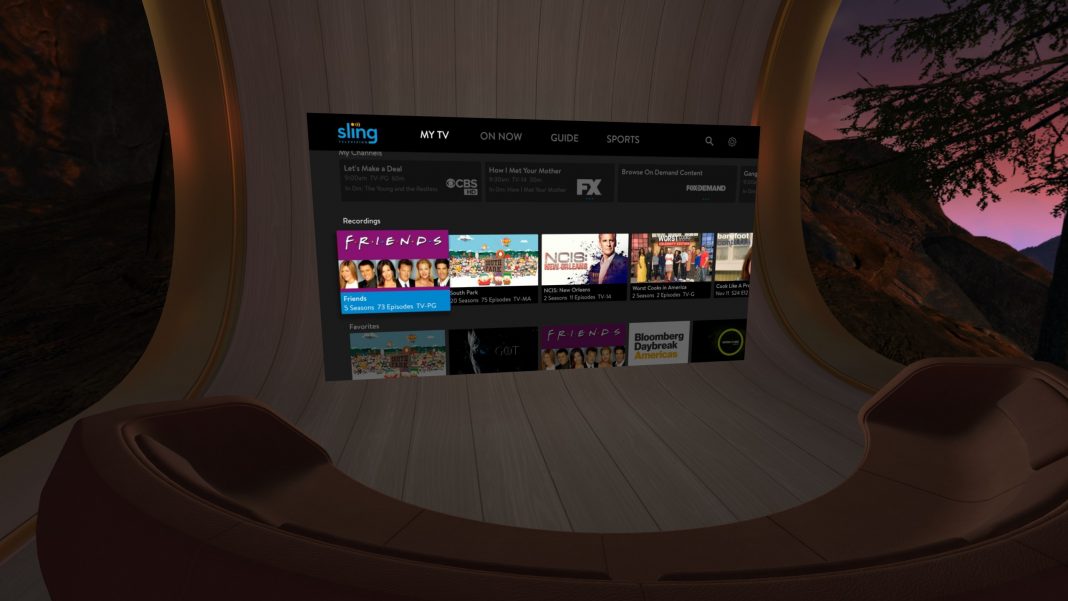 Oculus Go is getting even harder to shell out of its hard-won, best-all-in-one VR headset category. The plethora of available content just got bigger, with Sling TV becoming the first virtual vMVPD to grace the Go screens. Users can celebrate the Oculus Go virtual TV option with $80 credit for services, it’s on Sling.
At just $199, Facebook Oculus Go is pretty hard to beat in terms of value for money Virtual Reality. It has become an unavoidable stepping stone towards bigger and better, while being reasonably well put together itself. One thing was missing content-wise though, multi-channel virtual TV. But Sling TV, itself on a mission to spread across milieu of different devices, opens its VR home entertainment option to Oculus Go users. The Oculus Go virtual TV app is already available on the store. The service is integrated with the Oculus TV app, as well.
See the full story here: https://www.realitytechnologies.com/sling-tv-launches-first-vmvpd-for-oculus-go-virtual-reality-headset/
25Dec/18Off
New York Times App Lets You See a Higgs Particle Reaction from the Large Hadron Collider in Augmented Reality
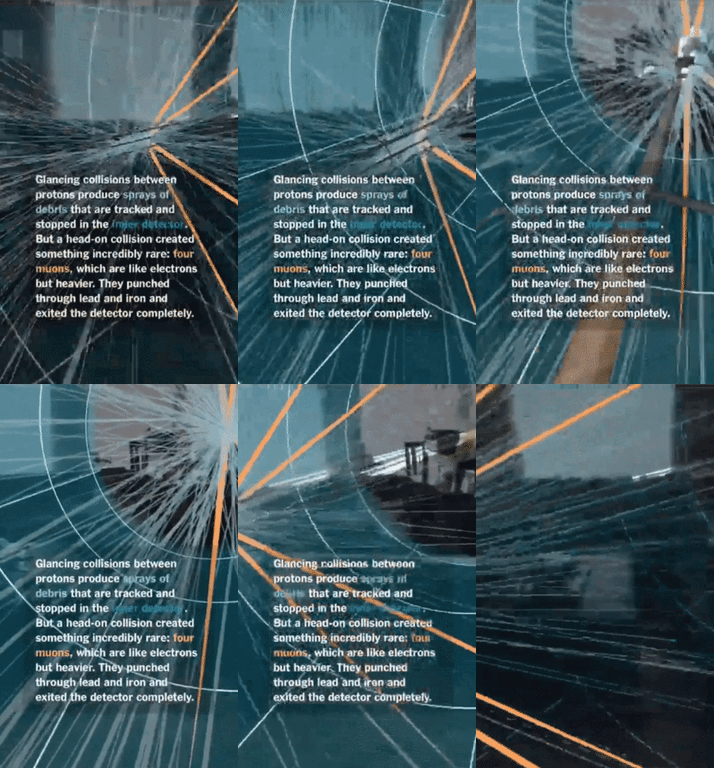 On Friday, the Times published "It's Intermission for the Large Hadron Collider," an interactive story that gives readers a virtual tour of the Large Hadron Collider at the European Center for Nuclear Research (CERN) in Switzerland and explores its most famous discovery, the Higgs boson.
A series of 360-degree photos and an accompanying VR video make up the virtual tour of the massive and costly Large Hadron Collider, which enables physicists to smash subatomic particles together to simulate the conditions of the Big Bang and reveal the hidden secrets of the universe.
Now, via augmented reality, readers can see one of the particle collisions that proved the existence of Higgs boson and earned the team a Nobel Prize. Using the surface tracking capabilities of ARKit and ARCore, the app projects the 3D collision data from the Atlas collider as it occurred on June 10, 2012.
The 3D model shows an outline of the device and the paths of the particles from the collision, tracking several rare particles that managed to pierce the lead and iron exterior of the collider's inner detector. The experience matches the Large Hadron Collider itself in scale, stretching across an average living room and spilling over into adjoining rooms.
The publisher's portfolio of mobile AR experiences now stands at 13, establishing a pace of more than an article per month. In terms of frequency of coverage and content innovation, the Times is far ahead of the competition in applying augmented reality to news coverage. But that doesn't mean that the rest of the news media landscape is standing still, as the Washington Post, USA Today, ABC News, and others are also working to leverage the technology for more immersive and compelling storytelling.
See the full story here: https://mobile-ar.reality.news/news/new-york-times-app-lets-you-see-higgs-particle-reaction-from-large-hadron-collider-augmented-reality-0191792/