Skyscraper Farms Are About to Go Global
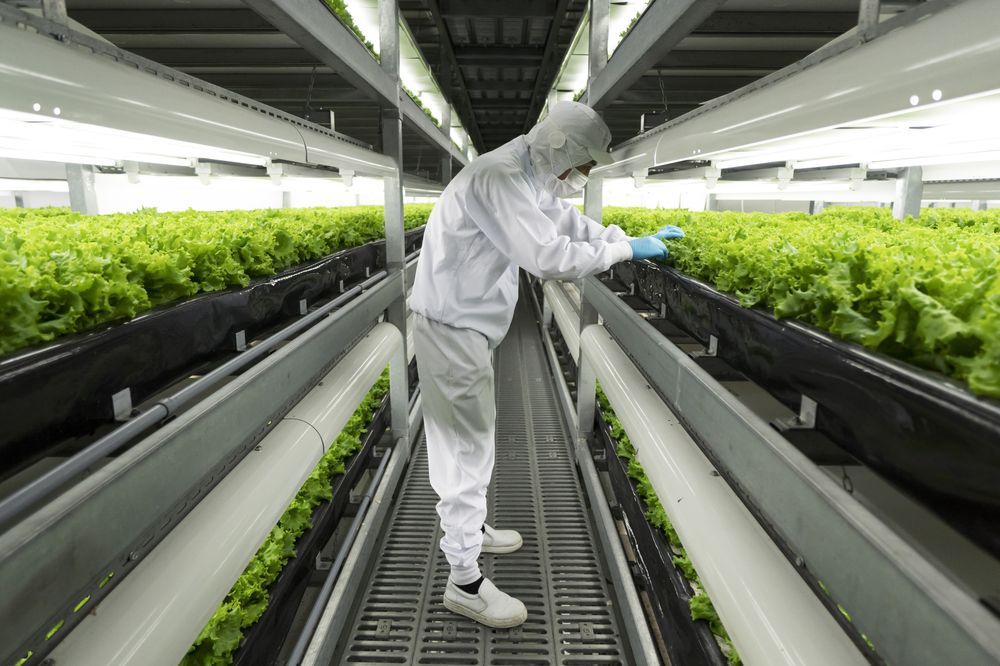
 “Our system can produce a stable amount of vegetables of a good quality for sale at a fixed price throughout the year, without using pesticides and with no influence from weather,” Spread President Shinji Inada, 58, said in an interview at the company’s existing facility in Kameoka.
About 60 percent of indoor-farm operators in Japan are unprofitable because of the cost of electricity to run their facilities, according to the Japan Greenhouse Horticulture Association. Most others only turn a profit because of government subsidies or by charging a premium to consumers for vegetables that are chemical-free. Spread sells lettuces for 198 yen a head to consumers, about 20 to 30 percent more than the normal price for conventionally grown varieties, according to Inada.
“We are targeting countries where fresh vegetables cannot be produced because of scarce water, extremely low temperatures or other natural conditions,” Inada said. “Our mission is to provide infrastructure for vegetable production to anybody, anywhere in the world.”
See the full story here: https://www.bloomberg.com/news/articles/2018-10-30/skyscraper-farms-are-about-to-go-global
How Augmented Reality and Virtual Reality Can Revolutionize Science
At Springer Nature (the parent company of Scientific American), we are looking to our own scientific data and imagining where all that information can take us when given a new life inside AR/VR applications.
To that end, we will be hosting our first-ever mixed-reality Hackathon, November 7–9 in San Francisco, hosted at the Microsoft Reactor.
Participants will bring their favorite AR/VR headsets, their laptops and lots of creative energy; Springer Nature will provide access to millions of scientific data points through various APIs. Teams will solve real world problems, visualizing data across the sciences, in categories like Health, Humanitarian Aid, the Environment, an Inclusive World and more. ...
Despite all advances, you still had to understand a three-dimensional object (the synapse) from a two-dimensional viewer (your screen).
ENTER VIRTUAL REALITY
With the arrival of the fifth wave of computing, amazing techniques like artificial intelligence, blockchain and virtual reality have become more mainstream, and, subsequently, products have been built that embrace these new kids on the block. ConfocalVR is one of them. These and similar VR applications give science a new dimension and allow researchers to view and share data as never before, as was also noted in a recent Nature "Toolbox" article.
Springer Nature continues to keep an eye on new technologies that can help our readers interact with scholarly publishing in impactful, engaging ways. One of our favorite ways that we do this is through a recently launched series of Hack Days and Hackathons; at these events, we have seen rapid prototyping of some incredibly imaginative applications that take research data and scholarly publishing to the next level. Previous #SN_HackDays explored challenges in discovery, research data and analytics.
During our next Hackathon, we will build from our VR experiments and take a more visual approach to scientific data, inspired by advances in mixed-reality technologies.
See the full story here: https://blogs.scientificamerican.com/observations/how-augmented-reality-and-virtual-reality-can-revolutionize-science/
Augmented reality artists add a new layer to your world in Snap’s ambitious ‘City Unseen’ exhibition
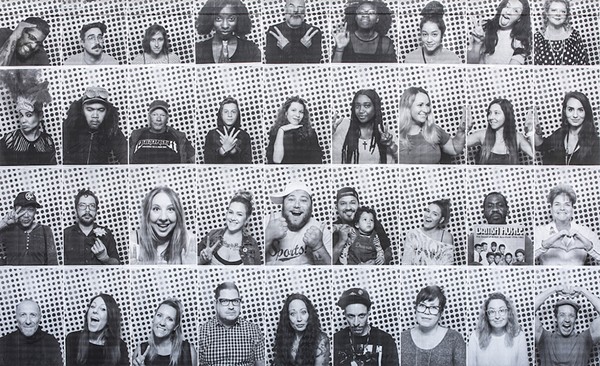 City Unseen resuscitates the Dreamers and other buffed-out murals, and adds the world's newest art medium to Orlando's repertoire of fine art.
"They may phase out DACA and the DREAM Act, but it is still part of us," Kahn said to Orlando Weekly recently. When City Unseen goes live Friday, Nov. 2, not only will the mural be visible again with the mediation of your cell phone, but three of the Dreamers will come alive and speak to you about their experiences as immigrants to America.
And this is only one of the 10 augmented reality experiences Snap will bring to Orlando, many to live on in cyberspace after the show is over. Download the City Unseen app from your smartphone's app store; when opened, the little orange tile takes you to a map of Orlando showing where you can augment our built environment's drab reality with a fine art experience. At each location, holding your phone over a City Unseen plaque snaps a three-dimensional object onto the screen or adds a new layer to the known world.
With so many people shuffling along the sidewalk nose down, instead of eyes on the surrounding city, artists are going where the action is – on the tiny screens that sadly pass for the new reality.
See the full story here: https://www.orlandoweekly.com/orlando/augmented-reality-artists-add-a-new-layer-to-your-world-in-snaps-ambitious-city-unseen-exhibition/Content?oid=20370354
Augmented Reality Allows Specialists to Provide Care in Remote Locations
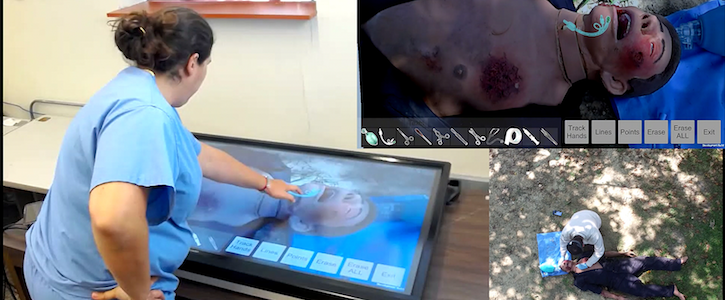 The creators of the AR describe it as “telementoring,” rather than telemedicine, since the remote mentor physician will be working with and through the help of an on-site mentee. The mentee dons an AR headset, which gives the off-site mentor a first-person view of the patient and of the mentee’s actions. Meanwhile, a drone can be deployed to provide the mentor with a bird’s eye view of the scene.
...the mentor physician can draw arrows or surgical instructions over the mentee’s field of vision. The headset also has a stabilizer feature, eliminating video instability caused by rapid movement by the mentee.
The system was built to rely on various strengths of internet access, using the WebRTC protocol, which Muñoz said is similar to the framework used by Skype.
“This allows us to have communication of video and audio over the network that handles unstable bandwidth,” he said. “Our communication has proved efficient when communicating over regular Wi-Fi and also over LTE cellular connection.”
See the full story here: https://www.hcanews.com/news/augmented-reality-allows-specialists-to-provide-care-in-remote-locations
Studies on Kids and Tech Flip the Meaning of Digital Divide
 According to Common Sense Media research, “lower-income teenagers spend an average of eight hours and seven minutes a day using screens for entertainment, while higher income peers spend five hours and 42 minutes.” Two other studies revealed that, “white children are exposed to screens significantly less than African-American and Hispanic children.”
Elsewhere, NYT takes a deeper dive into the growing consensus that screen time is bad for children, with the threats of addiction and stunting development and overblown promises of educational benefits. Apple chief executive Tim Cook stated he would not let his nephew join social networks, and Bill and Melinda Gates wouldn’t let their children have cellphones until they were teenagers. Even Steve Jobs kept his young children away from iPads.
Now, “rank-and-file Silicon Valley workers are obsessed … [and] no-tech homes are cropping up across the region.” Nannies are signing no-phone contracts, and Greylock Partners/former Mozilla chief executive John Lilly “tries to help his 13-year-old son understand that he is being manipulated by those who built the technology.”
See the full story here: http://www.etcentric.org/studies-on-kids-and-tech-flip-the-meaning-of-digital-divide/
5G Could Enable Interactive Video But Raise Privacy Issues
 According to interactive video company Wirewax co-founder Dan Garraway, the video becomes “a two-way conversation.” In other words, while we watch 5G content, it watches back.
CNET reports that the first 5G-compatible smartphones will begin to debut in 2019, and that, according to an Ovum forecast commissioned by Intel, 5G is expected to “propel annual revenue from immersive and new media applications from zero to $67 billion within a decade.” Those two companies forecast that, “5G will more than triple the mobile media market worldwide, reaching $420 billion in 2028 from $170 billion this year.”
“With 5G, new forms of video media entirely can be delivered into a mobile setting.”
With regard to latency, 5G’s 1 millisecond response time dramatically improves 4G’s 20 milliseconds; 5G also better handles video, which represents huge amounts of data. Sandvine said that video is “almost 58 percent of the downstream traffic on the Internet this year.” With 5G, new kinds of video are also possible, including interactivity.
“5G could leverage every piece of visual information a phone can see on cameras front and back in real time.”
See the full story here: http://www.etcentric.org/5g-could-enable-interactive-video-but-raise-privacy-issues/
Travelocity Transports Roaming Gnome into Augmented Reality with Its Mobile App
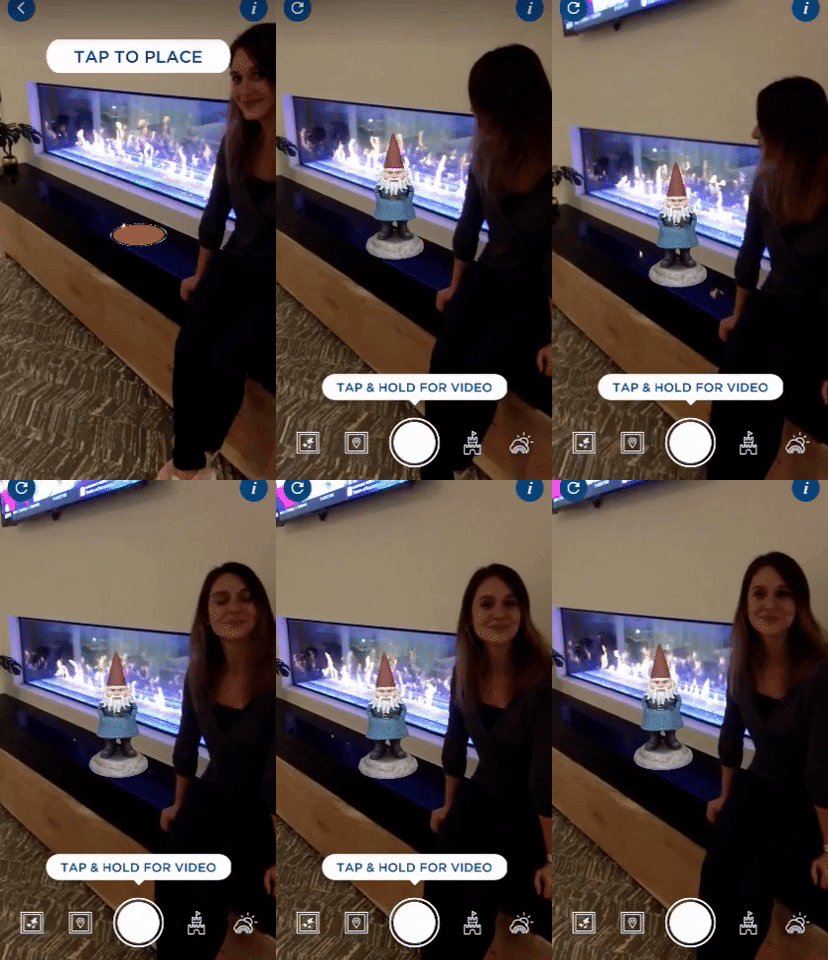 In the latest example of non-tech companies taking on augmented reality marketing, online travel site Travelocity has added an AR version of its Roaming Gnome mascot to its mobile app.
Available for iOS and Android, the feature, enabled by ARKit and ARCore, respectively, gives users the ability to dress up their vacation photos the famous Roaming Gnome often seen in the company's commercials.
Users can also add weather effects, like sunshine or snow, and travel-themed decorations, like a sandy beach or snowfall, to the scene. The app takes a cue from Snapchat and Instagram by letting users label the location of the shot before taking a photo or video for sharing on social media.
However, Travelocity's version of the AR experience is as much a marketing strategy as it is a creative tool. The company encourages users to share their photos on Instagram with the hashtags #RoamLocal and #Sweepstakes now through Nov. 18 for a chance to win a five-night stay at Live Aqua Resorts in Cancun, Mexico, where the winner can take even more photos with the Roaming Gnome.
See the full story here: https://mobile-ar.reality.news/news/travelocity-transports-roaming-gnome-into-augmented-reality-with-its-mobile-app-0189421/