‘Star Wars’ Augmented Reality Experience ‘Project Porg’ Will Let You Train Porgs
 Star Wars: Project Porg is a “mixed-reality immersive experiment in which you’ll need to gain the trust and affection of your porgs. How? You’ll feed them treats, play with them, and you’ll also teach them how to maneuver real-world environments with care instructions from C-3PO himself.” Actor Anthony Daniels will return to voice C-3P0 yet again.
ILMxLAB demonstrated the experience at a press preview event Tuesday, where the lab had added some extra AR easter eggs for L.E.A.P attendees. The living room setup used to demonstrate the app featured a handful of physical objects that could be controlled with the Magic Leap One headset, thanks to AR overlays that explained their functionality. This allowed attendees to turn on a Sonos speaker, change the program on a TV set and turn on a fan, and then see the porgs react to each of these devices — a nap in front of the TV included.
See the full story here: https://www.slashfilm.com/project-porg/
Step back in time with Auckland’s augmented reality tour
 Guided by the knowledgeable and ever-excited DJ Hannah, the audio tour follows nine different sites of interest including Orange Hall, the Mt Eden Prison and St David's Church, with each site offering its own augmented reality experience.
See the full story here: https://ourauckland.aucklandcouncil.govt.nz/articles/news/2018/10/step-back-in-time-with-aucklands-augmented-reality-tour/
Apple has acquired Spektral, a Danish computer vision startup, for augmented reality technology
 Apple has purchased Spektral, a computer vision company based out of Denmark that has worked on segmentation technology, a more efficient way to “cut out” figures from their backgrounds in digital images and videos, reportedly for over $30 million.
This type of technology can be used, for example, to make quicker and more accurate/realistic cut-out images in augmented reality environments, but also for more standard applications like school photos. That was actually the first market the startup targeted, in 2015, although it appeared to shift strategy after that to build up IP and make deeper inroads into video. You can see a demo of how its technology works at the bottom of this post.
Spectral’s first application may have been the fairly retro world of school pictures, but what’s most notable here is what Spektral might contribute to Apple’s imaging business. That could be for applications that Apple has yet to launch, but also to improve the quality of those that are already in the market, from legacy products like PhotoBooth through to ARKit, the company’s platform for mobile development.
See the full story here: https://techcrunch.com/2018/10/11/apple-has-acquired-spektral-a-danish-computer-vision-startup-for-augmented-reality-technology/
Magic Leap’s Mica is a human-like AI in augmented reality
 Magic Leap showed off a demo of Mica, a humanlike artificial intelligence that can be viewed in the company’s augmented reality glasses, the Magic Leap One Creator Edition.
On stage today at the Magic Leap L.E.A.P. event, Andrew Rabinovich, head of AI at Magic Leap, and John Monos, head of human-centered AI, talked about how they see digital humans and AI-based virtual avatars becoming real in the coming years on the Magic Leap platform.
See the full short story here: https://venturebeat.com/2018/10/10/magic-leaps-mica-is-a-human-like-ai-in-augmented-reality/
Your Move, Apple: Facebook Intros First-Party Cookie Option To Power Its Tracking Pixel
 The third-party cookie isn’t crumbling so much as imploding.
In a Friday email to advertisers and publishers, Facebook said that on Oct. 24 it will start offering a first-party cookie option for the Facebook tracking pixel so that businesses can keep targeting their ads and measuring their campaigns without relying on third-party cookies. Facebook confirmed the release to AdExchanger.
Buyers and pubs can immediately log into Events Manager, Facebook’s data management system, to update their settings in preparation.
Apple has been particularly aggressive in its attacks on third-party cookies in Safari, starting with Intelligent Tracking Prevention (ITP) last year, a mechanism that blocks cookies if they don’t have a first-party connection to the user.
In June at its Worldwide Developers Conference, Apple made a move to kill digital fingerprinting in iOS 12 and its latest Mac OS, making a direct dig at Facebook. “Data companies are clever and relentless,” said Craig Federighi, Apple’s SVP of software engineering, at the time.
Although the way Facebook’s ad products work won’t change, in cases where there aren’t first-party cookies feeding Facebook’s pixel, reporting will inevitably be less granular for conversions and activity coming from Safari.
See the full story here: https://adexchanger.com/platforms/your-move-apple-facebook-intros-first-party-cookie-option-to-power-its-tracking-pixel/
Generation Z Americans love Snapchat, Instagram, YouTube mobile apps: A Foolish Take
 Generation Z (16- to 24-year-olds) is considered America's first "digitally native" generation. These younger Americans frequently use mobile apps and social networks, but they mostly avoid Facebook (NASDAQ: FB), which is more popular with millennials.
Last year, a Piper Jaffray survey found that only 9 percent of teens considered Facebook their preferred social media platform. The vast majority preferred Snap's(NYSE: SNAP) Snapchat, as well as Instagram, which is owned by Facebook.
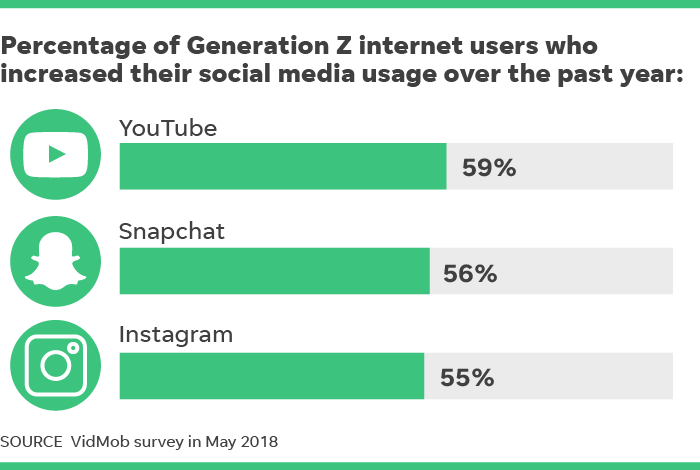
A large number of Gen Zers are also devoted to Alphabet's(NASDAQ: GOOG)(NASDAQ: GOOGL) YouTube, which is technically a social network. Last year, an AdWeek survey by Defy Media found that 50 percent of Gen Zers couldn't "live without" YouTube. A more recent survey by VidMob revealed that more than half of Gen Zers had increased their usage of YouTube, Snapchat, and Instagram over the past year.
These numbers indicate that Facebook and Google should retain their duopoly on digital ads in America. That's why eMarketer expects those two companies to control 57.7 percent of the U.S. digital advertising market this year. However, the figures also suggest that Snap – which has been struggling with slowing user growth – isn't down for the count just yet.
See the full story here: https://www.usatoday.com/story/money/markets/2018/10/06/generation-z-love-snapchat-youtube-instagram-mobile-apps/38008185/
Politicians Team With Tech Industry on Internet Bill of Rights
 The New York Times reports that, although the Internet has operated “nearly unfettered” since its inception, “it has become ever clearer with every misstep — including but not limited to Russian interference on social media platforms, the amplification of hate speech and fake news, and the misuse of personal information — that tech’s freedom has come at a steep price to the American people.”
The first principle elucidates the right “to have access to and knowledge of all collection and uses of personal data by companies,” something that some companies already follow but none are required to do by federal law. The second “right” is that consumers should have to give permission (opt-in) before their data can be collected and shared, and that the process should be simple.
The third “right” is “to obtain, correct, or delete personal data controlled by any company,” or, what is called in Europe the “right to be forgotten.” This is trickier territory, so Khanna added that this principle should be followed “where context appropriate and with a fair process.”
The fourth focuses on “timely notifications in the case of breaches,” the fifth gives consumers the right to move their data, and the sixth “calls for making net neutrality a law rather than a regulation.” The seventh would stop big ISPs “from collecting more data than is necessary for the rendering of services,” and the eighth “addresses fostering competition.”
The ninth principle protects consumers from being “unfairly discriminated against or exploited based on your personal data,” and the tenth requires companies that collect personal data to demonstrate “reasonable business practices and accountability to protect your privacy.”
NYT dubs this “an admirable list,” but adds that turning it into law “will be like pushing back the ocean, especially since the business models of many of these companies are predicated on sucking up as much data as they can and exploiting it for gain.”
See the full story here: http://www.etcentric.org/politicians-team-with-tech-industry-on-internet-bill-of-rights/
and here: https://www.nytimes.com/2018/10/04/opinion/ro-khanna-internet-bill-of-rights.html