HTC Viveport: ‘We’re Looking For Our Game of Thrones’
 “For Viveport, if we compare last quarter versus last quarter a year ago, our revenue growth, and our transaction growth is over 4X [greater], and so we've grown quite dramatically, and the main driver behind this growth is primarily subscription,” Steiber said. “Over 70% of the transactions are actually related to subscriptions, meaning people getting premium titles through subscriptions, rather than paying download.”
“It's very easy for you to have five $20 titles, and have $100 of value and only paying $8.99 [per month],” he said.
Viveport has about 1500 titles on the platform but the subscription itself includes around 500.
HTC Vive has always supported a more open platform than Oculus. Vive Studios’ boxing game Knockout League for example has appeared on both PSVR and Oculus, and following that same mentality, Viveport was recently opened up to Oculus users who may desire a subscription option as well. Steiber believes that this effectively doubles the addressable audience since Rift and Vive installed bases are “neck-and-neck,” he said.
The VR arcade scene initially saw more traction in Asia, but it’s picking up more steam here in the west lately. In fact, Bandai Namco just announced that it will bring its VR Portal experiences to Union Station in Washington DC,...
Not only does the arcade experience familiarize people with the Vive technology and brand, but any developers that get their games featured in an arcade station are likely to get a brand boost as well.
The home market is not setting any sales records, but Steiber refuted the idea that VR’s in trouble. In July, the Vive team posted a blog entry about the “so-called death” of VR, pointing fingers at analyst forecasts while boasting that, “Vive has paced at its highest sales velocity of all time, for weeks on end, and we sold out. For a consumer electronic product in its third calendar year, this continued trajectory is nearly unheard of.”
The Vive Pro, in particular, feels expensive at $799 without any controllers or base stations included.
“We do think that AR is very important,” Steiber affirmed. “And the way we view our future vision around Vive Reality, we think that you have this virtual reality continuum,...
But I do think that for us in our future, we're not announcing anything, but we do think that AR will be an important part of our Vive reality experience.”
See the full story here: https://gamedaily.biz/article/280/htc-viveport-were-looking-for-our-game-of-thrones
Virtual reality harnessed by remote Indigenous teens to make leap from comic to Future Dreaming film
 Four Indigenous teenagers, inspired by their remote community home in WA's Pilbara, are using their school holidays to create a futuristic world with a new virtual reality film titled Future Dreaming.
At its core the comic is a space opera, but it is clear the kids draw their inspiration from their land and culture.
Since launching NEOMAD, the comic has travelled to cities around the world such as Seoul, Los Angeles and Lodz in Poland.
Nelson Coppin visualised his world depicting the Pilbara landscape of red dust, spinifex and ghost gums with trains carrying iron ore traversing across his traditional homeland.
Max said virtual reality was a different way of storytelling but he identified it as part of his own cultural legacy.
See the full story here: http://www.abc.net.au/news/2018-10-02/indigenous-virtual-reality-film-future-dreaming/10326126
Lifeprint’s augmented reality photos get the most obvious Harry Potter partnership ever
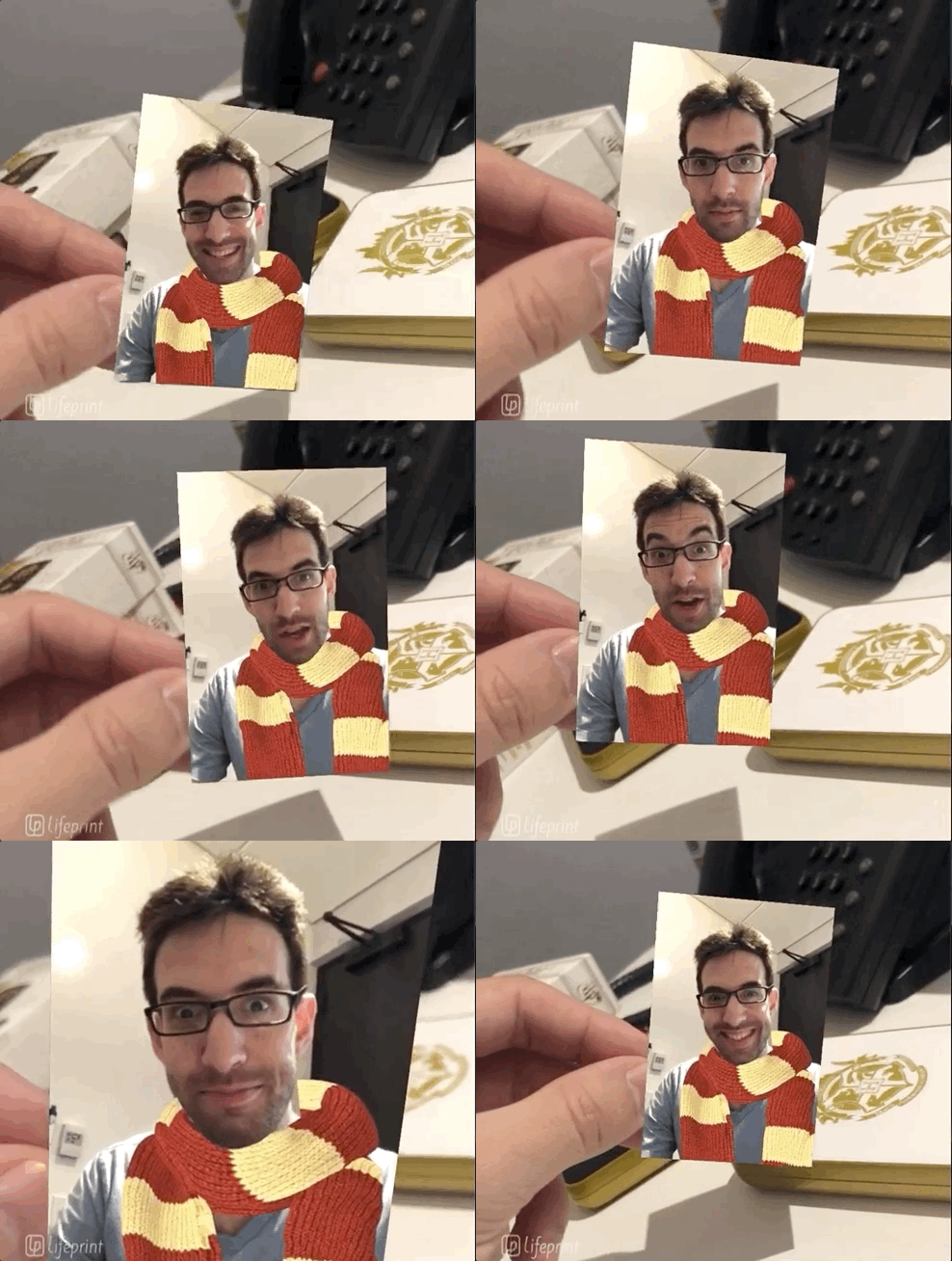 The Harry Potter Magic Photo and Video Printer, which bundles the company’s very Harry Potter-like AR pictures into a properly Harry Potter-branded package.
See the full story here; https://www.theverge.com/circuitbreaker/2018/10/2/17921132/lifeprint-harry-potter-augmented-reality-photos
Augmented reality, fog, and vision: Duke professor outlines importance of smart architectures
 An academic researcher’s talk on Monday at the Fog World Congress in San Francisco demonstrated both the limits of distributed computing structures and their critical importance to future IoT and augmented reality (AR) implementations.
Dr. Maria Gorlatova’s recent work has centered on the study of fog and edge architecture – specifically, the way in which particular methods of architecting those systems can affect latency and response time. She's studying the differences in systems which are on- and off-campus, that have different points of execution, which seems like the academic way of saying “where the computational work is done.”
The difference between the cloud – a highly centralized architecture – and fog computing, the industry’s current term of art for systems that have the abstracted nature of the cloud, but do their actual work much closer to the endpoint than the cloud’s faraway data centers – is immense. Both fog and its close cousin edge computing are useful alternatives to the cloud architecture.
“Fundamentally, our new devices that are generating high-bandwidth traffic and high-volume, high-velocity data just cannot afford to transfer all of the data to a centralized hub for processing,” Gorlatova said.
Some of the trade-offs, she said, are already fairly well-known. For instance, many tasks that aren’t terribly demanding from a compute or network perspective are best accomplished at the edge, but the advantages in terms of latency are outweighed by the cloud’s more potent computing capabilities for more complex tasks.
Some of the lessons from that research can seem self-evident, but they have wide-ranging implications. Gorlatova’s example was the security problem posed by bad actors influencing augmented reality systems – for example, creating huge, obtrusive holograms that block a user’s view of the real world, creating potentially serious safety issues.
Solutions to the vision-blocking problem, which was first described a year ago, center on fixed policy recommendations, which have to be implemented, manually, by human beings. By applying machine learning to the problem, however, an AR system could be taught to recognize when holograms are obstructing the view of a user, and simply move them out of the way, or make them transparent.
“Fog offers a natural chokepoint for reducing the resources consumed on mobile nodes in multi-user settings, as well as a natural point for making those experiences more intelligent.” She and her team are currently working on a fog-based pilot deployment for secure, responsive AR on Duke’s campus, and hopes to have a system in place early next year.
See the full story here: https://www.networkworld.com/article/3309446/cloud-computing/augmented-reality-fog-and-vision-duke-professor-outlines-importance-of-smart-architectures.html
VR influencer Jesse Damiani to host one of the largest VR/AR/MR art shows ever featuring CatsAndVR favs JOY and Steve Teeps.
 Jesse Damiani, the Editor-at-Large of VRScout and VR influencer is producing one of the world’s largest virtual reality, augmented reality, and mixed reality art shows Sponsored by RYOT, with additional support from Meow Wolf, VRScout, Raptor House Effects, and Magik Gallery, with LACMA curator Britt Salvesen serving as consultant, the exhibit will feature over twenty-five world-class artists working in this cutting-edge space.
AR’s success depends on perfecting input methods
 So those are the four primary inputs: Eye-tracking (gazing), controllers, voice, and gesture recognition. The question still remains, what input is going to lead to what in terms of UI and UX? We don’t have the answers yet but I believe it’s going to be an amalgamation of all of those inputs. And the combination will have to be contextual.
See the full story here: https://thenextweb.com/contributors/2018/09/29/ars-success-depends-on-perfecting-input-methods/
Here is what Marines really need for realistic simulations training
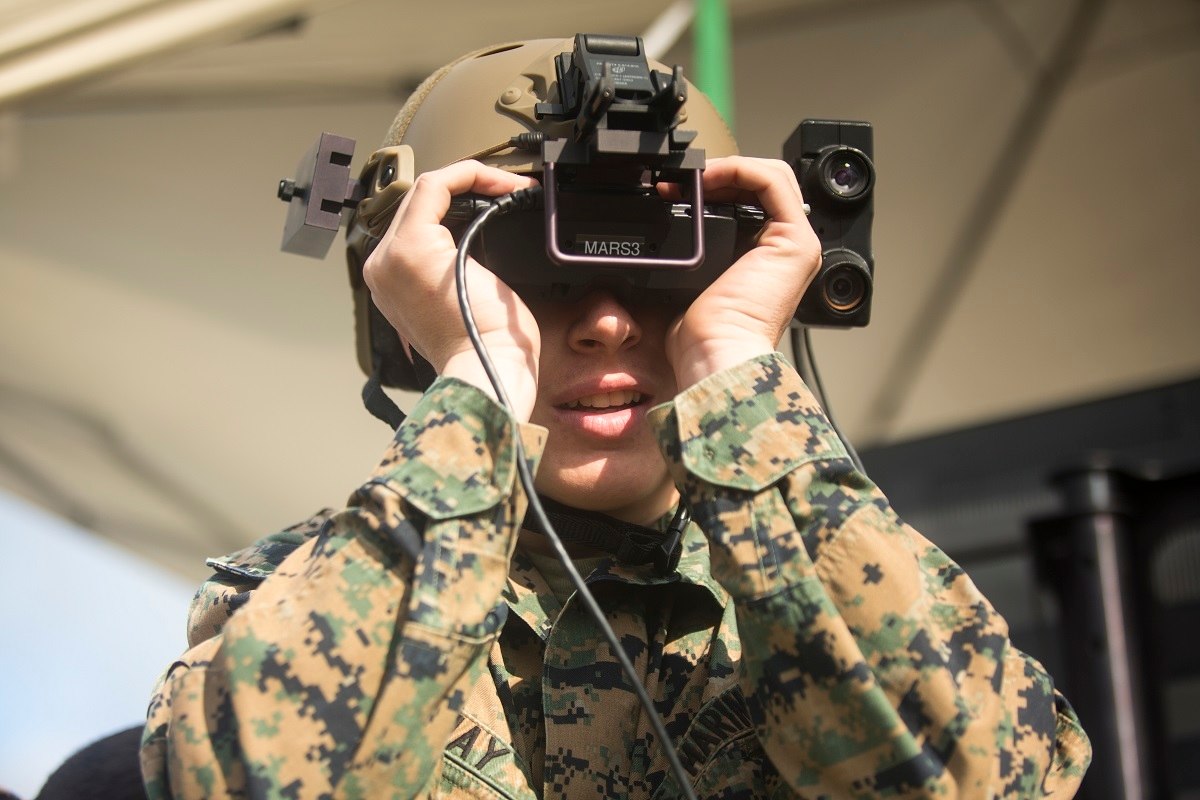 Last year at the annual military expo here, Commandant Gen. Robert B. Neller told industry his vision for simulations is a kind of Star Trek-like holodeck in which any Marine could fight any battle on any terrain in virtual reality.
Since then, Secretary of Defense James Mattis has said that close combat infantry units should fight 25 battles before they ever taste real combat.
This year one of the Marines in charge of bringing those simulation dreams to reality laid down some of the tangible needs of the Corps now and in the near-term.
Harder said a goggle that is about twice the weight of existing eye protection, perhaps with its power source somewhere on the body, is likely five to 10 years away based on his survey of the field.
There’s another an ongoing need: better drones.
...smaller drones that can fly lower, giving Marines a street-level, detailed view of the battlespace so they can create their own terrain maps and fight the simulated fight in the areas they’ll really be operating in.
Which brings it to one of the more ambitious items beyond terrain and hardware: getting simulations to act more like humans.
What’s needed is both civilian simulations to act like civilian populations might act in the real world and the same for the enemy, taking advantages, fighting and withdrawing.
But one step further is key: The enemy has to talk back.
Across the infantry battalions Marines received new gear last year called Tactical Decision Kits. These allow for squad to company-sized elements to do video game-play for their unit exercises, complete with NFL-style replay of engagements and decisions.
That’s a low-level example of one thing that’s lacking in current training, Harder said. Right now the main piece of tech for a Marine commander conducting an after action review is a pen and paper pad.
See the full story here: https://www.marinecorpstimes.com/news/your-marine-corps/2018/09/28/here-is-the-current-checklist-for-marine-corps-simulations-training/