Magic Leap Is Now David Versus Apple’s Goliath, & Microsoft Goes Hollywood
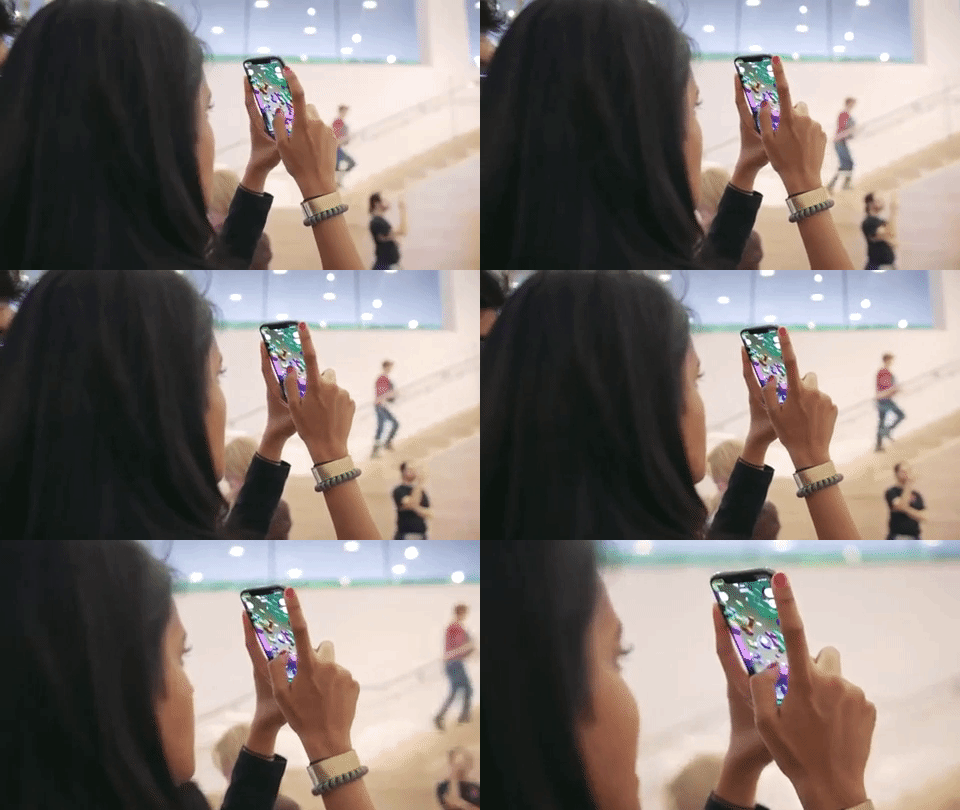 While Magic Leap has gained attention for its ability to raise capital, the company (now with an actual product on the market) still faces an uphill climb against the titans of the industry.
Namely, there's the looming presence of Apple, who 18 months ago didn't even have an AR product or service to its name. Now, the trillion-dollar company leads the mobile AR app ecosystem, and its own AR wearable will reportedly arrive sooner than expected. And there's Microsoft, who didn't begin prototyping HoloLens until after Magic Leap's emergence from stealth and still beat Magic Leap One to market. Now Microsoft is moving even faster by nurturing the same developer market that Magic Leap is concentrating on by launching yet another Microsoft Mixed Reality Capture Studio.
A multitude of AR startups, like Ubiquity6, have similar hopes of bringing their technology to developers and customers, though they don't have near the war chest that Magic Leap has accumulated. But, like Magic Leap, Ubiquity6 now has new funding that makes it a company to watch in the AR space.
See the full story here: https://next.reality.news/news/market-reality-magic-leap-is-now-david-versus-apples-goliath-microsoft-goes-hollywood-0186584/
Inside Remnant, an Interactive Story Told Through Mixed Reality and Food
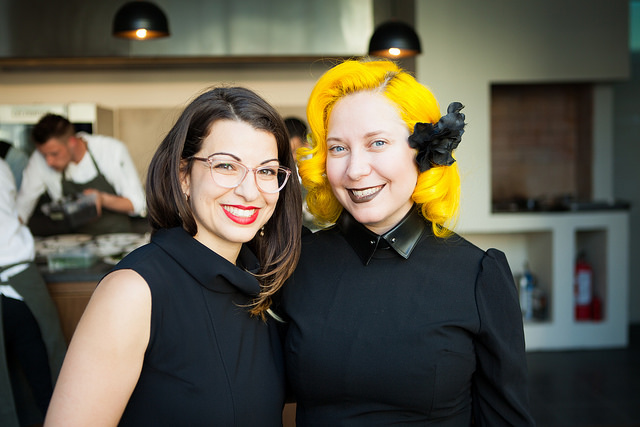 About 41 guests were invited to partake in Remnant’s culinary adventure, which unfolded over several hours and three courses. The interactive elements were introduced slowly as the night progressed. During the appetizer course, projection mapping, sound effects, and actors were used to establish the narrative, while the chefs served up canapes and other comforting, familiar snacks to set the tone.
The second course incorporated augmented reality. Guests were given iPads and used them to interact with virtual objects on the tables. The actors encouraged them to forage and hunt for food within the app, which led to the meal’s main course — deer carpaccio served on a pair of antlers, with a red sauce that looked like blood, and a roasted deer leg served with vegetables.
For the final course, Laidacker and Sarkeesian turned the restaurant into an escape room, complete with puzzle boxes for each table to solve. Finishing the puzzles unlocked the story’s ending — and the dessert. Then, at the end of the night, each guest received a little box containing a fresh croissant and jam for the next morning, a delicious reminder of the meal and narrative they just encountered.
See the full story here: https://variety.com/2018/gaming/features/mixed-flour-remnant-dinner-1202902258/
Brussels to act against tech groups over terror content
 The European Commission has decided to abandon a voluntary approach to get big internet platforms to remove terror-related videos, posts and audio clips from their websites, in favour of tougher draft regulation due to be published next month.
“We cannot afford to relax or become complacent in the face of such a shadowy and destructive phenomenon,” said Mr King.
One EU official said the commission’s push for an EU-wide law targeting terrorist content reflected concern that European governments would take unilateral action. Germany this year enforced a high profile “hate speech” law that targets anything from fake news to racist content. Companies must remove potentially illegal material within 24 hours or face fines of up to €50m.
The EU still opts for self-regulation by platforms on more subjective areas such as hate speech and fake news.
See the full story here: https://www.ft.com/content/a4068e88-a22a-11e8-85da-eeb7a9ce36e4
Blockchain Is Starting to Show Real Promise Amid the Hype
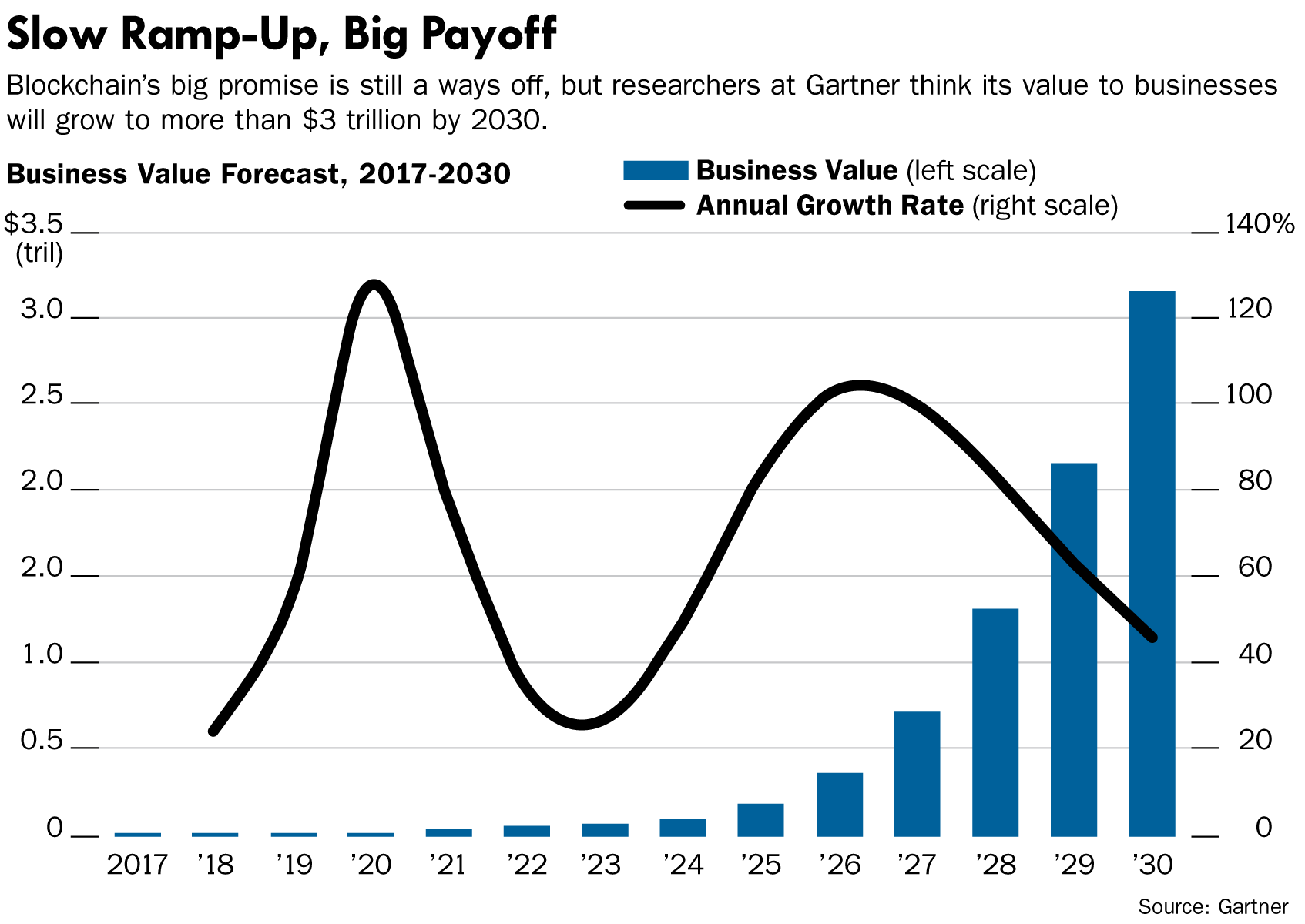 Projects that actually solve real-world problems are much rarer. The research firm Gartner surveyed 3,160 chief information officers this year and found that only 1% had put blockchain to work.
Take the Australian mining giant BHP Billiton (ticker: BHP), which announced in 2016 that it would use blockchain to track its supply chain, including the movement of rock and fluid samples. But after the company tested it in a pilot project, a BHP executive said this month that the technology “hasn’t reached the point of maturity where we think it applies to us.”
Still, it’s a bit like trying to pick future winners and losers of the internet back in the early 1990s. Tomorrow’s Facebook—and its Pets.com—are not yet visible on the horizon.
“Blockchain is not a technological solution to a technological problem,” he says. “It’s a technological solution to a political problem. A political problem within business. You don’t want a PayPal or an eBay or an Uber or a Facebook at the center of a lot of markets, because that gives a tremendous amount of power to those entities, greater than arguably even AT&T had when it was at the center of the phone market.”
“Fifteen years ago, if someone had said to you we’re going to see the advent of the self-driving car on the streets before we see T+2 settlements [trades getting settled two days after they take place] and before you can walk from one doctor’s office to the next and have your health-care records precede you there, you would have been declared crazy, right?” Masters says.
“It is those kind of delays and extraordinary inefficiencies that have plagued financial services and big enterprises in other industries like health care.
For investors, there are few ways to invest directly in blockchain. Some exchange-traded funds have been introduced, including Amplify Transformational Data Sharing (BLOK), Reality Shares Nasdaq NexGen Economy (BLCN), and Innovation Shares NextGen Protocol (KOIN), but they offer minimal real revenue exposure to the technology, which is currently generating little revenue.
AXA (CS.France), the French insurance company, is using blockchain technology to transform the flight-insurance industry. Its product, called Fizzy, allows fliers to buy insurance that immediately pays out if their flight is delayed by more than two hours, for any reason.
“Blockchain challenges what you do rather than amplifying what you do,” said Rajesh Kandaswamy of Gartner. “Technologies like mobile amplify what you do. Mobile was additive for banks. Blockchain as an underlying technology makes you rethink your business processes or even your business model. That will take years for people to pass.”
Walmart, Nestlé, Dole Food, and other companies are building a platform with IBM called Food Trust that would put the whole food-supply chain—farm to supermarket —on a blockchain that presumably can track the entire chain in seconds. The software can now track about 50 products, far from the whole supermarket but enough to get a sense of the software’s viability.
That includes more than following a head of lettuce as it’s trucked across the country; the software has been tested on trickier tasks, like tracking all of the ingredients in a container of Gerber’s sweet potato-apple-pumpkin puree baby food.
See the full story here: https://www.barrons.com/articles/blockchain-is-starting-to-show-real-promise-amid-the-hype-1534554901
Also see - U.S. experts optimistic about broad application prospects of blockchain
Verses sets up blockchain-based property rights in augmented reality
 Verses has launched a protocol for virtual and augmented reality to help people establish ownership of virtual real estate, 3D space, and other goods in the virtual world. The company likes to refer to this idea of owning things within the virtual world as Web 3.0.
Just as websites have a proprietary address, Verses is using blockchain technology to identify specific 3D spaces in augmented reality. That allows people to own parts of the virtual world, or Metaverse, if you will. And Los Angeles-based Verses has set up the nonprofit Verses Foundation to serve as arbiter for the protocol that will delineate this “spatial web.”
The Verses Spatial Web Protocol is a universal and open standard for the next generation of the web that exists in AR or VR, connecting people, places, things, and currencies into a single digital network.
Verses has sold $6 million worth of tokens to various investors, including Blockchain Industries, Decentra, and other parties, and the company plans to raise additional capital via its private token sale from the international community.
This is reminiscent of the World Wide Web consortium that sets web protocols, such as hypertext transfer protocol, or http.
Verses is set up as a nonprofit. The Verses technology works as an open standard, establishing a universal protocol that powers its key feature set for virtual assets across a multitude of applications. This includes use cases such as virtual commerce, interconnected virtual reality spaces, smart city infrastructure, and secure holographic telecom.
The company currently has 35 staff and 15 partners.
See the full story here: https://venturebeat.com/2018/08/15/verses-raises-6-million-to-set-up-blockchain-based-property-rights-in-augmented-reality/
Virtual reality beginning to take off in the poultry house
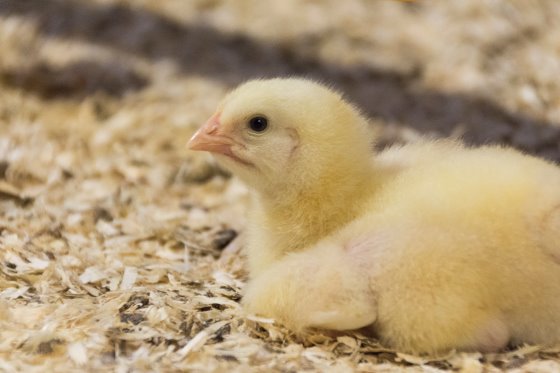 The National Chicken Council (NCC) announced last month that it had developed a series of 360 degree virtual reality videos showing the various stages of a chicken’s life during modern, commercial production.
Other forms of virtual reality are being trialled at the University of Iowa by Professor Austin Stewart, who has developed Second Livestock, which places virtual reality headsets on chickens.
This allows them to enjoy the free range live wherever they area, even if they live their lives in a colony building.
Virtual Free Range combines the physical and psychological benefits of free range life with the safety and security of conventional agriculture. Chickens are free to roam, socialise and even eat “virtual food”, which appears in the virtual world where their real food trays are located.
Training can be boosted through virtual reality particularly in processing lines. For example, virtual reality can be used to train line workers how to trim meat, walk through a house without disturbing the birds or even how check the animals.
Researchers at Georgia Tech’s Agricultural Technology Research Programme have designed two systems that project graphical instructions from an automated inspection system onto birds on a processing line. These symbols tell workers how to trim or whether to discard defective products.
See the full story here: https://www.poultryworld.net/Meat/Articles/2018/8/Virtual-reality-beginning-to-take-off-in-the-poultry-house-321943E/
UCLA 3D PRINTS AN ARTIFICIAL “BRAIN” THAT COULD BREED NEW AUTONOMOUS VEHICLES
 A team from the UCLA Samueli School of Engineering in Los Angeles, California, have applied 3D printing to create a “seeing” device modeled on the human brain.
Appearing as a series of neatly stacked plastic plates, this device is capable of analyzing image data to identify objects such as items of clothing, and handwritten characters.
By developing technologies based on the device, the scientists could have discovered a simpler way of teaching artificially intelligent (AI) products, like autonomous vehicles and “smart assistants”, to perceive the world around them.
Each plate in the UCLA device is patterned with artificial neurons, in the shape of tiny pixels, that each diffract light in a different way.
When looking at an object, the device determines what it can see by the way light travels through the plates, and what comes out at the other side. UCLA principle investigator Aydogan Ozcan, explains, “This is intuitively like a very complex maze of glass and mirrors,”
“This work opens up fundamentally new opportunities to use an artificial intelligence-based passive device to instantaneously analyze data, images and classify objects,” adds Ozcan. “This optical artificial neural network device is intuitively modeled on how the brain processes information,”
“It could be scaled up to enable new camera designs and unique optical components that work passively in medical technologies, robotics, security or any application where image and video data are essential.”
“All-optical machine learning using diffractive deep neural networks” is published online in Science journal. It is co-authored by Xing Lin, Yair Rivenson, Nezih T. Yardimci, Muhammed Veli, Yi Luo, Mona Jarrahi and Aydogan Ozcan.
See the full story here: https://3dprintingindustry.com/news/ulca-3d-prints-an-artificial-brain-that-could-breed-new-autonomous-vehicles-137469/
AR startup Ubiquity6 lands $27M Series B to build a more user-friendly augmented reality
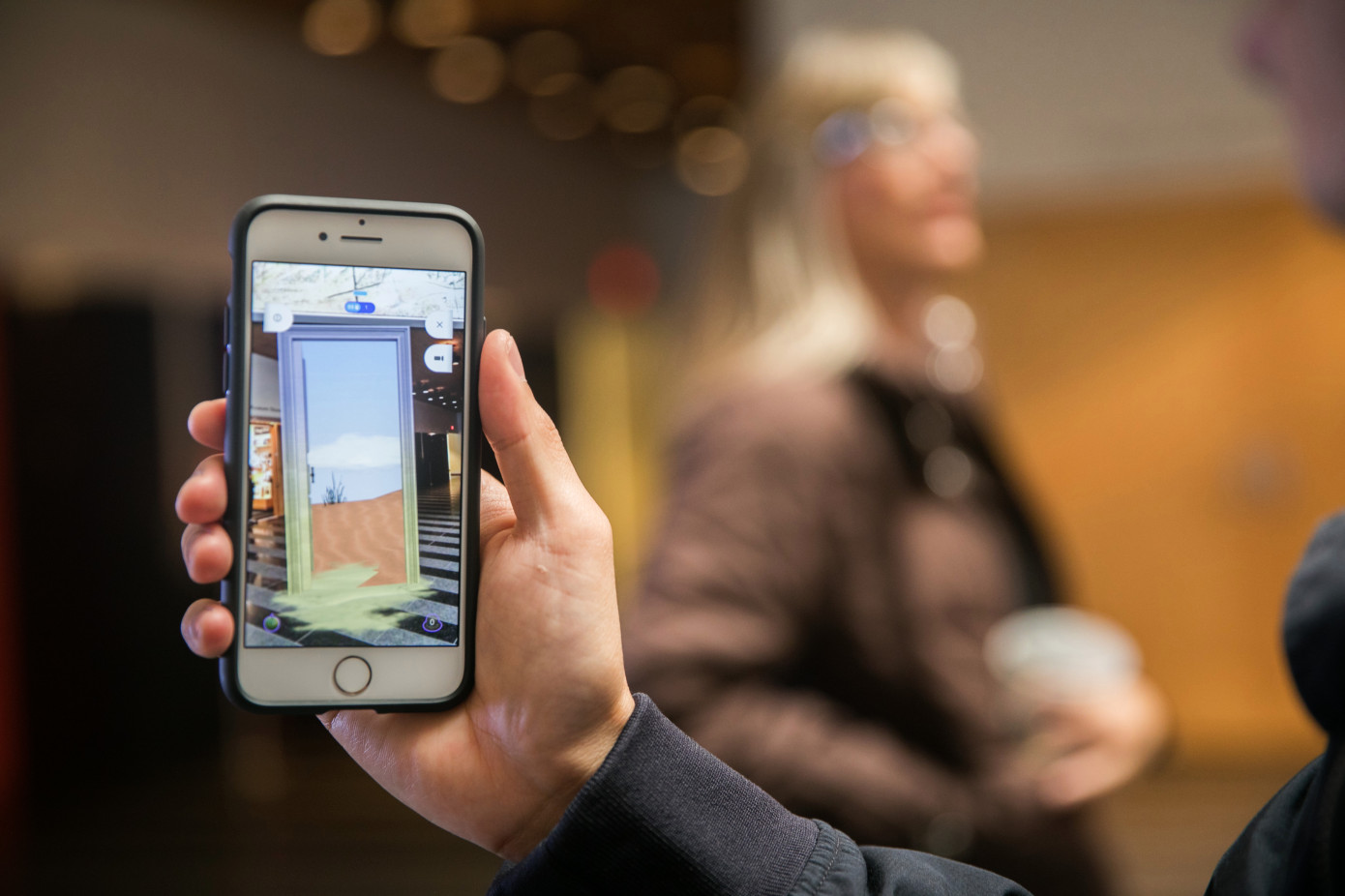 Ubiquity6 is one of a handful of startups aiming to tackle the backlog of backend features currently missing from most AR experiences available today. The fast-growing company is looking to build tools that will essentially enable users to create a cloud-based AR copy of the physical world and enable persistent, dynamic multiplayer AR experiences as a result.
A big focus of the Ubiquity6’s efforts have been on building 3D mesh maps of entire public areas so the onboarding process just naturally grows to be instantaneous.
This strategy works great for museums and much less well for your living room, but Ubiquity6 is hoping that the experiences available in their app can have episodic utility that ties them closely with events at public geographic locations.
The company’s partnership with the San Francisco Museum of Modern Art was previewed earlier this month with an activation inside the Magritte exhibit.
See the full story here: https://techcrunch.com/2018/08/14/ar-startup-ubiquity6-lands-27m-series-b-to-build-a-more-user-friendly-augmented-reality/
SFMOMA is Putting the ‘AR’ in ‘Art’ With Augmented Reality Exhibits
Magritte's work is on display at the museum with an interactive gallery by frog design that's filled with digital puzzles based on the artist's paintings. As people roam through the exhibit snapping photos with their smartphones — a practice SFMOMA actually encourages — Coerver and his staff are considering making those phones a more central part of the museum experience.
In a massive one-night play test, San Francisco-based startup Ubiquity6 — which just announced $27 million in new funding — was invited to hand out a hundred Apple iPhones in the museum's lobby, loaded with new multiplayer augmented reality software. By looking through the phones' cameras, guests were invited to explore Magritte's bizarre universe, creating apples, pipes and bowler hats for others to find as they went along.
See the full story here: https://www.nbcbayarea.com/news/tech/SFMOMA-is-Putting-the-AR-in-Art-With-Augmented-Reality-Exhibits-490879581.html