California Passes Tough New Law to Protect Online Privacy
 The California State Legislature quickly passed a digital privacy law that gives consumers much more control over their online personal data. Governor Jerry Brown signed the law into effect, narrowly beating a deadline to remove another, tougher initiative headed for the November ballot. Consumers now have the right to know what information tech companies are collecting, and why they’re collecting it, as well as with whom they are sharing it. Consumers can also demand their data be deleted or not sold or shared.
The New York Times reports that the new law, which goes into effect January 2020, states that, “businesses must still give consumers who opt out the same quality of service … [and] also makes it more difficult to share or sell data on children younger than 16.” It also makes it easier “for consumers to sue companies after a data breach … [and] gives the state’s attorney general more authority to fine companies that don’t adhere to the new regulations.”
Although the California law isn’t as “expansive” as Europe’s General Data Protection Regulation (GDPR), Carnegie Mellon University incoming assistant professor Aleecia McDonald called it a “step forward,” adding that it is “one of the most comprehensive in the United States, since most existing laws — and there are not many — do little to limit what companies can do with consumer information.”
See the full story here: http://www.etcentric.org/california-passes-tough-new-law-to-protect-online-privacy/
Using virtual reality systems to teach chemistry in 3-D
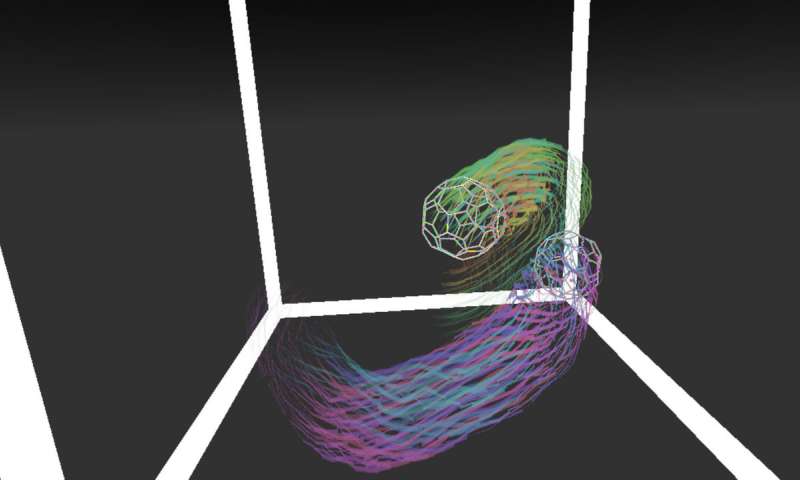 A team of researchers affiliated with several institutions across the U.K. has developed a framework for using virtual reality (VR) systems to teach chemistry. In their paper published on the open access site Science Advances, the team describes the system they developed and the advantages it has over standard teaching methods.
With their new system, the researchers point out, users are able to achieve co-location, which they describe as a phenomenon in which interactions in an actual 3-D physical space align with interactions in a simulated 3-D environment. Their system is cloud-based, which means the data used in the simulations can be constantly updated and improved, even as the system is being used.
The system currently allows six people to use the system at the same time—they can be in the same room, or other parts of the world. Users use wireless controllers that behave like tweezers, allowing them to grab molecules and their parts.
To test their system, the researchers asked 32 volunteers to carry out three different tasks: manipulating a methane molecule through a carbon nanotube, manipulating an organic helicene molecule to change its rotation, and finally, to tie a knot in a polypeptide. They report that most of the volunteers, none of whom had ever used a VR system before, were able to use the system to some degree.
Read more at: https://phys.org/news/2018-07-virtual-reality-chemistry-d.html#jCp
Read more at: https://phys.org/news/2018-07-virtual-reality-chemistry-d.html#jCp
High Fidelity to Create New Virtual World on EOS Blockchain
 Blockchain and virtual reality are arguably two of the most innovative inventions of this generation. Bringing the future to the present day, VR platform High Fidelity is creating a new virtual world powered by the EOS blockchain.
Sam Englebardt, High Fidelity board member and Head of Strategic Partnerships at Galaxy Digital, told Reuters:
“Virtual reality may be the first killer app for blockchain. It’s a global phenomenon that fundamentally requires a trustless consensus mechanism for currency, property and identity.”
See the full story here: https://cryptoslate.com/high-fidelity-to-create-new-virtual-world-on-eos-blockchain/
Something Bigger Than Toy Story Land Is Coming to Disney Parks Today
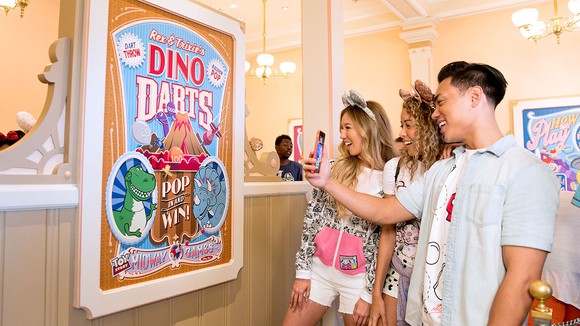 The new 11-acre Toy Story-themed expansion opened this morning at Disney's Hollywood Studios in Florida. Disney World's least visited park can use the boost, but it's not the only thing being introduced at the entertainment giant's theme parks today. The new Play Disney Parks mobile app makes its debut this morning, giving guests at Disneyland and Disney World a new way to enhance their time at the two U.S. resorts.
Families as well as individual players can fire up the app to engage in themed augmented reality games playable in the queue areas of certain attractions. Strolling through the park can unlock achievements and other virtual goodies. Folks can also earn points playing Disney trivia. There's even a curated playlist of theme park music that's available. Toy Story Land is going to be a big asset to the only Disney park worldwide to experience a downtick in attendance in 2017, but don't dismiss the long-term potential of today's mobile app debutante.
See the full story here: https://www.fool.com/investing/2018/06/30/something-bigger-than-toy-story-land-is-coming-to.aspx
Augmented Reality Meets Revenue Reality
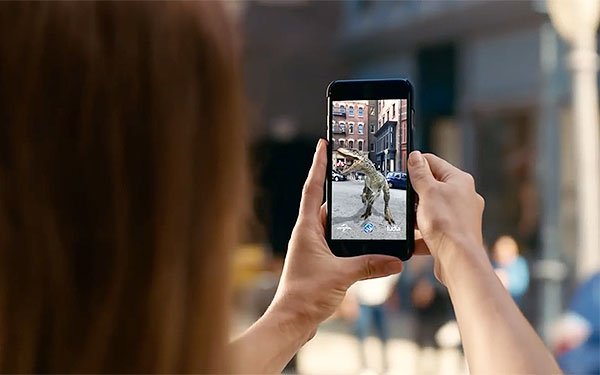 As a starting point, only about a third (32%) of consumers have tried mobile AR, according to the Virtual Reality Monitor, a survey of 1,200 U.S. adults conducted by Thrive Analytics for ARtillry Intelligence, which wrote the survey questions.
Of those who user AR, most (64%) would pay 99 cents or more for apps, with 14% saying they would pay more than $5. However, many of those would be in-app purchases rather than paying upfront for an AR app. For example, they may not pay for an app but would pay for items within a game.
Those who have not yet used augmented reality have a different view, with more than a third (38%) unwilling to pay any amount of money for mobile AR apps and 29% willing to pay $1 or more. That group also has a number (32%) of people who would be willing to consider in-app purchases after downloading a free AR app.
See the full story here: https://www.mediapost.com/publications/article/321491/augmented-reality-meets-revenue-reality.html
FOUR WAYS CITIES CAN USE AUGMENTED REALITY GAMES LIKE POKÉMON GO TO BOLSTER CIVIC ENGAGEMENT
[The Knight Foundation] partnered with Niantic to explore how Pokémon GO might enhance or augment existing efforts to support vibrant public life.
- Adapt games for local events. Cities should adapt AR platforms to amplify local strengths and better reflect civic needs. For example, cities can layer walking tours, scavenger hunts and other activities on top of the game, adding value for existing players and integrating play with local campaigns.
- Invite player networks (not just individuals). Pokémon GO players of all ages often arrived to events in groups and with existing social media networks poised for discussion. Recruiting is also easier through player and fan networks, and cities can help by tapping network leaders, beyond the usual open invitations.
- Focus digital activity near inviting and accessible physical spaces. Players often want to interact, but bringing people from different backgrounds and walks of life happens more easily when cities position play near inviting physical spaces with seating and food.
- Bring local culture to online platforms. Players can be connected to global cultures through AR platforms like the Pokémon universe. At the same time, games can engage players with local culture, from murals to local history. In a digital age, cities should increasingly invest in technology innovations that shape how we discover local culture.
 See the full story here: https://knightfoundation.org/articles/four-ways-cities-can-use-augmented-reality-games-to-bolster-civic-engagement
and the full report here: https://playfulcity.net/go/pokemon-report/download-report/ (select "download and cite")