Early impressions of Oculus Go from a bunch of us at GeekWire
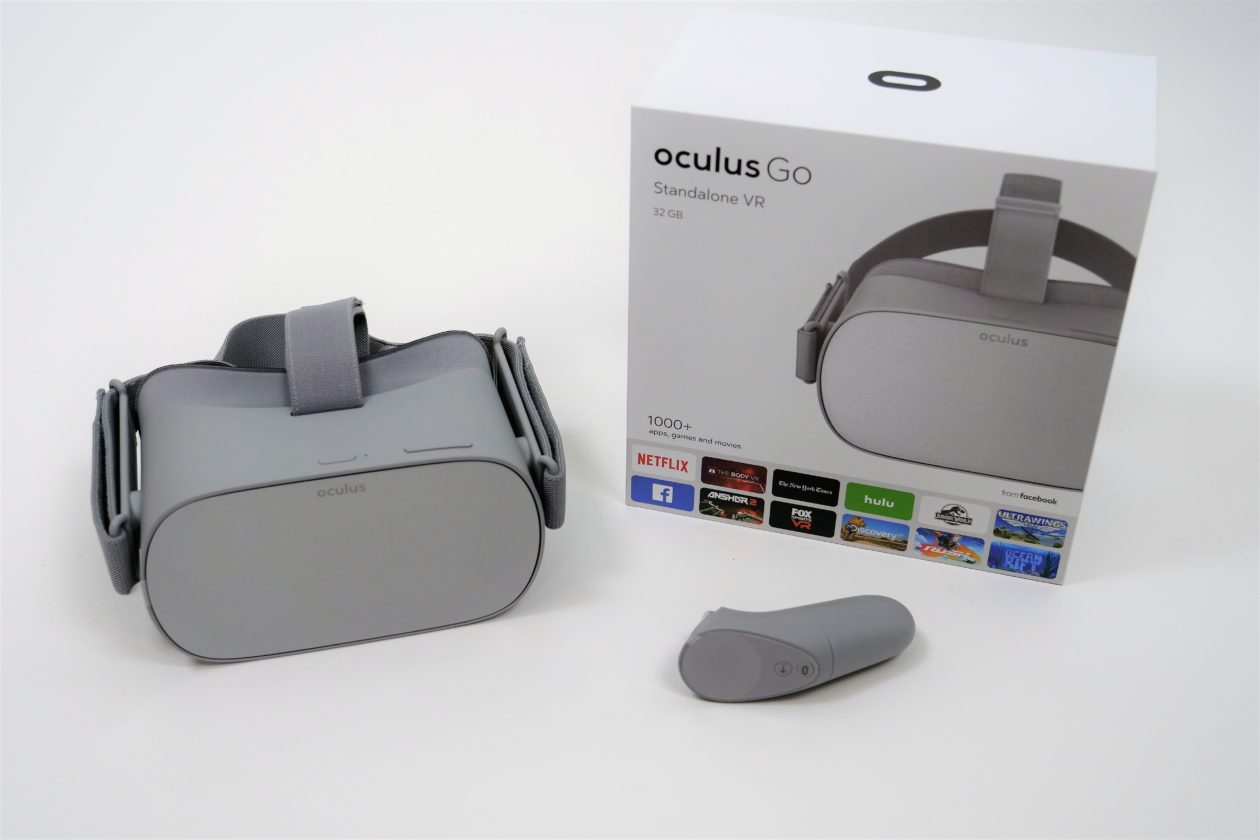 Here are the biggest pros of the Oculus Go, based on our collective observations.
- No need to connect the headset to computer.
- No requirement to use your smartphone as a screen.
- Relatively affordable, at $199 for 32GB and $249 for 64GB.
- The controller is accurate, responsive, and easy to use.
- The headphone-free spatial audio is more than adequate. (There’s also a headphone jack.)
- The user interface inside the headset is relatively easy to figure out.
- The social experiences, such as Oculus Rooms, were surprisingly fun.
- The headset fits well, even when wearing glasses, and adjusts easily. (There’s a spacer for people who wear glasses, as well as the option to buy and insert prescription lenses directly into the headset.)
And here are the biggest downsides that emerged from our experience.
- Games can be slow to install initially and launch on an ongoing basis, requiring some patience.
- Depending on the game or experience, and the speed of wireless connectivity, graphics can still appear pixelated.
- The battery drains relatively quickly, lasting only about 2 hours for gaming and a bit longer for watching videos.
- The Oculus Go default privacy settings require users to opt-out to avoid sharing basically everything they do with their Facebook friends.
- The extra costs: Yes, there are plenty of good free games and experiences, but with some top games going for as much as $10, it can add up.
- Even with the relatively light weight, 1 pound, the headset leaves red marks under the eyes after even a short period of use.
Even with those downsides, what stood out to me was the immediate enthusiasm from everyone I handed one of the headsets.
With the launch this week of the Oculus Go and the competing $399 Lenovo Mirage Solo, this really does feel like the moment when virtual reality becomes mainstream.
See the full story here: https://www.geekwire.com/2018/virtual-reality-unleashed-early-impressions-oculus-go-bunch-us-geekwire/
Dubai Sports Council supports UAE’s first-ever sports-centred virtual reality arcade
 VR Sports, the first all-sports virtual reality arcade in the country, located in the state-of-the-art Virtual Reality Theme Park in Dubai Mall, was launched by the international innovative digital agency, ARkub Interactive, in the presence of Saeed Hareb, Secretary-General of the Dubai Sports Council.
VR Sports is a one-stop-shop for sports fans and active families, where enthusiasts of all ages can play over 20 VR games, including basketball, football, skiing, golf and cricket. Competitions and activities designed for everyone will start next month, in time for the World Cup.
The 75,000 sq. ft. VR Park complex is yet another in a long line of imaginative and interactive developments from Emaar Entertainment. It was the ideal location to set up the first VR Sports arcade in the region.
"The fit was just natural. The VR Park is geared towards the newest and most innovative ideas in virtual reality today. We plan to enhance the experience on a regular basis by integrating new content as users’ expectations are growing exponentially towards VR and the sports industry is transforming," said Hind Sergieh, Managing Director of ARkub in Dubai.
"The unique capabilities of our high-definition projectors create an immersive gaming experience with crisp images projected in exquisite detail, which is what ARkub required to integrate the real and virtual world. The solution is not only limited to projection but also includes a web interface, which can involve online communities to the gaming experience, seamlessly bridging the gap between physical and digital.
See the full story here: https://www.emirates247.com/sports/dubai-sports-council-supports-uae-s-first-ever-sports-centred-virtual-reality-arcade-2018-05-07-1.668969
PKG Token ICO: Pokemon GO Blockchain Virtual Reality Game?
 What Is PKG?

PKG is proclaimed as a decentralized gaming platform that has been created to run on blockchain. Incorporating blockchain technology is believed to help regulate the number of gamers present and their privacy, while potentially eliminating fraud. Most importantly, PKG wants to create a gaming experience in which users can immerse into the game, as opposed to simply experiencing small physical changes. In order to create a connection that is far from that of a virtual experience, PKG relies heavily on the use of VR (Virtual Reality) and ART (Augmented Reality Technology).
What Can One Expect From The PKG Token?
PKG will also introduce a token of its own, which is referred to as the PKG Token. It is supposedly an ERC20-based token. Unlike most tokens where users are not sure of its real-life uses, the PKG token can be used to buy, sell and rent digital gaming goods through blockchain. The token is said to be convenient, as users no longer need to rely on cash or credit card payments nor worry over time consuming transactions.
The token sales have commenced April 27th, 2018, ...
PKG Token Conclusion
The overall idea of improving one’s gaming experience is unique, especially using blockchain, as it can increase security. However, using virtual technology does not distinguish PKG from standard games. Another problem that arises is the fact that transparency on behalf of PKG is lacking.
First, there appears to be no word on the team involved. Second, their roadmap does not provide enough information as to how they plan to achieve their goals. Lastly, the use of machine learning tools has been mentioned, however what they are and how its uses can contribute towards a real-life gaming experience is yet to be disclosed. For more information, check out the PKG white paper at: http://pokemongopkg.com/
See the full story here: https://bitcoinexchangeguide.com/pokemon-pkg-token-ico/
Baobab’s ‘Jack’ Merges Theater And Virtual Reality With Empathy
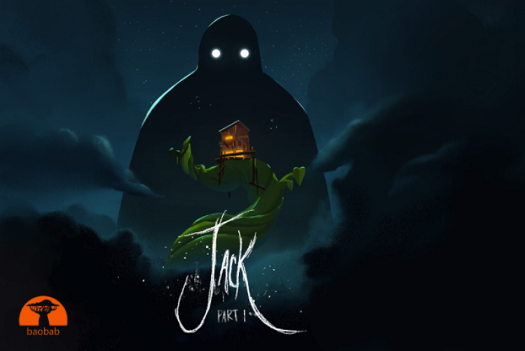 I was ushered into the room without any means of interacting with a digital space. At first, I did my best to take in my cartoonish surroundings, not paying much attention to where I was walking. I hit my head on a light-bulb hanging on a string, which may as well have been akin to a figurative light-bulb switching on inside of my cranium.
“Oh, this is all real,” I murmured to no one at all.
And it was. Well, about as real as mixed reality gets, anyway.
I walked over to the far end of the room where a hot plate burner was running and a kettle was sitting idle. I picked it up and placed it on the burner, where there was quite clearly some kind of heat source concentrated in that area. I walked back across the room, bumped my head on the same damn light-bulb (because it still hadn’t sunk in that my virtual world and the real world existed in the same capacities), only to be startled by a voice and a physical presence in the room with me. I suppressed a yelp.
Chelebourg acknowledged that it was a difficult task, bringing theater and virtual reality together.
Lee pointed out that it was difficult to live up to the Baobab ethos of bringing the best virtual reality experiences to everyone in the world when the installation could only accommodate one person at a time.
Jack is a fully immersive experience, straddling the virtual and physical worlds in a way that I’ve never seen before. Chelebourg’s gift for visual storytelling and emergent narrative is stunning. Baobab’s eye for talent is equally astounding and the indie studio may very well see another Emmy under its belt by this time next year. More than anything, I’m truly excited to see what Part Two of Jack will look like.
See the full story here: http://www.shacknews.com/article/104726/baobabs-jack-merges-theater-and-virtual-reality-with-empathy
VR Needs More Social
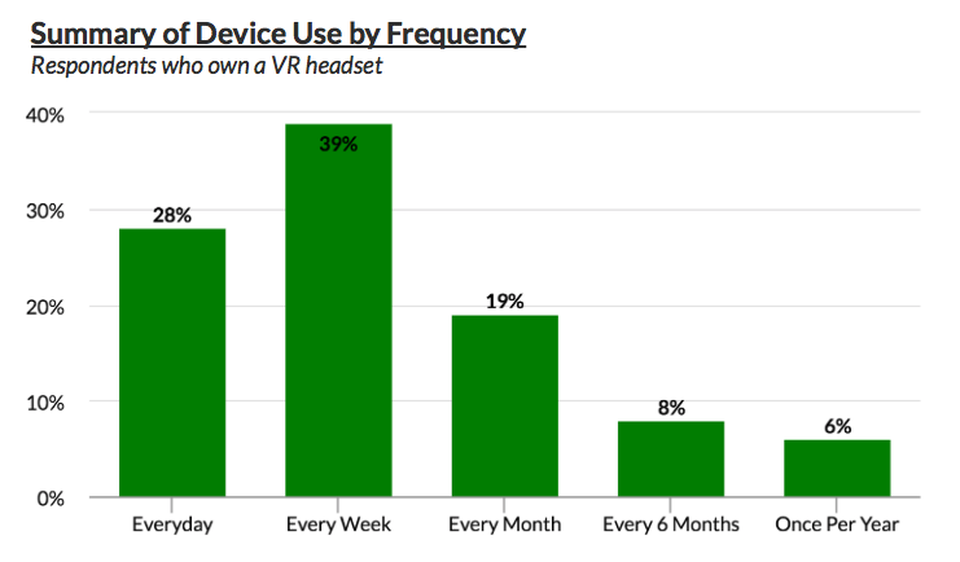 77% of people who use virtual reality want more social engagement in VR, according to a new survey of 4,217 consumers. And while many of their headsets don't get regular use, most intend to use their VR headsets more in the future.
"Led by Generation Z and Millennials, 77% of respondents who own a VR headset say they are interested in interacting socially with other people in VR," says Greenlight Insights, which ran the survey. "Playing games, watching videos and video communications ranked highest as social VR activities of interest."
See the full story here: https://www.forbes.com/sites/johnkoetsier/2018/04/30/virtual-reality-77-of-vr-users-want-more-social-engagement-67-use-weekly-28-use-daily/#6eb0cd1518fc
Israeli Startup Uses Augmented Reality to Battle Hiring Biases
 Actiview’s system can help companies become more diversified by eliminating any prejudice from the process, according to Mr. Libi. “Intellectually, we all want to create a diversified company, but the human brain is limited in its ability to ignore traits that are irrelevant for the position such as ethnicity, gender or sexual orientation,” he explained. Actiview’s system can simply ignore these traits, only taking into account a person’s performance, qualifications, and personal traits, he added.
In order to asses the most significant traits for candidates, Actiview’s system first tests the company’s current employees to get a better idea of what it takes to succeed in the specific environment of that company, Mr. Libi said.
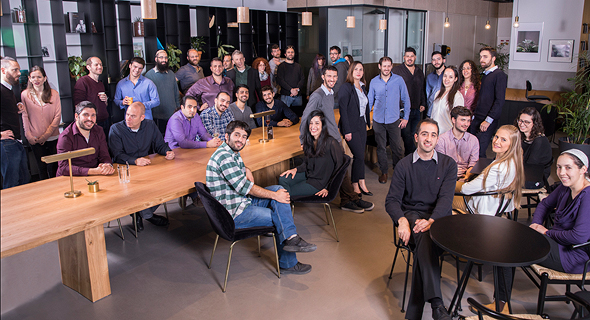
Actiview has almost 50 employees working out of its headquarters in Lod, a town in central Israel, and additional offices in Tel Aviv and London. The team includes neuroscientists, data scientists, engineers, psychologists, and designers. Actiview has 10 current clients and collaborations with academic research centers such as Tel Aviv University’s neuroscience research lab.
See the full story here: https://www.calcalistech.com/ctech/articles/0,7340,L-3737181,00.html
Virtual Reality Asserts Itself as an Art Form in Its Own Right

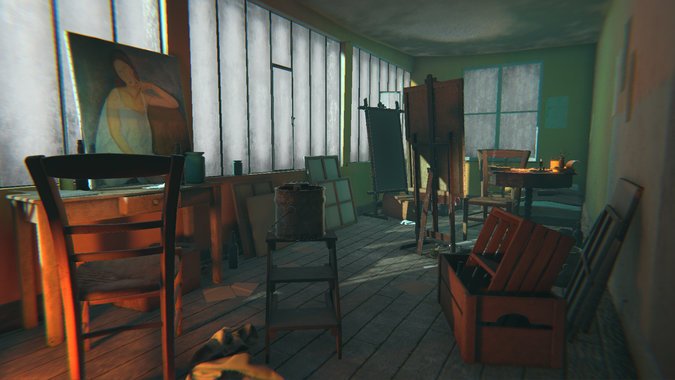 The Berlin-based artist Olafur Eliasson said that we were only in “the Stone Age” or prehistoric period for the medium.
“There is a new space out there where a lot more people will have access to artistic experience,” he said last week in a panel discussion here at the Art Leaders Network hosted by The New York Times. He added that “the quality of the glasses is getting so much intensely better” over the three years he has been experimenting with virtual reality.
Mr. Eliasson envisions a future in which people access art “on a platform like Netflix” once the necessary equipment is more widespread and the business model more developed. “Rainbow” was presented in March at the contemporary exhibition space Kunsthal Charlottenborg during the Copenhagen International Documentary Film Festival.
If virtual reality has proved useful as an educational tool through recent initiatives such as a re-creation of Modigliani’s last Parisian studio at the Tate Modern in London, it is still asserting itself as an artistic form in its own right. A panel discussion with Sandra Nedvetskaia, partner of the virtual-reality production company Khora Contemporary, and Edward Klaris, an adviser and lawyer specializing in intellectual property, addressed some of the issues at stake.
While a painting is acquired through a single sale payment, Mr. Klaris said, virtual-reality works may demand a monetization plan more along the lines of the film industry. An artist who creates such a work “might be paid every time it is sold or distributed,” he said.
Ms. Nedvetskaia cited a “triangular” business model involving the artist, production company and gallery. The structure varies on a “case-by-case basis.”
But the collector base is just developing. “It is too early to talk about at this point,” she said of “a very nascent market” while mentioning sales in Asia and the interest of private museums and collections.
“When art doesn’t move people emotionally, it has no purpose,” she said. “The next generation only grows up with screens. They have a totally different point of access.”
“There use to be these categories,” he said. “High art, fashion, commerce, you name it. Artists have demolished that.”
See the full story here: https://www.nytimes.com/2018/05/01/arts/art-leaders-network-berlin-vr-virtual-reality.html